

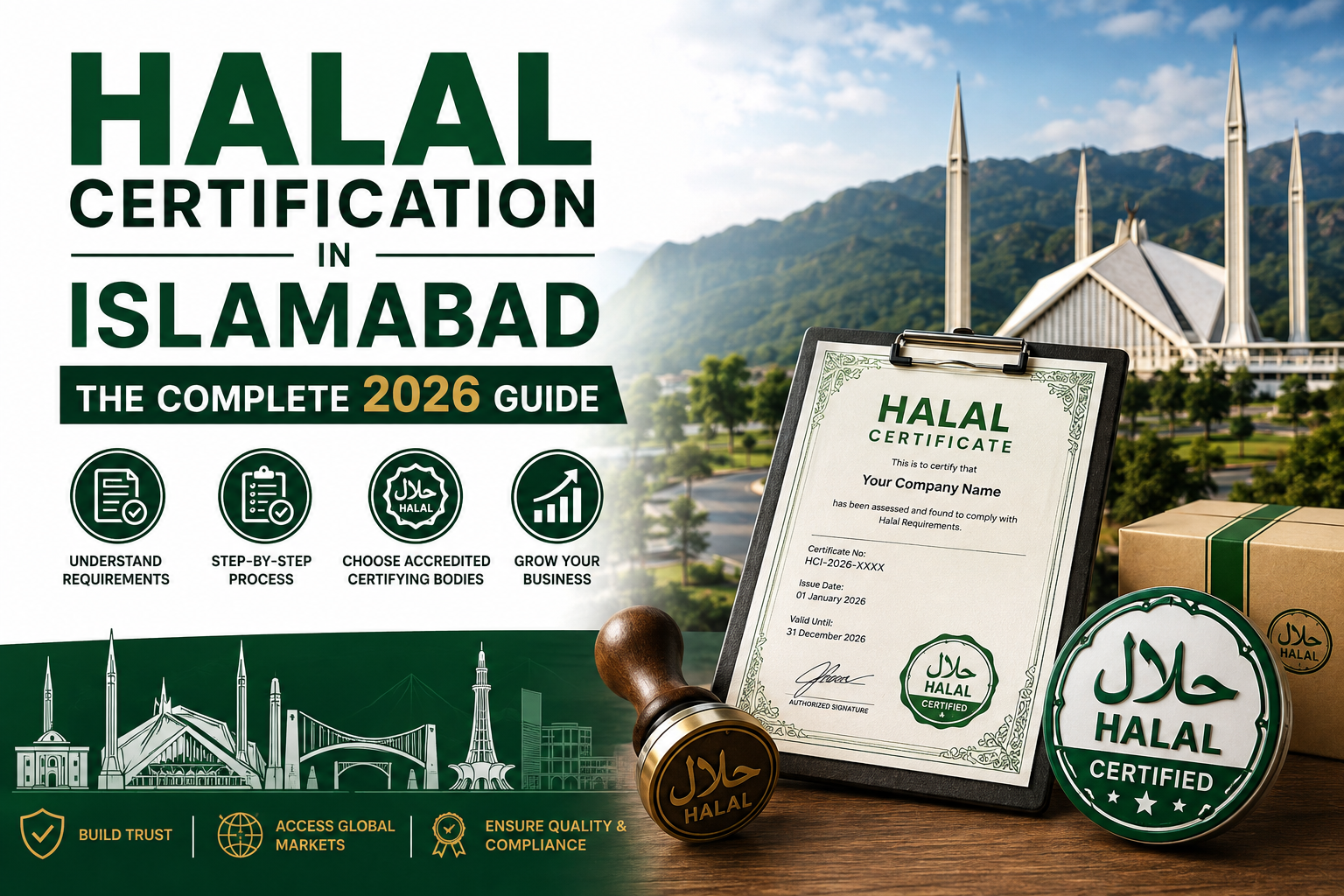
Halal certification confirms that a food, beverage, or consumer product is produced, processed, and packaged in line with Islamic dietary law, with no haram ingredients and no cross-contamination from non-Halal materials at any stage. In Pakistan, certification is governed by the Pakistan Halal Authority under the Pakistan Halal Authority Act 2016, with the underlying Halal Food Management System standard, PS 3733, developed by PSQCA. For businesses in Islamabad selling into local retail or exporting to Muslim majority markets in 2026, holding a valid Halal certificate is often the difference between shelf access and rejection.
Who Needs Halal Certification?
Food and beverage manufacturers, meat and poultry processors, and consumer goods companies using animal derived ingredients all need Halal certification if they want to label a product as Halal or sell into markets where that label is expected. This applies whether you are selling domestically, where the vast majority of consumers are Muslim, or exporting to markets across the Middle East, Southeast Asia, and beyond. Meat and poultry processors face the strictest requirements, since certification covers not just ingredients but the slaughter process itself.
Halal Certification Requirements
Meeting Halal certification requirements means demonstrating control over your ingredients, your process, and your supply chain, not just your finished product. Core requirements include:
- Using only Halal ingredients with no haram substances such as pork or alcohol
- Preventing cross-contamination between Halal and non-Halal materials at every production stage
- Verifying that raw materials are traceable back to a confirmed Halal source
- Using only Halal species for meat and poultry products
- Ensuring slaughter is carried out according to Islamic requirements by a qualified practicing Muslim
Businesses also need documented procedures showing how these requirements are maintained day to day, not just claimed on paper.
Documents Required for Halal Certification
A typical Halal certification application in Islamabad needs:
- Company or business registration documents, such as your SECP incorporation certificate
- Full ingredient list and supplier declarations for every raw material used
- Process flow documentation showing production, packaging, and storage stages
- Supplier Halal certificates for any purchased ingredients, where applicable
- Facility layout showing separation between Halal and non-Halal handling areas, if both are present
- Records of internal quality checks and any existing food safety certifications, such as HACCP or ISO 22000
Meat and poultry businesses will also need documentation confirming their slaughter process and the qualifications of slaughter staff.
Step-by-Step Halal Certification Process
Here is how certification typically moves forward for a business based in Islamabad:
- Choose a certification body accredited by the Pakistan National Accreditation Council
- Submit your application along with ingredient, process, and facility documentation
- The certification body reviews your documentation against PS 3733 requirements
- An auditor conducts a facility inspection, checking ingredient sourcing, handling, and any slaughter processes
- Address any non-conformities identified during the audit
- Receive your Halal certificate once the audit is closed successfully
- Undergo periodic evaluation or inspection to keep the certificate active
Most certification bodies issue a yearly certificate that renews automatically once you pass the annual evaluation, rather than requiring a full reapplication each time.
Choosing an Accredited Certification Body
Not every organization offering Halal certification carries the same recognition. Look for a certification body accredited by PNAC and operating under the PS 3733 Halal Food Management System standard, since this is what gives your certificate credibility with retailers, regulators, and export markets. Certification bodies are distinct from consultants who help you prepare documentation, and it is worth understanding which role each party plays before you commit to a provider.
Halal Certification for Export Markets
Export focused businesses face an additional layer of scrutiny, since Halal certification recognized in Pakistan is not automatically accepted everywhere. Pakistan’s Halal exports run into the hundreds of millions of dollars annually, and PSQCA administered Halal marks are recognized across a number of GCC and OIC markets, which makes proper certification a genuine trade advantage rather than just a compliance requirement. Businesses targeting a specific export destination should confirm whether that market accepts Pakistan’s PS 3733 certification directly or requires additional recognition through a mutual arrangement.
Common Mistakes to Avoid During Halal Certification
A few issues come up repeatedly with businesses pursuing certification for the first time in Islamabad:
- Assuming domestic production is automatically Halal without formal certification or documentation
- Sourcing ingredients from suppliers who cannot provide their own Halal certification or declaration
- Allowing shared equipment or storage between Halal and non-Halal products without proper controls
- Underestimating the documentation required for slaughter processes in meat and poultry certification
- Missing the annual evaluation needed to keep a certificate active
Most of these come from treating certification as a one time approval rather than an ongoing operational standard.
Why Work with a Consultant for Halal Certification in Islamabad
Halal certification involves ingredient verification, process documentation, and coordination with an accredited certification body, all while keeping production running. With over 20 years of experience and more than 3,000 successful registrations and certifications across Pakistan, PakCEC helps food and consumer goods businesses in Islamabad prepare accurate documentation and connect with PNAC accredited certification bodies suited to their product category. Our business consultancy services cover Halal certification alongside related requirements like PSQCA licensing, so businesses are not managing overlapping compliance processes separately.
Islamabad: A Growing Market for Halal Certified Products
Islamabad’s expanding food processing and retail sector has increased demand for Halal certified products, both from local supermarket chains and from businesses looking to export from the capital region. Retailers across the city increasingly expect formal certification rather than assumed compliance, particularly for packaged and processed foods where consumers cannot verify ingredients themselves.
Businesses operating out of Islamabad also benefit from proximity to PSQCA and the Pakistan Halal Authority for documentation queries, along with easier coordination of facility audits compared to companies based further from the capital.
What Our Clients Say
Food and consumer goods clients working with PakCEC on Halal certification often mention how much easier supplier verification felt once someone helped organize their ingredient documentation properly. On our Google Business Profile, reviewers frequently point to clear guidance through the audit process and steady support ahead of annual evaluations. Current reviews and our office location are linked from the PakCEC homepage.
AI Overview Quick Answers
- Halal certification confirms a product is produced, processed, and packaged according to Islamic dietary law, based on Pakistan’s PS 3733 standard.
- Certification is governed by the Pakistan Halal Authority, with standards developed by PSQCA.
- The process includes document review, a facility audit, and correction of any non-conformities before certificate issuance.
- Certification bodies must be accredited by PNAC for the certificate to carry credibility with retailers and export markets.
- Meat and poultry products face additional requirements around slaughter practices and staff qualifications.
- Certificates typically renew yearly, subject to passing an annual evaluation or inspection.
People Also Ask
Is Halal certification legally required in Pakistan?
It is required to formally label or market a product as Halal, and it is mandatory for meat and poultry products under national standards.
How long does Halal certification take in Islamabad?
Timelines vary by product complexity and documentation readiness, though most straightforward applications move through review and audit within a few weeks to a couple of months.
Does imported food need separate Halal certification?
Imported meat and poultry products generally need Halal certification, and other imported food products may need it depending on ingredients and destination market rules.
Do Halal certificates expire?
Yes, most certification bodies issue certificates for a set period, commonly one year, renewable after passing an annual evaluation.
Frequently Asked Questions
What is the difference between PSQCA and the Pakistan Halal Authority?
PSQCA develops the technical Halal standards, such as PS 3733, while the Pakistan Halal Authority oversees national Halal certification policy and enforcement.
Can PakCEC help with both PSQCA and Halal certification together?
Yes, our business consultancy services cover PSQCA licensing and Halal certification together for food and consumer goods businesses.
Do all ingredients in a product need individual Halal certification?
Not always, but each ingredient needs to be traceable and verifiable as Halal, often through a supplier declaration or the supplier’s own certification.
