

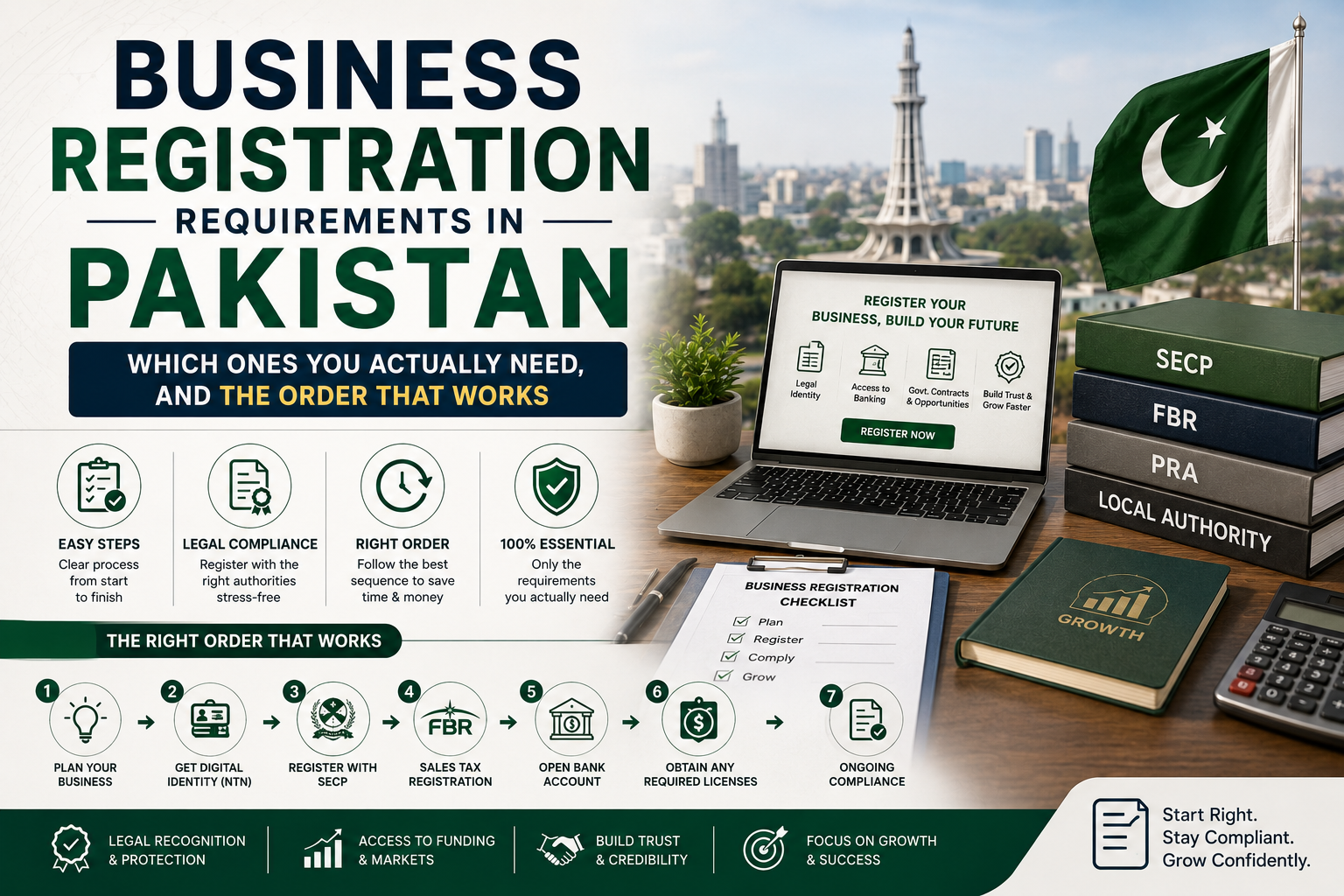
Most compliance advice in Pakistan answers the wrong question. It tells you how to do one registration. It does not tell you whether you need it, or what has to exist before it.
That gap is expensive. A solar company that applies for certification before fixing its engineering licence waits months. A manufacturer that ships before its product licence lands watches the consignment sit at the port. A founder who incorporates and then forgets the thirty day filings finds the bank will not open an account.
This is a sequencing map rather than a how to guide. It sorts what is legally required from what is merely useful, shows the order that dependencies actually impose, and flags where files stall. PakCEC has run this sequence for more than 3,000 registrations and certifications over 20 years, and the same handful of ordering errors accounts for most of the lost time.
First, separate what is law from what is leverage
Half the confusion in this space comes from treating every certificate as equivalent. They are not. Some are statutory and you cannot trade without them. Others are commercial, and you get them because a buyer, a bank or a tender scorecard wants them.
| Registration | Statutory or commercial | What triggers it |
|---|---|---|
| SECP incorporation | Statutory for companies | You want a company rather than a sole proprietorship or AOP |
| NTN and income tax registration | Statutory | The moment you start trading |
| Sales tax registration, federal and provincial | Statutory above thresholds | Turnover, sector, or a client who needs a tax invoice |
| PEC licence | Statutory | You practise engineering or bid on public works |
| AEDB certification | Statutory for on grid solar | You install, market or operate net metered systems |
| PSQCA certification mark licence | Statutory for listed products | Your product sits on the compulsory items list |
| Halal certification | Statutory for some food categories, commercial elsewhere | Meat and poultry, or a buyer requirement |
| Public procurement registration | Access requirement | You want to bid on government tenders |
| ISO certification | Commercial | A buyer, bank or tender scorecard asks for it |
Read that table before you spend anything. Businesses routinely pay for the commercial certificates early because they are easy to buy, then discover the statutory ones they actually needed take four times as long.
Find your path
Five patterns cover most businesses. Find yours, then work left to right.
Engineering, construction and MEP contractors. Incorporate, get your NTN and sales tax registration, then apply for your engineering licence in the category your staff and finances actually support, then register for public procurement if you intend to bid. The step that gets skipped is category realism. Firms apply for a category their engineer roster cannot carry, get refused, and start again. Our PEC engineering services desk maps the category before the file is opened.
Solar and renewable energy companies. Incorporate, sort tax standing, secure the engineering licence carrying the solar specific codes, then apply for energy certification, then arrange the bank guarantee. The engineering licence is a hard prerequisite here. There is no version of this sequence where certification comes first, which is why AEDB energy approvals files fail more often on missing licence codes than on anything else.
Manufacturers of regulated products. Incorporate, register for tax, confirm whether your product appears on the compulsory items list, then run product testing and factory inspection ahead of the licence application. Bottled water, edible oils, electrical goods, cement, steel and LPG cylinders all sit inside regulated categories. Check the list before you build the line, not after. PSQCA product certification is where most food and beverage projects meet their first real delay, and a laboratory that cannot produce compliant test reports adds months, so laboratory compliance belongs in the plan early.
Importers and trading companies. Incorporate, get your NTN and sales tax registration, confirm product regulation status before you place the order, and prepare labelling to Pakistani requirements at origin. Imported packaged food needs labelling in English or Urdu carrying product name, ingredients, net weight, production and expiry dates, and importer details. Meat and poultry need halal certification from the country of origin. Goods that arrive non compliant sit at the port until they are fixed or re exported, and halal certification services cannot be arranged retrospectively at the dock.
Services, consultancy and IT businesses. Incorporate, get your NTN, then register for provincial sales tax on services in every province where you deliver. This last point catches people. Services tax is provincial, not federal, so a firm in Islamabad billing clients in Lahore and Karachi may have obligations in more than one jurisdiction. Sector specific work adds its own layer through specialized industry licensing or healthcare licensing.
The dependency chain nobody explains
Order matters because these bodies check each other. The chain runs roughly like this.
Incorporation comes first because almost everything downstream asks for a legal entity. Company registration in Pakistan runs through the SECP online portal under the Companies Act 2017, and a straightforward file is typically incorporated within one to three working days, with the full sequence including name reservation usually landing inside a week. Reserved names hold for sixty days, so do not reserve one and then take a quarter to file.
Tax registration comes next because the National Tax Number is requested by banks, by other regulators, and by every client who needs a proper invoice. Registration through the tax authority portal commonly completes within the same day to a week. From that point, your active taxpayer status becomes a live dependency, and a lapsed status quietly blocks applications elsewhere. Our FBR tax compliance team treats it as maintenance rather than a one off task.
Banking sits in the middle of the chain, and this is where sequencing bites hardest. The central bank expects companies to be current with their corporate annual filings before opening new accounts, and provincial revenue authorities want the same before they will register you. A company that skips its corporate filings has not just missed a deadline. It has blocked its own banking and provincial tax registration, usually discovering it at the counter.
Sector licences come last, because they test everything upstream. Your engineering licence needs the company to exist and to be tax compliant. Energy certification needs the engineering licence with the right codes. Product certification needs the entity, the tax registration and testable product. Skip a rung and you climb back down.
The thirty day window most founders miss
Incorporation is not the finish line. It starts a clock.
Within thirty days of incorporation, a company must file its general information statement and beneficial ownership return with the corporate regulator. Special resolutions amending the constitutional documents must be filed within fifteen days of being passed. If you are hiring, employee old age benefit and provincial social security registrations follow. If your activities attract provincial taxes, provincial excise and taxation registration is separate again.
Two 2026 developments make this stricter. The beneficial ownership framework was expanded with a broader penalty regime, so an unmaintained register is now a live exposure rather than a paperwork nicety. And an SRO issued during 2026 made conversion of physical share certificates to book entry form mandatory, with a stipulated conversion timeline, which means companies still holding paper certificates have a task they may not know about.
None of this is difficult. It is simply invisible unless somebody tells you, which is why SECP corporate services engagements at PakCEC start with a post incorporation checklist rather than a congratulations email.
What recurs, and when
Registrations are events. Compliance is a calendar. This is the part that quietly decides whether you stay eligible for work.
| Obligation | Cycle | What a lapse costs you |
|---|---|---|
| Corporate annual return and audited accounts | Annual, tied to your financial year end | Blocks new bank accounts and provincial registrations |
| Beneficial ownership register | Ongoing, event driven | Penalties under the expanded 2026 framework |
| Income tax return | Annual | Active taxpayer status, which other bodies check |
| Sales tax returns | Monthly | Lapsed status stalls unrelated applications |
| Engineering firm licence renewal | Annual, 1 July to 30 June | Immediate loss of tender eligibility |
| Energy certification | Three years | Re application rather than a light amendment |
| Product certification mark licence | Per licence term, product specific | Product cannot be legally sold or cleared |
| Management system certification | Three year cycle with surveillance audits | A missed surveillance audit can suspend the certificate |
Diarise the renewals a month early rather than on the deadline. The engineering licence cycle is the clearest example. It closes on 30 June, and firms that start in June routinely miss it, then spend the first quarter of the new fiscal year off tender lists. PakCEC sets client reminders in May for exactly that reason, alongside the tax filing dates that sit in the same window.
What ISO actually is, and what it is not
ISO certification is not a government licence. No authority in Pakistan will stop you trading because you lack ISO 9001. That is exactly why it gets misunderstood in both directions.
Some businesses buy it too early, treating a quality management certificate as though it substitutes for a statutory licence. It does not. Others dismiss it and then lose tenders, because procurement scorecards and institutional buyers weight it heavily, and export customers frequently require it before they will place a first order.
Treat it as commercial leverage with a compliance shape. It runs on a three year cycle with surveillance audits in between, and it works best once your processes are real rather than aspirational. Firms that certify a process they do not actually follow fail the first surveillance audit, and PakCEC will say so before the engagement starts rather than after. ISO certification is worth doing properly or not yet.
Five sequencing mistakes that cost the most time
Applying for a sector licence before fixing tax standing. Active taxpayer status is checked at submission. An inactive status on the day you file sinks the application regardless of everything else in the pack.
Choosing a licence category by ambition. Categories are tested against staff, experience and financial capacity. Applying above your evidence produces a refusal, and in several regimes a category change later means starting over rather than amending.
Buying commercial certificates first. They are easier to obtain, so they feel like progress. They do not unblock anything statutory.
Treating provincial obligations as federal ones. Sales tax on services is provincial. Operating across provinces can create obligations in each, and companies discover this during an audit rather than during setup.
Ignoring the renewal calendar after approval. Getting registered is a project. Staying registered is a routine. In PakCEC’s experience the businesses that lose eligibility almost never lose it at the application stage. They lose it eighteen months later, on a date nobody owned.
If you are already trading, run a twenty minute self audit
Most established businesses are not missing a registration. They are missing a renewal, or carrying a status they believe is active and is not. Six checks surface almost everything.
- Entity standing. Pull your corporate filing history. Are the annual return and audited accounts filed for the most recent year end, or is there a gap nobody closed?
- Beneficial ownership. Does the register exist, and does it still match reality after any share transfer or director change?
- Active taxpayer status. Check it today rather than assuming. It is the single most common silent blocker, and it fails quietly.
- Provincial coverage. List every province you invoice into, then confirm you are registered for services tax in each one.
- Licence expiry dates. Note the exact date for every sector licence you hold, not the year. Renewal windows are narrower than people remember.
- Category fit. Confirm your licence category still matches the size of work you are winning. Growth outruns categories quietly, and bidding above your category wastes the bid.
If two or more come back uncertain, that is normal rather than alarming. PakCEC clients usually find the same on a first pass, and most items are fixable within weeks once somebody has actually looked.
Where to start
If you are setting up, work down the chain in order and resist the urge to jump to the interesting certificate. If you are already trading and unsure what you are missing, the fastest diagnostic is a gap check across entity status, tax standing, sector licences and renewal dates. That usually takes an hour and surfaces two or three items nobody had noticed.
PakCEC runs that check from Islamabad for clients nationwide, across our full range of business consultancy in Pakistan services, and we would rather tell you that you do not need something than sell it to you. Tell us what you do and where you operate, and we will map the sequence that applies. Talk to the PakCEC team when you are ready.
