

Every web agency in Pakistan says it builds custom websites. Most of them are installing a purchased theme, changing the colours, and swapping the stock photography.
That is not a scandal. For plenty of businesses a well configured theme is the correct answer, and paying for bespoke work you do not need is its own kind of waste. The problem is that buyers cannot tell the difference from the quotation, so they pay custom prices for template work, or they pay for custom and get a site nobody can maintain after handover.
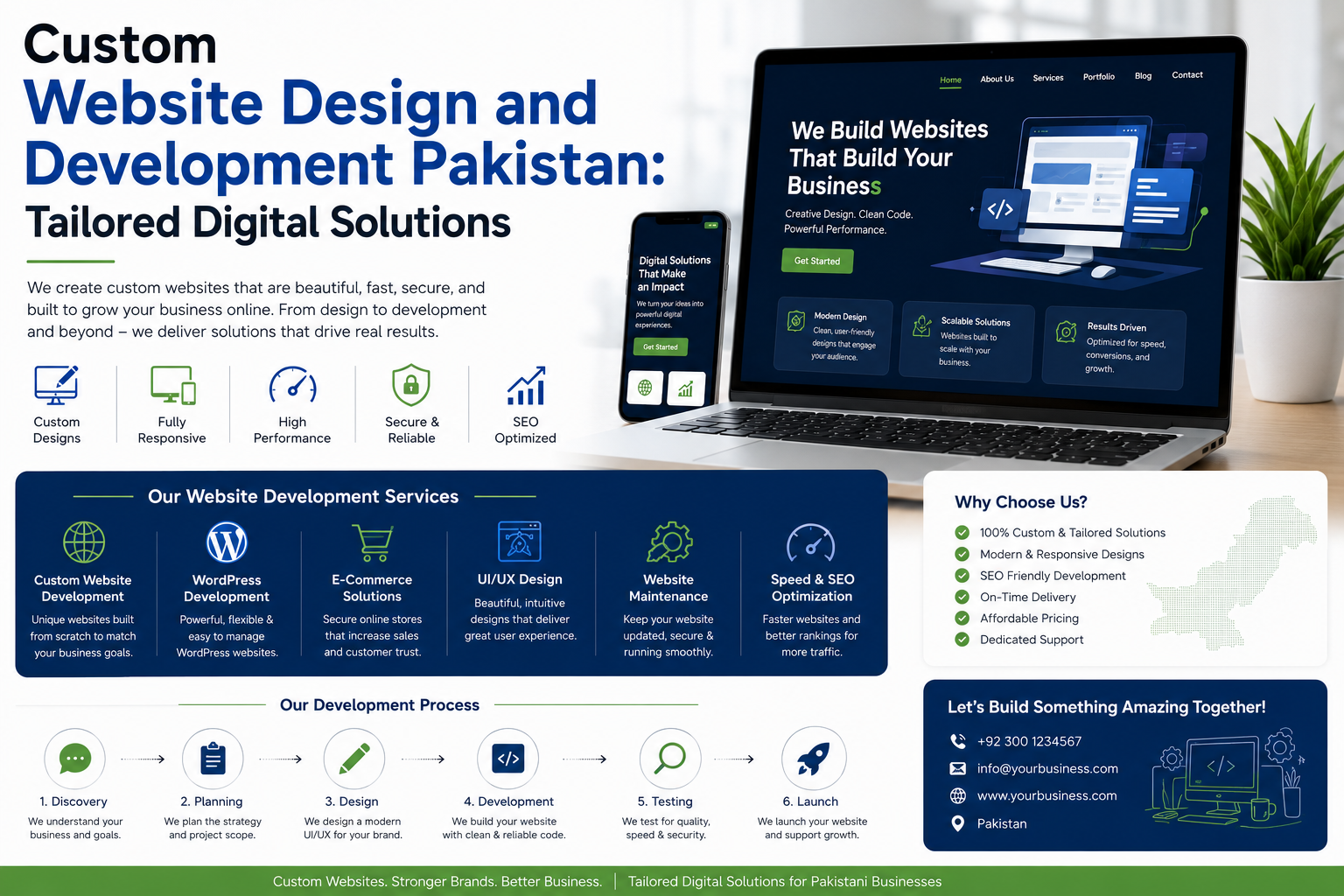
Custom Website Design and Development Pakistan side means building the site around your requirements rather than trimming your requirements to fit a purchased theme. This guide explains what that actually involves, where the line sits between custom and configured, and what to ask before you commission anything.
What Is Custom Website Development?
Custom website development means the site is built around your requirements rather than your requirements being trimmed to fit a template. The distinction is not about how it looks. It is about what happens underneath.
A theme based site starts with a finished product and adapts it. A custom build starts with what your business needs to do and constructs the site to do it. Both produce a working website. They differ in how far they can be pushed before they break.
The honest middle ground, which most Pakistani businesses actually need, is a custom front end on a standard content platform. You get a design nobody else has and functionality built for you, without paying to rebuild the parts that already work well as standard.
Three signals tell you that you have crossed into genuinely needing custom web development Pakistan side rather than a configured theme.
- Your process does not exist in any plugin. Quotation logic, batch tracking, approval workflows, anything specific to how you actually operate.
- You need to connect to something. An inventory system, an ERP, a payment gateway with unusual requirements, a plant monitoring feed.
- You have a data or compliance obligation the website touches, which changes what you can store, where, and for how long.
If none of those apply, be sceptical of anyone insisting you need bespoke website design. They may simply be pricing on what you will pay rather than on what you need.
Custom Features and Functionality
This is where custom earns its cost, or fails to. Features worth building rather than buying tend to fall into a few categories.
| Requirement | Why a template struggles | What custom gives you |
|---|---|---|
| Complex quotation or configuration tools | Plugins handle simple pricing, not multi variable logic | Logic that mirrors how you actually quote |
| Integration with internal systems | Generic connectors assume generic systems | A connection built to your data structure |
| Role based access | Off the shelf roles rarely match real org charts | Permissions matching who should see what |
| Document and record handling | Storage without retention rules or audit trail | Controlled records that survive a review |
| Reporting and dashboards | Vanity metrics, not operational ones | The numbers your managers actually decide on |
| Performance at scale | Plugin stacking slows everything down | Only the code you need, running |
One warning worth taking seriously. Every feature you commission is a feature somebody has to maintain. A site with forty custom functions and no maintenance arrangement becomes unmaintainable within two years, usually at the exact moment the original developer becomes unavailable. Build what you will use, not what sounded impressive in the kickoff meeting.
UI and UX Design Process
Design is the part clients most want to discuss and the part where the least useful conversations happen. Colour preferences dominate. Structure gets skipped.
A workable process runs roughly like this.
- Discovery. Who uses the site, what they arrive to do, and what currently stops them.
- Information architecture. What lives where. This is the single highest impact stage and the one most often rushed. A visually beautiful site with incoherent navigation performs worse than a plain site organised properly.
- Wireframes. Structure without styling, deliberately, so the conversation stays on layout and flow.
- Visual design. Type, colour, spacing, imagery, and a system rather than a set of one off screens.
- Prototype and review. Click through the real journeys, including the awkward ones.
- Build and test. Across devices and connection speeds, not just on the designer’s laptop.
- Handover. Documentation, training, and clarity about who maintains what.
Two Pakistan specific points. Test on mid range Android devices on mobile data, because that is what most of your visitors are using, not a fast desktop connection. And if any part of your audience reads Urdu, decide early whether you are supporting it properly, because retrofitting bilingual content into a finished site is painful and usually done badly.
Benefits for Businesses
The commercial case for custom work, stated without inflation.
You own the thing. No dependency on a theme author who may abandon the product, no licence that changes terms, no plugin that stops being maintained.
It does what you need. The value is in the fit. A site that handles your actual process removes manual work every single day, and that compounds.
It performs. Custom builds carry only the code they need. Template sites accumulate plugins, and each one adds weight. Speed affects both search ranking and whether visitors stay.
It scales in the direction you are growing. Adding a language, a product line, a location or a portal is a planned extension rather than a rebuild.
It is genuinely yours visually. Themes are sold to thousands of buyers. In a market where several competitors may have bought the same one, distinctiveness has real value.
It can be built to a compliance requirement. For regulated businesses this is the strongest argument of all, and it is the one most agencies cannot deliver.
Worth stating what custom does not do. It will not fix weak content, it will not compensate for no search strategy, and it will not make a business people were not looking for suddenly findable. Custom Website Design and Development Pakistan buyers sometimes expect the build to solve a demand problem. It solves a fit problem.
When a Template Is the Right Answer
An article selling custom development should still tell you when not to buy it. Choose a well configured theme when:
- You need a credible brochure site and nothing more
- Your budget is better spent on content and search visibility than on bespoke code
- You have no internal capacity to maintain custom work
- Speed to launch matters more than perfect fit
- Your requirements are genuinely standard, which for many service businesses they are
There is no shame in this and no long term penalty, provided you go in knowingly. The expensive mistake is paying custom rates for a configured theme, or commissioning bespoke work you cannot maintain.
What Custom Means for a Regulated or Industrial Business
Here is where the generic web agency conversation runs out, and where PakCEC works differently.
If you run a bottled water plant, a fertilizer blending operation, a juice line or a cosmetics facility, your website is rarely the interesting part of your software problem. The interesting part is everything the regulator, the inspector and your own quality manager need.
Consider what a manufacturer actually needs recorded and retrievable:
- Batch records tied to production dates and declared specifications
- Laboratory results with calibration status attached, because an uncalibrated instrument produces numbers rather than results
- Certification and licence expiry dates, with reminders before the window closes rather than after
- Retained sample logs that hold up when a customer queries a batch from four months ago
- Document version control, so the procedure on the floor is the current one
None of that is website work in the ordinary sense. All of it is software, and all of it is judged during inspection. A dev agency will build you whatever you describe. It will not tell you that your record structure will fail an audit, because it has never sat through one.
That is the difference. PakCEC builds custom software development for water filtration, fertilizer, juice and manufacturing operations because we also install the plants and file the certifications. When we design a records module, it is shaped by what inspectors actually ask for. Our water plant installation and fertiliser plant installation clients get systems that reflect the standards their products are tested against, and the lab equipment side means we know what the bench can actually produce.
If your requirements are purely commercial, plenty of good agencies can serve you. If your software has to survive an inspection, that is a narrower field.
Mistakes That Cost the Most
From projects PakCEC has been asked to rescue after another supplier finished, five patterns recur.
No written scope. The commonest and the most expensive. Without an agreed feature list, every disagreement becomes a negotiation and the project stops having an end.
Design signed off without content. Layouts get approved around placeholder text, then real content arrives and does not fit. Write the content first, or at least know its shape.
Nobody nominated to decide. Projects with four approvers and no owner stall in review. Name one person who can say yes.
Launch treated as the finish. Analytics not configured, redirects from old URLs not mapped, search console not connected. A relaunch that drops the old URL structure without redirects can lose years of accumulated search visibility overnight.
Credentials never collected. Domain registrar, hosting, repository, analytics, payment gateway. Gather them at handover while the developer is still engaged and still responsive.
The redirect point deserves emphasis because it is silent. The new site looks better, everyone is pleased, and traffic quietly halves because a hundred old URLs now return errors. Map them before launch, not after somebody notices.
What to Ask Before You Commission
Six questions that separate a real proposal from a confident one.
What exactly is custom here, and what is a theme or plugin? A straight answer is a good sign. Evasion is not. There is nothing wrong with using standard components well, but you should know what you are paying for.
Who owns the code and the accounts? Domain, hosting, repository, analytics. Get this in writing before work starts. Businesses discover they do not own their own domain at the worst possible moment, usually during a dispute. Registering your brand properly is a related question, and intellectual property services are worth sorting alongside it.
What happens after launch? Updates, security patches, backups, and who to call when something breaks. A warranty covers defects. It does not cover a site that stops working on a Sunday.
Can I edit content myself? If every text change needs a developer, you will stop making changes, and the site will go stale within a year.
How is this being tested? Devices, browsers, connection speeds. Ask specifically about mid range Android on mobile data.
What does handover include? Documentation, credentials, training, and a clear statement of what is left unfinished. Vague handovers are how projects end up half owned.
The Cost Nobody Quotes
Custom carries running commitments that rarely appear in the proposal. Hosting appropriate to the build. Security updates. Content changes. Fixes when a browser or payment gateway changes something. And eventually, a refresh, because a site built today will look dated in four or five years.
Budget for the life of the thing rather than the build of it. A business that spends its whole allocation on the build and nothing on the following two years ends up with an expensive site slowly going wrong.
Where PakCEC Fits
We are not a general purpose web agency, and we would rather say so. PakCEC builds website development, e-commerce development and mobile application development work for businesses whose operations we already understand, across manufacturing, plant projects and regulated products.
Twenty years, more than 3,000 completed registrations and certifications, and a preference for telling clients what they do not need. If a configured theme is genuinely the right answer for you, we will say that too.
Tell us what your business does and what the site has to handle, and we will tell you honestly whether it needs bespoke website design or something simpler. See our IT and software solutions range, or talk to the PakCEC team.
