

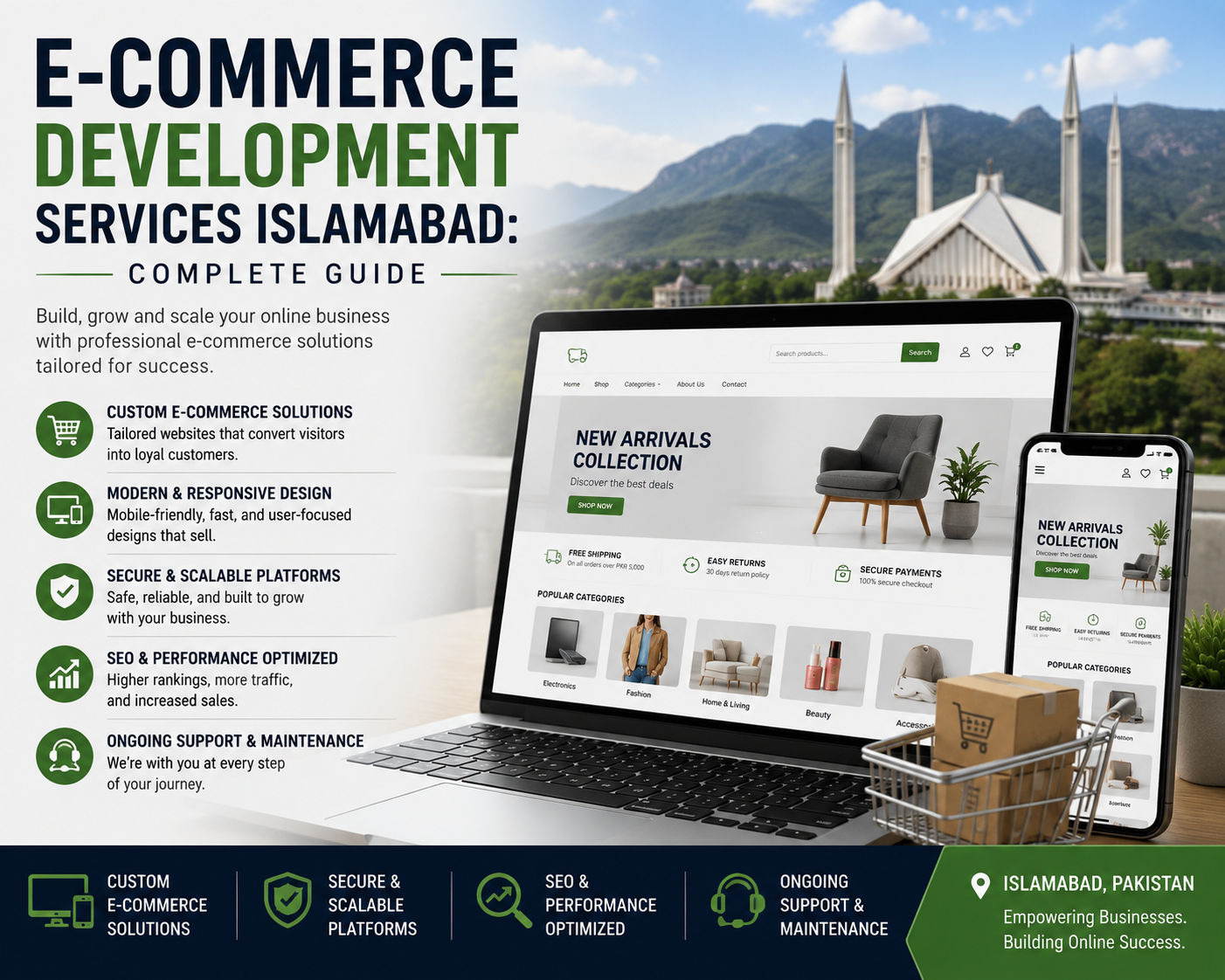
Islamabad sells differently from Karachi and Lahore, and a store built on national assumptions will feel slightly wrong here without anyone being able to say why.
The capital’s buyer base is unusual. Federal ministries, regulators, embassies, international organisations, the development sector, universities and a dense professional class. Institutional purchasing sits alongside consumer purchasing in a way it does not elsewhere. And the delivery map is not one city but two, with Rawalpindi’s older commercial districts operating on completely different logistics from Islamabad’s sector grid.
This guide covers what e-commerce development services Islamabad businesses actually need, with real depth on the two areas that decide whether a store survives its first year: how it is built, and whether it stays fast and secure once real traffic arrives.
E-commerce Development Solutions
Ecommerce development Islamabad side breaks into four scopes, and quotations routinely cover one while implying all four.
Storefront. Catalogue, search, product pages, cart, checkout, accounts.
Operations. Orders, inventory, fulfilment, returns, refunds, customer records.
Integrations. Payments, couriers, accounting, notifications, analytics.
Compliance. Invoicing, tax handling, and the settlement reconciliation the current withholding regime requires. That last one is a genuine build requirement rather than an accounting afterthought, and we cover it in detail in our guide to e-commerce development across Pakistan.
Two solution shapes are common in the capital specifically.
Consumer stores selling to the professional population. Boutique fashion, home and decor, specialty and organic food, books, electronics, gifting. These live or die on checkout experience and delivery reliability.
Institutional and B2B stores selling to organisations rather than individuals. Different requirements entirely: quotation workflows, purchase order handling, account based pricing, proper tax invoices, and documentation that survives a procurement audit. Suppliers to government departments and international organisations need this, and most off the shelf store builds do not provide it.
If you sell to institutions, say so in your first conversation with any developer. A consumer store retrofitted for B2B is a bad B2B store.
Store Design and Development
Design decisions that matter more than they sound.
Online shopping website development is judged on whether people can find and buy the thing, not on how the homepage looks.
Structure before styling. Information architecture decides whether people find products. Get the category structure, filtering and search right first. A beautiful store with incoherent navigation converts worse than a plain one organised properly.
Product pages that answer objections. Photography from multiple angles, real specifications, sizing, delivery expectations, return terms, and stock status. Every unanswered question is a reason to close the tab.
Checkout with as little friction as the payment method allows. Guest checkout, minimal fields, visible delivery cost early, and no surprises at the final step.
Address handling built for local reality. Many Pakistani addresses are descriptive rather than structured, and Islamabad addresses in particular carry sector, street and house number formats that a generic form handles badly. Rawalpindi addresses look nothing like them. A rigid form causes failed deliveries.
Mobile first, genuinely. Most of your traffic is on mid range Android over mobile data. Build and test there, not on a designer’s laptop.
Bilingual, if you mean it. Decide at the start. Retrofitting Urdu into a finished store is painful and usually done badly.
The development process worth insisting on runs discovery, information architecture, wireframes, visual design, prototype review, build, test, then a handover that includes documentation, credentials and training. Skipping wireframes to get to visuals faster is the most common shortcut and the most expensive one.
Security and Performance
This is where stores quietly lose money, and where most quotations say almost nothing.
Security
Keep card data out of your systems. Use hosted checkout or a redirect flow so card details never touch your server. This dramatically reduces your compliance exposure and your risk surface. A developer who proposes handling raw card data on your own infrastructure is proposing a liability you do not want.
Handle OTP flows properly. Card payments in Pakistan use one time password authentication, which introduces timeouts, retries and failure states. A checkout that handles the happy path and breaks on a delayed OTP loses real orders.
Lock down the admin. Two factor authentication, role separation so warehouse staff cannot change prices, and audit logging so you can see who changed what.
Plan for cash on delivery fraud. Fake orders, repeat refusers, and velocity abuse are ordinary here rather than exceptional. You need order verification before dispatch, customer level risk flags, and a way to blacklist.
Tested backups. Not backups. Tested restores. An untested backup is a belief, not a safeguard.
Keep the stack patched. WooCommerce plugin vulnerabilities are a leading route into Pakistani stores, and an unmaintained plugin is an open door.
Performance
Google measures three field metrics from real Chrome users, at the 75th percentile, which means a store that feels fast on your office connection can still be failing.
| Metric | What it measures | Good threshold |
|---|---|---|
| Largest Contentful Paint | How fast the main content appears | Under 2.5 seconds |
| Interaction to Next Paint | How fast the page responds to taps and clicks | Under 200 milliseconds |
| Cumulative Layout Shift | Whether the page jumps while loading | Under 0.1 |
Interaction to Next Paint replaced First Input Delay in 2024 and is stricter, because it measures every interaction rather than just the first. On stores it is usually the hardest to fix.
The practical culprits, in the order we usually find them:
- Image weight. Unoptimised product photography is the commonest cause of a failing Largest Contentful Paint on Pakistani stores. Modern formats, correct dimensions, lazy loading below the fold.
- Plugin sprawl. Every plugin adds JavaScript. Twenty plugins doing small jobs will fail Interaction to Next Paint no matter how good your hosting is.
- Third party scripts. Chat widgets, pixels, analytics, review apps. Each one costs you responsiveness. Audit them quarterly and remove what nobody reads.
- Layout shift from ads, banners and fonts. Reserve space for anything that loads late.
- Hosting and server geography. Distance adds latency. Use a content delivery network so assets are served closer to your customers.
Measure with field data rather than a lab score. A perfect Lighthouse result on a fast laptop tells you very little about a customer on patchy mobile data in Rawalpindi.
Common Mistakes We Get Called In to Fix
Patterns from stores that came to PakCEC after another supplier finished.
Launched without redirects. The new store looks better and traffic halves, because a hundred old product URLs now return errors. Map the old structure to the new one before launch, never after somebody notices.
Checkout tested only on the happy path. Nobody tried a delayed OTP, a declined card, a wallet timeout or a back button mid payment. Real customers find all four in week one.
Returns treated as an edge case. With cash on delivery volumes, returns are daily operations. A store with no returns workflow turns a staff member into a full time spreadsheet operator within two months.
Inventory that lies. No reservation on the cart, so two customers buy the last unit. The apology costs more than the feature would have.
Product photography as an afterthought. Inconsistent, oversized, and shot on a phone against a cluttered background. It slows the site and it undersells the product simultaneously.
No staging environment. Changes go straight to the live store on a Friday. This ends the way you expect.
Nobody owning the site after launch. The agency finishes, the internal champion moves on, and eighteen months later the store is running unpatched plugins nobody has permission to update.
None of these are exotic. All of them are cheaper to design around than to fix.
Business Benefits
The commercial case, without inflation.
You own the customer relationship. Marketplaces own the buyer, the data and increasingly the margin. Your own store is the only channel where the customer is yours.
Better margin per order. No marketplace commission, and pricing you control rather than pricing dictated by a search results page.
You keep the data. What sells, what gets abandoned, which sources convert, which customers return. That is the raw material for every decision you make afterwards.
Brand, not just product. On a marketplace you are a row in a list. On your own store you control the whole experience.
Reach beyond the twin cities. An Islamabad business with courier integration sells nationally without opening a shop anywhere.
Institutional credibility. For B2B and government adjacent selling in the capital, a proper store with proper documentation is a procurement asset, not just a shop window.
One honest caveat. A store does not create demand. If nobody is looking for what you sell, a better website will not fix that. Budget for how people will find you, not only for the build.
Selling in the Twin Cities
Operational realities specific to this market.
Two cities, two logistics. Islamabad’s planned sectors and Rawalpindi’s older commercial districts behave differently for delivery. Access, addressing and timing all vary. Test both properly before you promise same day anything.
Delivery promises are a trust asset. In a professional market that talks to itself, a reliable two day delivery beats an optimistic same day promise that fails a quarter of the time.
Cash on delivery is still here. Even in a relatively high income market, plan for it as an operating model rather than a checkbox. Order verification, courier remittance reconciliation and returns handling are all real work.
Institutional buyers need documents. Proper tax invoices, delivery challans, and records that survive an audit. Build this in rather than producing it manually.
Watch your own payment mix. Do not assume the national picture applies to your customers. Look at your actual analytics after the first quarter and rebalance your checkout around what your buyers do, not what an article told you.
Getting the Business Side Right First
Before launch, three things need to be in place, and none of them is a development task.
Company registration, if you have not incorporated. SECP corporate services come before anything downstream needs a legal entity.
Tax registration and active status. Online sellers face specific registration requirements and a withholding regime that deducts before money reaches you, with penalties for inactive taxpayer status that cost you real cash on every order. FBR tax compliance is not a background chore for an e-commerce business.
Payment provider contracted, with rates and settlement timing in writing before you build the checkout around it.
Sort these during the build, not after launch. Every one of them can hold up your first order.
Why Working Locally Actually Helps
Most claims about local advantage are marketing. Two are real.
You can meet. Complex projects, and particularly B2B and institutional builds, go better with people in a room. Requirements get clarified in an hour that would take a fortnight of messages.
We are in the same regulatory city you are. PakCEC operates from Aabpara in Islamabad, minutes from the ministries and regulators our clients deal with. We handle company registration, tax compliance and sector licensing for businesses across the capital, and we build the software too.
For an online store, that combination matters more than it sounds. The difficult parts of e-commerce in Pakistan right now are not the shopping cart. They are reconciliation, tax handling, invoicing that satisfies an institutional buyer, and cash on delivery operations. Those sit on the boundary between development and compliance, and most suppliers only stand on one side of it.
What to Ask Any Islamabad Developer
Seven questions worth asking before you sign.
- Which of the four scopes are you quoting? Storefront, operations, integrations, compliance.
- Which Pakistani payment provider have you integrated, specifically? Names, not categories.
- How will settlement reconciliation work? If deductions are not mentioned, they have not built a store here recently.
- Which courier APIs have you worked with? This is where scopes quietly expand.
- What field performance do you commit to? Ask about the three metrics above, measured on real users.
- Who owns the code, domain and hosting? Settle it before work starts.
- What happens after launch? Updates, security patches, backups, and who answers during a sale weekend.
Where PakCEC Fits
We build e-commerce development, website development, mobile application development and custom software development projects for businesses in Islamabad, Rawalpindi and across Pakistan, alongside the registration and compliance work those businesses need.
Twenty years, more than 3,000 completed registrations and certifications, and a preference for telling clients what they do not need. If a simpler build is the right answer for you, we will say so.
Tell us what you sell, who buys it, and how you expect them to pay. See our IT and software solutions range, or talk to the PakCEC team.
