

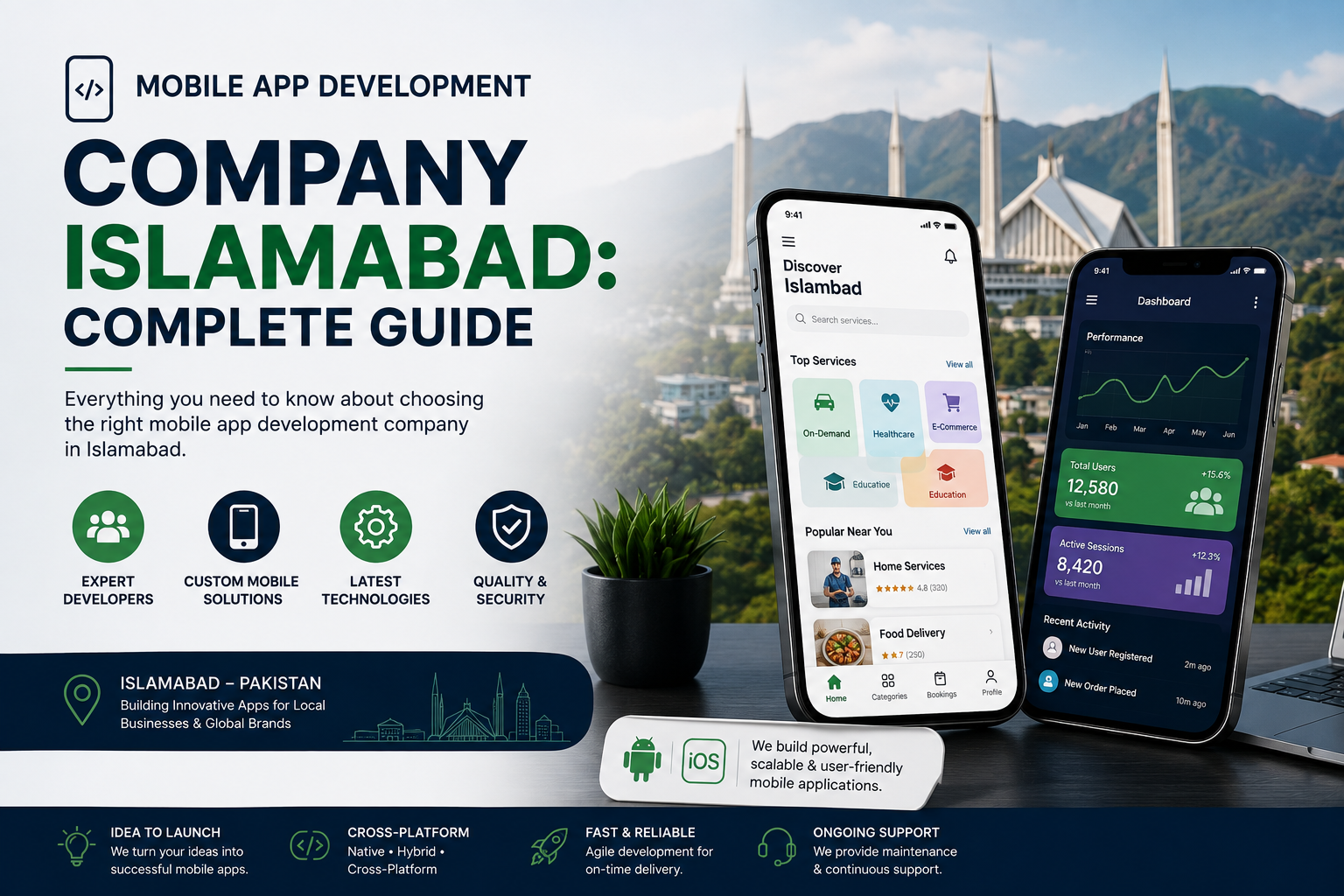
Most app projects in Pakistan are quoted as a build. They are actually a build plus a publishing project, and the second half is where timelines slip.
Getting an organisation account on either store now requires a verified business identity that can take weeks to obtain. Google has a testing requirement that stops personal accounts publishing at all until it is satisfied. And there is a target platform deadline arriving at the end of August 2026 that will block updates to any app that has not been rebuilt for it.
None of that is in a typical proposal. This guide covers the build, the publishing, and the device reality your app will actually run on, so you can commission a mobile app development company Islamabad side with the right questions ready.
Mobile App Development Services
App development covers more than the app. A complete scope has four parts, and quotations routinely price the first.
The app itself. Screens, navigation, offline behaviour, notifications, and everything the user touches.
The backend. APIs, database, authentication, admin tooling. Unless your app is a calculator, this exists, and it is often larger than the app.
Integrations. Payments, maps, messaging, analytics, crash reporting, and whatever internal systems you already run.
Publishing and release. Store accounts, listings, review submissions, testing requirements, and the update pipeline afterwards.
Ask any supplier which of the four they are quoting. A number covering only the app is not a cheaper price for the same thing.
Common project types in the capital, where the buyer mix is unusual because federal institutions, regulators, development organisations and a dense professional population all sit in one city:
- Consumer apps for retail and services
- Delivery and logistics apps with driver and dispatch sides
- Internal operations apps for field staff, inspections and stock
- Institutional and B2B apps, where documentation and access control matter more than polish
- Companion apps extending an existing web platform
The internal operations category is underrated. An app used by thirty field staff daily often returns more than a consumer app nobody downloads.
Android and iOS Solutions
Android first is usually correct in Pakistan. Android dominates the market by a wide margin. iOS matters for premium segments, expatriate audiences and anything targeting a higher income user base, but if you are building for reach here, Android is where the users are.
Native or cross platform. Native means separate codebases in the platform languages. Cross platform frameworks let one codebase serve both, and for the majority of business apps the result is indistinguishable to the user.
| Approach | Choose it when | Trade off |
|---|---|---|
| Cross platform | You need both stores, budget matters, and the app is not graphics or hardware intensive | Occasional friction at the edges of platform specific features |
| Native Android only | Android is your entire market and you want maximum control | No iOS without a second build |
| Native both | Performance critical, heavy hardware use, or platform specific design matters commercially | Roughly double the build and double the maintenance |
| Web app or progressive web app | Content or transaction focused, no strong need for device features | No store presence and weaker engagement tooling |
One question to settle before anything else. Do you actually need an app, or do you need a better mobile site? Apps earn their cost through repeat use, notifications and offline capability. If your users will visit twice a year, a good mobile site serves them better and costs a fraction. An honest supplier will tell you this. Our website development team says it regularly.
App Development Process
Seven stages. The order matters more than the labels.
- Discovery. What the app does, who uses it, what it connects to, and what happens when there is no signal.
- User flows and wireframes. Structure before visuals. Approving screens before flows is the commonest and most expensive shortcut.
- Design. A system, not a set of screens, with both platforms considered.
- Backend. APIs and data model, usually started in parallel with design.
- Build. Iterative, with something installable early rather than a reveal at the end.
- Testing. Real devices, not just emulators. Mid range Android on mobile data, and offline states.
- Publishing and release. Covered below, and it is a project stage rather than a final afternoon.
Insist on installable builds throughout. An app you cannot hold until month three is an app whose problems you find in month three.
Publishing Is Now a Compliance Project
This is the section most guides skip, and it is where Pakistani app projects lose weeks.
Organisation accounts need a D-U-N-S number. Both Apple and Google require a D-U-N-S number for organisation developer accounts. It is a business identifier issued by Dun and Bradstreet, it is free, and it can take anywhere from a few business days through Apple’s request tool to around a month going direct.
The detail that catches people: the legal entity name and address on your D-U-N-S record must match exactly what you enter on the store accounts. Mismatches cause verification failures, and fixing a record is slower than getting one.
You also need a registered legal entity before any of this starts. If you have not incorporated, that is the first task, not the last, and SECP corporate services sit ahead of everything else in this sequence.
Personal Google Play accounts face a testing requirement. Personal accounts created after November 2023 must run a closed test with at least twelve testers opted in continuously for fourteen days before they can apply for production access. Organisation accounts are exempt from this entirely.
That exemption is the practical argument for setting up as an organisation. The requirement is not a formality either. Testers who install and never open the app are the commonest cause of rejection, and if your tester count drops below the threshold the continuous window can restart.
Developer verification is being enforced from late 2026. Google is rolling out identity verification across the Android ecosystem. Verification opened to developers in March 2026, with enforcement beginning at the end of September 2026 in an initial group of countries and widening from 2027. Organisations verify identity, a D-U-N-S number and their website. It applies beyond Google Play to other Android app stores.
Pakistan is not in the first enforcement group, but the direction is clear. If you are building an app now, set up as a verified organisation rather than solving this later.
The deadline arriving right now. From 31 August 2026, Google Play requires all new apps and all app updates to target Android 16, API level 36, or higher.
If you already have an app in the store, this is immediate. It does not remove your app, but it stops you shipping updates until the target level is raised, which means bug fixes and security patches are blocked too. If you have an app and nobody has mentioned this to you, ask your developer today rather than next month.
Apple has its own review process, generally stricter than Google’s, with rejections common on first submission for reasons ranging from incomplete information to features that duplicate existing platform functionality. Budget for at least one rejection cycle rather than treating approval as automatic.
Building for How Pakistan Actually Uses Phones
An app built on assumptions from a high end device on office wifi will underperform here, and the reasons are practical rather than aesthetic.
Mid range Android is your baseline. Test on modest hardware, not on the newest device in the office. Performance problems that are invisible on a flagship are obvious on a three year old handset.
Device storage is contested. Users uninstall large apps to make room. App size is a retention feature, not a technical detail.
Data costs money. Every unnecessary download is a cost you are imposing. Compress images, cache aggressively, and do not sync what nobody asked for.
Connectivity drops. Signal disappears in lifts, basements and half of Rawalpindi’s older commercial districts. Decide what the app does offline, and make failures recoverable rather than final.
Android version spread is wide. Decide your minimum supported version deliberately, with data rather than instinct.
Onboarding must be quick. Long sign up flows lose users. Consider whether people can use the app before creating an account.
Urdu and language support. Decide early if it matters to your audience. Retrofitting is painful.
Why Choose a Professional Team
The honest case, and it is mostly about what happens after the launch party.
Apps are not finished at launch. Both platforms change every year. Operating system updates break things. Target level requirements move, as the August 2026 deadline demonstrates. An app with no maintenance arrangement degrades and eventually cannot be updated at all.
Store account ownership matters. Your accounts should be in your company’s name with the developer added as a team member, never the reverse. Recovering an app from a freelancer’s personal account is unpleasant and entirely avoidable.
The backend is the durable part. A well designed backend outlives the app it was built for, and a badly designed one caps everything you try afterwards.
Security is not optional. Apps hold credentials, personal data and sometimes payment details. Hardcoded keys and unencrypted local storage are common in cheap builds and expensive later.
Publishing experience is worth paying for. A team that has been through store rejections, verification and testing requirements will navigate them. A team that has not will learn on your timeline.
And a caution. Professional does not mean expensive by default. It means someone who tells you when you do not need an app, when a simpler build serves you, and what the ongoing cost will be. Any supplier who only ever agrees with you is selling, not advising.
Hiring in Islamabad: What to Ask
The capital has a deep developer pool. It also has a wide quality spread, and the difference is rarely visible in a proposal. Six questions worth putting to any app developers Islamabad side before you commit.
Show me an app you shipped that is live in the store now. Not screenshots, not a case study page. A store listing you can open on your phone. This is the single best filter and it takes thirty seconds.
Whose name will the store accounts be in? The correct answer is your company’s, with them added as a team member. Anything else is a hostage situation waiting to happen.
Have you taken an organisation account through D-U-N-S verification? If they have, they will describe the name matching problem without prompting. If they have not, your timeline will absorb their learning.
What target API level are you building to? With the August 2026 deadline live, this is now a competence question rather than a technical detail.
What is included after launch, and for how long? Operating system updates, store policy changes and crash fixes are recurring work. Get the arrangement named in writing.
Which devices will you test on? If the answer does not include mid range Android hardware, your users will find the problems your developer did not.
Working With a Local Team
Two arguments for hiring a mobile app company Islamabad based rather than remote, and only two that hold up.
You can sit in a room. App projects involve a lot of subjective judgement about flows and screens. An hour together settles what a fortnight of messages does not, and complex or institutional projects benefit disproportionately.
Shared context. A local team already understands the devices your users carry, the connectivity they have, the payment methods they use and the institutions you may be selling to. That context is not written down anywhere for a remote supplier to read.
Everything else you may be told about local advantage is marketing. Time zones and language matter less than whether the team has shipped something.
What Actually Drives Cost and Timeline
Five variables, and only two are the developer’s.
Screen and feature count. The most obvious driver and the easiest to control by cutting the first release.
Backend complexity. Simple content delivery versus real time updates, role based access and third party integrations. This is usually the bigger half.
One platform or two. Doubling the platforms does not double everything, but it is not free.
Integration count. Each payment provider, courier or internal system adds work and adds a dependency you do not control.
Your decision speed. Projects with one empowered decision maker move. Projects with four approvers and no owner stall in review.
If you want to compress the timeline, reduce the first release rather than compressing the testing. Ship something small that works and add to it.
After Launch
Watch crashes from day one. Crash reporting configured before release, not after the reviews arrive.
Expect a rapid first update. Real users find things testing did not. Plan for a release within the first fortnight.
Track what people actually do. Which screens they reach, where they abandon, what they never touch.
Budget for platform maintenance. Annual operating system releases, target level requirements, and store policy changes are recurring costs, not surprises.
Protect the name. Your app name and icon are brand assets, and intellectual property services are cheaper before someone registers your name than after.
Where PakCEC Fits
PakCEC builds mobile application development, custom software development and e-commerce development projects from Aabpara in Islamabad, alongside the company registration and compliance work those projects sit on top of.
That combination is genuinely useful here, because the publishing side of an app project is an entity and documentation problem before it is a technical one. Store verification wants a registered company, matching records and a real business identity, which is work we do anyway.
Twenty years, more than 3,000 completed registrations and certifications, and a preference for telling clients what they do not need. If your users would be better served by a mobile site, we will say so.
Tell us what the app has to do and who will use it. See our IT and software solutions range, or talk to the PakCEC team.
