

Losing a tender on price is a normal commercial outcome. It means you competed.
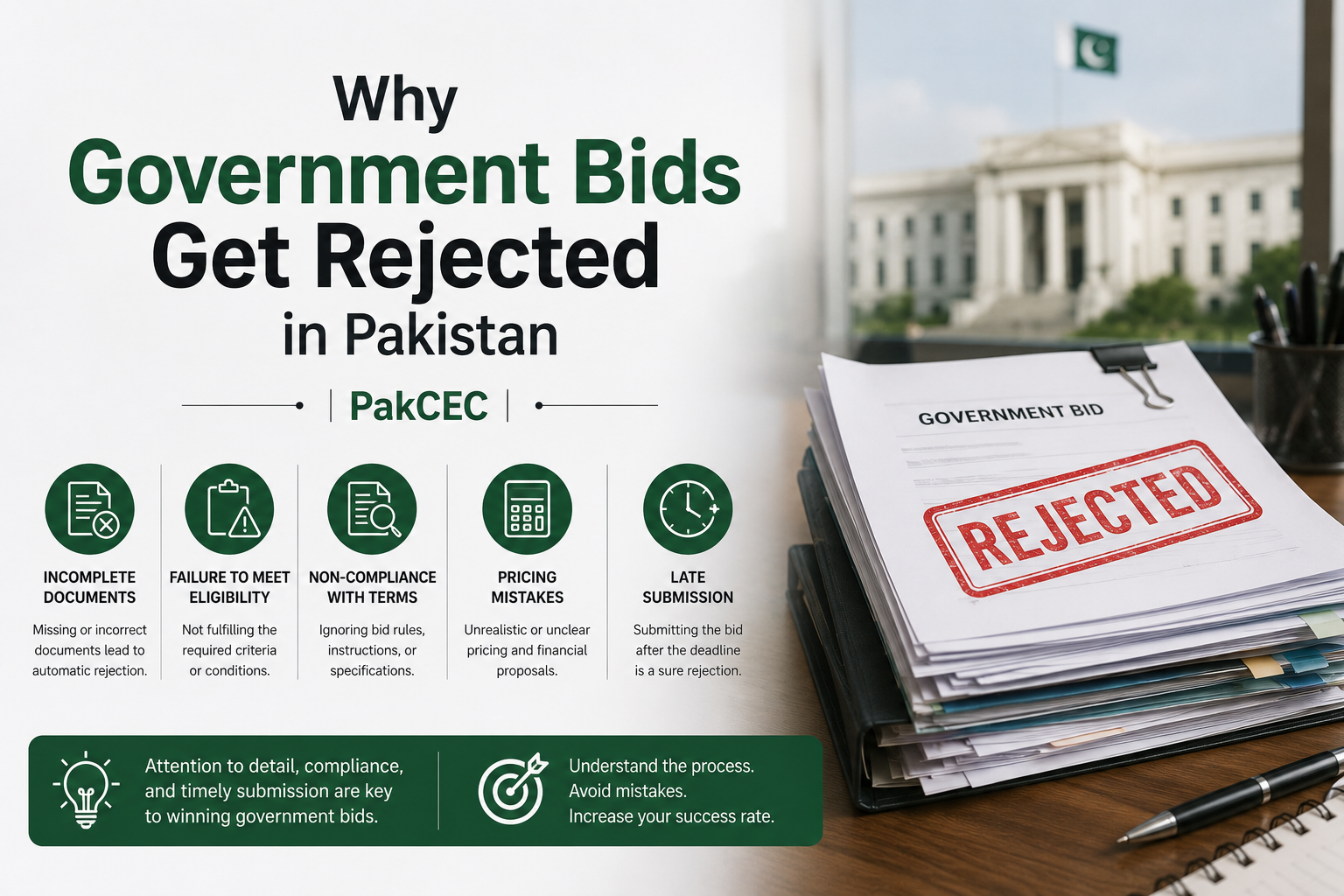
Most Pakistani businesses do not lose that way. They are eliminated earlier, at a documentation gate, and the procuring agency never reaches their price at all. The bid was not beaten. It was set aside.
That distinction matters because the two problems have completely different fixes. Losing on price means sharpening your costing. Being eliminated at a gate means your paperwork was wrong, and no amount of competitive pricing will help until it is right.
This article walks the gates in order and shows where bids actually die.
Gate zero: you were not registered in time
Since February 2026, federal procurement runs through the e-Pak Acquisition and Disposal System, EPADS, in its second version. Roughly 1,660 federal procuring agencies and over 15,000 vendors have registered on the platform since launch.
The consequence is blunt, and it appears in the standard bidding documents themselves. Manual submission of bids is not entertained. Paper bidding for federal procurement is over.
Worse for latecomers, tenders state a registration deadline, and it typically falls before the bid opening on the same day. If you find a tender you want, discover you are not registered, and start the process that week, you will miss it. Registration is not something you do per tender. It is something you do once, in advance, so that you are able to respond when an opportunity appears.
Where bids die here. Not registered. Registered but not verified. Registered under a different entity name from the one on your documents. Or registered by a former employee whose account nobody can now access.
The fix. Register now, before you have a tender in mind. Then check that your registered entity name matches your incorporation documents exactly. SECP corporate services and PPRA public procurement registration sit together for this reason.
Gate one: basic eligibility
Every tender lists eligibility conditions, and the evaluation committee checks them mechanically before looking at anything substantive.
The recurring killers:
Inactive taxpayer status on the submission date. This is the single most common avoidable disqualification in Pakistani tendering. Your status is checked, it fails silently, and nobody calls you to ask. FBR tax compliance is not a background task if you bid for public work.
Sales tax registration missing or provincial registration absent where the tender requires it.
Blacklisting or debarment. And here is a development worth knowing about. The federal and provincial procurement authorities have been working on mutual enforcement of blacklisting and debarment decisions. If that framework completes, a debarment in one jurisdiction becomes a problem in all of them rather than a local inconvenience.
Entity name mismatches. Your incorporation certificate, your tax registration, your EPADS profile and your bid documents must all show the same name. Trading names, abbreviations and old names cause rejections that feel unfair and are entirely mechanical.
Missing sector licence. Engineering work requires a valid engineering council licence in the right category. Solar work requires energy certification. Regulated products require their product licences. The tender will name what it wants.
Where bids die here. A single expired document. That is genuinely all it takes.
Gate two: technical qualification
This gate tests whether you are capable, not whether you are cheap.
Category or class. Engineering and construction bidders are assessed against their licensed category, and a category that does not cover the contract value is a hard stop. Firms routinely bid above their category, hoping it will not be checked. It is checked. Our PEC engineering services work exists largely because firms discover their category ceiling at exactly the wrong moment.
Similar work experience. Usually expressed as a number of comparable contracts within a stated period, at a stated value. Read the definition of comparable carefully, because it is often narrower than you assume.
Financial capacity. Turnover thresholds, audited accounts for specified years, and sometimes a bank facility letter. Audited accounts that are not current are a common failure, and they take weeks to produce.
Personnel. Named staff with named qualifications, often with a requirement that they are actually employed by you rather than borrowed for the bid. Certificates attached.
Certifications. Quality management certification appears in many tenders as either a requirement or a scored criterion. Where it is scored rather than required, it is often the margin between two otherwise identical bids, which is the practical commercial case for ISO certification. Product tenders may separately require PSQCA product certification.
Where bids die here. Bidding above your category. Experience that does not match the definition. Accounts that are a year out of date.
Gate three: bid security
Bid security is a financial instrument that guarantees you will honour your bid. Procuring agencies increasingly accept a bid security declaration instead, which is an undertaking rather than cash, but you must supply whatever the tender specifies, in the form it specifies.
Where bids die here. Wrong amount. Wrong validity period. Wrong beneficiary wording. Instrument from an institution the agency does not accept. A declaration supplied where an instrument was required, or the reverse.
The fix. Read the bid data sheet, not the general conditions. The bid data sheet is where the tender specific values live, and it overrides the general text. Bidders who read only the general conditions get this wrong constantly.
Gate four: submission mechanics
This gate is pure procedure, and it is where the most infuriating losses happen because none of them relate to your capability.
Deadlines are absolute. Late is disqualified. There is no discretion and no sympathy.
Every required document, in the required format. Missing attachments, unsigned pages, unstamped declarations, forms filled in the wrong version.
Digital submission mechanics. Upload failures, oversized files, wrong file formats, incomplete uploads, and submissions attempted in the final ten minutes on a connection that drops.
Language and translation. Supporting documents in another language generally require an accurate English translation of the relevant pages.
Where bids die here. Submitting on the last afternoon. Almost every horror story starts there.
The fix. Submit a day early. Do a dry run on the platform on a tender you do not care about, so your first real submission is not also your first use of the system.
Gate five: technical evaluation
Only now does anyone assess your actual proposal, and only bidders who cleared every previous gate are in the room.
Specification compliance. The evaluation is a matrix. Each requirement is marked compliant, not compliant, or partially compliant. Deviations you consider improvements are still deviations.
Scored criteria. Where evaluation is scored, understand the weighting before writing. A criterion worth thirty points deserves thirty points of effort.
Documentary substantiation. Every claim needs evidence attached. An unsubstantiated claim scores as if you had not made it.
Where bids die here. Answering the question you wanted rather than the question asked. Technical proposals that read as marketing brochures rather than point by point responses to the specification.
And finally, price
Financial bids are opened only for technically qualified bidders. If you got here, you competed properly.
Two things worth understanding. Lowest evaluated bid is not always lowest quoted price, since evaluation may adjust for deviations, delivery timing or other stated factors. And an abnormally low bid invites scrutiny rather than an automatic award, because agencies are wary of bids that cannot be delivered at the price offered.
What EPADS 2.0 changed, and what it did not
What changed. Federal procurement is now conducted end to end on a single platform, with a central registry of verified vendors. Bid opening is systematised, and for larger procurements agencies broadcast openings publicly. Procurement data is published in a standardised open format, which means you can research what agencies have bought and from whom.
That last point is underused. The published data is a competitive intelligence source sitting in the open, and almost nobody in the market mines it.
What did not change. The documentation burden. Digitisation moved the process online. It did not reduce what you must prove, and in some respects it made compliance stricter, because a system checks fields mechanically where a human might once have accepted a near miss.
What is still moving. A revised set of procurement rules has been through drafting and approval stages, with standard bidding documents being revised alongside. Provincial authorities run their own regimes and are adopting the platform on their own timelines. So confirm the current rules and the current bidding documents for the specific tender and jurisdiction you are bidding into, rather than working from a version you used last year.
The readiness file every serious bidder maintains
Businesses that win public work do not assemble documents per tender. They maintain a file and refresh it on a schedule.
| Document | Refresh when |
|---|---|
| Incorporation certificate and constitutional documents | On any change |
| Tax registration and active taxpayer status | Monthly check |
| Sales tax registration, federal and provincial | On any change |
| Sector licences with category and expiry noted | Diarise a month before expiry |
| Audited accounts | Annually, promptly after year end |
| Bank facility and financial capacity letters | Annually |
| Similar work certificates from past clients | After every completed contract, while they still remember you |
| Staff certificates and qualifications | On any hire or departure |
| Quality and product certifications | Per certification cycle |
| Company profile and organogram | Annually |
The similar work certificates row is the one businesses neglect and later regret. Ask for a completion certificate when the contract ends, not two years later when you need it for a bid and your contact has moved on.
What to do when you lose
Most bidders find out they lost and move on. That wastes the most useful information available to you.
Ask why. Procurement is meant to be transparent, and award information is published. Find out who won, at what value, and where you were placed. If you were eliminated at a gate, find out which one.
Separate the two failure types deliberately. Eliminated at a gate means a documentation problem, and it will happen again on the next tender unless you fix the file. Lost on evaluation or price means you competed and something in your offer was weaker. These need completely different responses, and businesses conflate them constantly.
Log it. Keep a simple record of every bid: agency, tender, outcome, and cause. After ten bids the pattern is usually obvious, and it is frequently the same document failing repeatedly.
Use the published award data. Awards are published in a standardised open format. Over time that tells you which agencies buy what you sell, how often, at what values, and who keeps winning. That is a bidding strategy, not a guess.
Do not treat a grievance mechanism as a first resort. Procurement regimes provide for complaints, and they exist for genuine irregularities. Using one because you missed a deadline damages a relationship you will need again.
The mistake underneath most of these
Treating tendering as an event rather than a capability.
A business that decides to bid when it sees an interesting tender is already behind. Registration takes time. Audited accounts take time. Category upgrades take time. Completion certificates have to be collected from clients while they still remember the work.
The businesses that win public sector work are not usually the cheapest. They are the ones whose file was ready before the tender existed.
Should you bid at all?
An honest article includes this. Not every tender is worth the effort, and bidding indiscriminately is how businesses spend a quarter’s capacity to lose ten times.
Skip a tender when:
- You do not meet a stated eligibility condition. Hoping is not a strategy.
- The category exceeds your licensed class.
- The timeline does not allow you to assemble the documents properly.
- The specification appears written around a particular product or supplier.
- The contract value does not justify the bid cost, which for a serious technical bid is real.
Bid when you clear the gates comfortably, the work fits your capacity, and you can substantiate every claim you intend to make.
Where PakCEC fits
Every gate above except the last two is a compliance question rather than a commercial one. Entity documents, tax standing, sector licences, categories, certifications and platform registration. That is the work PakCEC does, and we do it from Aabpara in Islamabad, minutes from the federal procuring agencies our clients bid into.
Twenty years, more than 3,000 completed registrations and certifications, and a preference for telling clients what they do not need. If a tender is not winnable for you, we would rather say so than help you spend three weeks proving it.
Tell us what you bid for and what you currently hold. We will tell you which gate you would fail at today. See our PPRA public procurement registration service, our wider business consultancy in Pakistan range, or talk to the PakCEC team.

[…] If you are registered with PSEB as an IT or IT-enabled services company, ISO 27001 also strengthens your profile with foreign buyers. See our PSEB registration guide. […]