

A manufacturer we spoke with had built a plant, sourced packaging and printed labels for an anti-dandruff shampoo. The product was ready. The regulatory position was not, because nobody had asked one question early enough.
Is it a cosmetic or a medicated cosmetic?
That question decides which authority licenses you, what you must prove, how long it takes, and whether your printed labels are legal. Get it wrong and you do not have a small problem. You have a finished product you cannot sell.
This guide routes products to their regulator. Find yours, then read what that route actually demands.
The question that decides everything
Classification in Pakistan does not follow what you call your product. It follows what your product claims to do and what is in it.
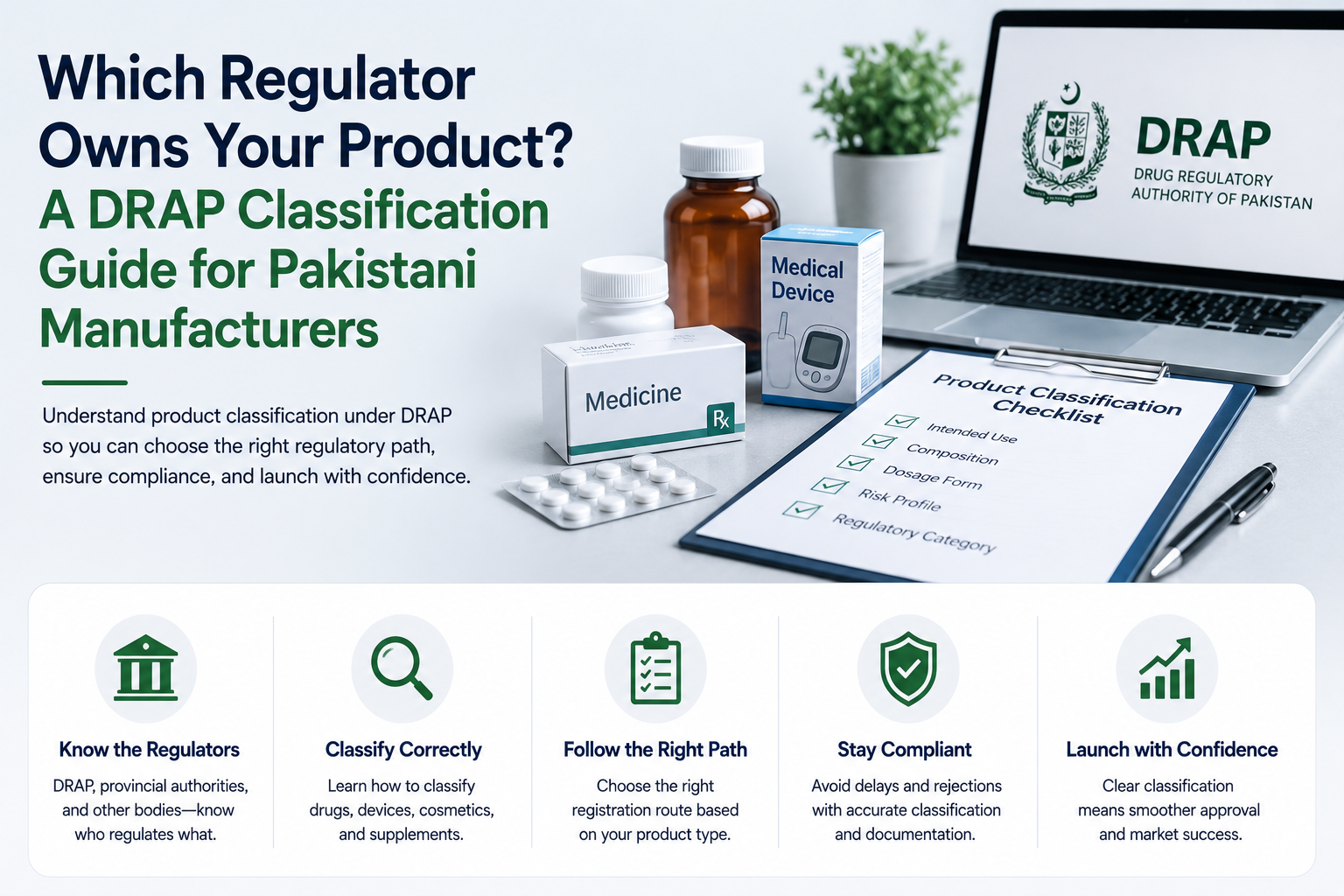
The Drug Regulatory Authority of Pakistan, established under the DRAP Act 2012 and operating under the Ministry of National Health Services, Regulations and Coordination from Islamabad, regulates therapeutic goods. That term covers drugs, medical devices, medicated cosmetics, alternative medicines and health products.
The practical test is the claim. A shampoo that cleans hair is a cosmetic. A shampoo that treats a scalp condition is making a therapeutic claim, and therapeutic claims pull a product into DRAP’s remit regardless of what the marketing team wanted to call it.
Two things follow that manufacturers consistently underestimate.
Your label is a regulatory document. Wording that reads as a health benefit can change your classification. The claim is not a marketing decision that regulatory then works around. It is the thing that determines your regulatory route.
Ingredients matter as much as wording. An active ingredient at a therapeutic level can classify your product even if the label is carefully neutral.
The routing table
| Your product | Who regulates it | What you need |
|---|---|---|
| Medicines and pharmaceuticals | DRAP, drug licensing | Manufacturing licence and product registration |
| Medical devices and in vitro diagnostics | DRAP, medical devices division | Establishment licence plus device registration by risk class |
| Medicated cosmetics, medicated shampoos, medicated soaps | DRAP, same division as medical devices | Enlistment or registration |
| Nutritional products and food supplements | DRAP, health and OTC products division | Enlistment or registration |
| Alternative medicines: ayurvedic, unani, Chinese, homeopathic | DRAP, health and OTC products division | Licensing and registration |
| Ordinary cosmetics with no therapeutic claim | Standards and consumer product regime, plus provincial enforcement | Product standard compliance and labelling |
| Food and beverages | Standards authority and provincial food authorities | Product certification and food licensing |
Two structural points about that table.
DRAP’s cosmetics jurisdiction is narrower than people assume. The division responsible is titled medical devices and medicated cosmetics, and its remit is expressly medicated cosmetics, medicated shampoos and medicated soaps. An ordinary face cream making no therapeutic claim is not on that list.
That does not mean ordinary cosmetics are unregulated. They sit under the standards and consumer product regime instead, with provincial enforcement, and commentary in this area has consistently noted that oversight of non medicated cosmetics has been the weaker part of the picture. Weak enforcement is not a compliance strategy. It is a risk you are carrying, and it is the kind that resolves suddenly rather than gradually.
Route A: medical devices
The most structured route, and the one with the clearest rules.
Governing framework. The Medical Devices Rules 2017, made under the DRAP Act 2012, which came into force in January 2018 and replaced the earlier 2015 regulations.
Risk classes. Devices and in vitro diagnostics are classified A through D, with A the lowest risk and D the highest. Classification turns on intended use, how long the device contacts the body, how invasive it is, whether it is active, and what happens if it fails.
Classification is your first task, not a formality. It determines your evidence burden and your timeline, and getting it wrong means resubmitting.
Two separate approvals. This trips up newcomers constantly.
An establishment licence authorises you as a manufacturer or importer. It is granted by the Medical Device Board and runs for five years unless suspended or revoked earlier.
A device registration covers the individual product. Holding an establishment licence does not let you sell an unregistered device, and registering a device does not substitute for the establishment licence.
What the file generally contains. Quality management system certification to the medical devices standard, authorisation from the manufacturer where you are not the manufacturer, a free sale certificate, a declaration of conformity, and technical documentation demonstrating conformity with the essential principles.
Site inspection. A manufacturing site inspection may be required, and it is more likely where the device has not already been approved by a recognised reference regulator. Devices from manufacturers established in certain reference countries are commonly exempted from that step.
Two recent changes worth knowing. DRAP launched an electronic service portal for medical device licensing and registration in 2025, so applications go online rather than by hard copy dossier. And the import no objection certificate moved onto the Pakistan Single Window system with effect from March 2026, which changes how your import documentation flows.
If you are working from guidance written before those two changes, you are working from an obsolete process.
Route B: medicated cosmetics
This is the route Pakistani cosmetics manufacturers most often discover late, and it matters commercially because medicated products command better margins than plain ones.
The same DRAP division that handles medical devices handles medicated cosmetics, medicated shampoos and medicated soaps. Enlistment or registration is required before marketing.
The boundary is drawn by claims and actives. Ask yourself three questions about the product you are formulating:
- Does the label, packaging or advertising claim to treat, prevent or alleviate a condition?
- Does it contain an active ingredient at a level intended to have a therapeutic effect?
- Would an ordinary buyer read your marketing as a health benefit rather than a cosmetic one?
If any answer is yes, plan for the DRAP route.
Businesses building a facility should settle this before the plant is designed rather than after. A production line built for ordinary cosmetics may not satisfy the requirements applying to a medicated product, and PakCEC handles cosmetics plant installation alongside healthcare licensing precisely because that sequencing decision is where projects go wrong.
Route C: supplements, nutritional products and alternative medicines
DRAP’s health and OTC products division handles alternative medicines, meaning ayurvedic, unani, Chinese and homeopathic products, and separately the enlistment or registration of nutritional products and food supplements.
This is the most confused category in the Pakistani market, and the confusion is understandable. A herbal product may sit close to a food, a supplement close to a medicine, and a wellness product close to both. The routing question is the same as everywhere else. What does it claim, and what is in it?
Two practical warnings.
A food registration does not cover a health claim. If your packaging asserts a health benefit, a food or beverage licence is unlikely to be the whole answer.
Enlistment and registration are not the same thing. They are different processes with different evidence requirements, and which applies depends on your product category. Establish which one you are pursuing before you start assembling documents.
Route D: everything with no therapeutic claim
If your product is genuinely an ordinary cosmetic, food, beverage or consumer good with no health claim, DRAP is not your regulator. Your route runs through the standards regime and, for food, provincial food authorities.
Practically that means PSQCA product certification where your product is on the compulsory certification list, labelling that satisfies pre packaged product rules, and provincial food authority licensing where applicable.
The decision to stay in this lane is legitimate and often commercially sensible. It just has to be a decision, held consistently. You cannot claim therapeutic benefits in your advertising and rely on a consumer product registration when questioned.
What the route costs you beyond the licence
Classification does not just change your paperwork. It changes what your business has to be able to do, permanently.
Facility requirements. A therapeutic goods route brings expectations around premises, segregation, air handling, water quality and cleaning validation that an ordinary consumer product line is not built to. These are structural. Adding them later means rebuilding, not adjusting.
Quality control capability. Every DRAP route assumes you can test what you make, batch by batch, and evidence it. That means instruments, calibration records, trained analysts and retained samples, not a bench with a pH meter on it.
Documentation as a habit. Batch records, deviation records, complaint handling, change control. Inspections examine records as closely as premises, and a system assembled the week before an inspection looks exactly like what it is.
Named technical staff. Therapeutic routes generally expect qualified people in defined roles, and they must actually work for you.
Ongoing obligations. Licences expire. Registrations expire. Product changes require reassessment. Adverse event and complaint reporting continues for as long as the product is on the market.
The honest summary: a therapeutic classification is a permanent operating commitment, not a one time approval. That is a good reason to be certain which route you are on before you commit, and a bad reason to claim a lighter classification than your product deserves.
Where classification goes wrong
Five patterns, all avoidable.
Marketing writes the claim after regulatory approval. The product is registered as a cosmetic, then the campaign promises treatment of a condition. Your advertising has now outrun your registration, and advertising of therapeutic goods is separately regulated.
Reformulating without reassessing. Adding an active ingredient to an existing product can change its classification. A formulation change is a regulatory event.
Assuming a foreign classification transfers. A product sold as a cosmetic elsewhere may classify differently here. Check against Pakistani categories rather than assuming.
Confusing the two medical device approvals. Manufacturers obtain an establishment licence and believe they may now sell. They may not, until each device is registered.
Designing the plant before deciding the route. The most expensive of the five, because retrofitting a facility to meet requirements it was not built for costs more than building it right. This is also why laboratory compliance and lab equipment specification belong in the design conversation, since every route above assumes you can test what you make.
The order to work in
- Write your intended claim down, in the words you actually plan to use on the label and in advertising.
- List your actives and their levels.
- Classify from those two things, not from what you would prefer.
- Confirm the classification with the relevant division before you commit to packaging or plant design.
- Sort the corporate layer. SECP corporate services and tax registration gate everything downstream.
- Design the facility to the route, including quality control capability.
- Assemble the file and apply.
- Keep claims and registration aligned afterwards, forever.
Step one is the whole article compressed. Almost every expensive classification problem starts with a claim decided after the regulatory route was chosen.
Where PakCEC fits
We work the plant side and the licensing side of the same projects, which is a useful place to stand for a classification question. Whether a facility can support a medicated product, whether your laboratory can run the tests the route requires, and whether the sequence is right are engineering questions and regulatory questions at the same time.
Twenty years, more than 3,000 completed registrations and certifications, and a preference for asking what your label will say before recommending anything.
Tell us what you are making and what you intend to claim, and we will tell you which regulator owns it. See our healthcare licensing and specialized industry licensing services, our wider business consultancy in Pakistan range, or talk to the PakCEC team.

[…] If you are registered with PSEB as an IT or IT-enabled services company, ISO 27001 also strengthens your profile with foreign buyers. See our PSEB registration guide. […]