

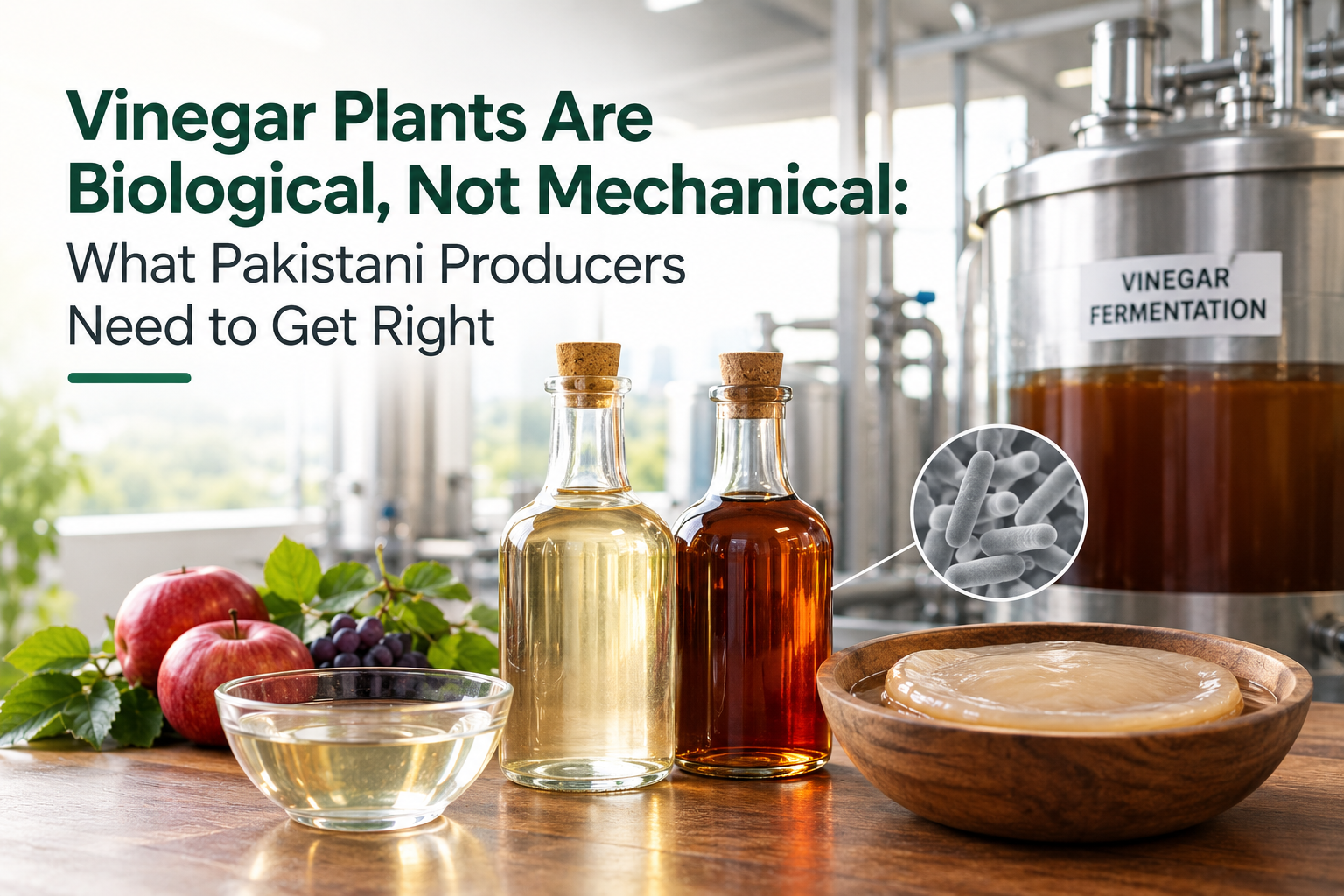
Everything else PakCEC installs moves a liquid, heats it, and puts it in a container. A vinegar plant does something different. It keeps a colony of bacteria alive and working, and every piece of steel in it exists to serve that colony.
That distinction is not philosophical. It explains why vinegar plants fail in ways juice plants do not, why a stopped compressor costs you a week rather than an hour, and why the cheapest quotation is frequently the one that has not understood the process at all.
This guide starts with what the culture needs and derives the plant from there.
First, decide what you are actually making
Pakistan draws a legal line here, and producers should understand which side they are on before anything else.
The Pakistan Standard for synthetic vinegar, PS 3602, addresses the question directly. It records that the term vinegar has historically described a fermented product, normally with a prefix naming the raw material, and that using the bare word for a dilute acetic acid solution has long been contested. The standard settles it by defining synthetic vinegar as a dilute solution of acetic acid, requiring the qualifier, and setting a minimum total acidity expressed as acetic acid of four percent. Brewed fruit vinegar sits under its own separate Pakistan Standard.
So you have two genuinely different businesses.
Synthetic vinegar is a blending operation. Food grade acetic acid, treated water, dilution to specification, filling. There is no fermentation, no biology, no time in a tank. It is cheap, fast and legal, provided you label it as what it is.
Brewed vinegar is a fermentation business. Longer, more capital intensive, more technically demanding, and a completely different product with a completely different market position.
Most of the rest of this guide concerns the second, because that is where the engineering questions live. But be clear which you are building. A plant designed for one will not do the other.
The two fermentations
Brewed vinegar is made in two biological stages, run by two different organisms.
Stage one, alcoholic fermentation. Yeast converts sugars into ethanol. This is the same biology as any alcohol production, and it is a means to an end rather than the product.
Stage two, acetous fermentation. Acetic acid bacteria convert that ethanol into acetic acid. This is the stage that makes vinegar, and it is the stage that governs your plant design.
Both stages are living processes with preferences. What follows is what they need, and what each requirement forces you to buy.
The culture needs sugar: choosing your feedstock
Your raw material determines your product identity, your seasonality and your intake equipment.
Sugarcane and molasses. Pakistan grows a great deal of sugarcane, and cane and molasses feedstocks are locally available, year round in the case of molasses, and inexpensive. For a domestic market producer this is usually the commercially sensible starting point.
Dates. Available, culturally well positioned, and a premium product.
Apple. Apple cider vinegar carries a health positioning and a price premium, and demand for it in Pakistan has grown substantially. Fruit intake, washing and pressing equipment is required unless you buy juice or concentrate.
Spirit or distilled. Fermentation of distilled alcohol, giving a neutral, consistent product with the simplest intake.
Whey, malt and other substrates. Viable, and each brings its own handling requirements.
Two practical points. Fresh fruit brings a season, and a plant sized around a three month intake window looks very different from one running on molasses year round. And your feedstock choice is a label claim, so a product sold as apple cider vinegar has to be made from apples.
The culture needs oxygen, and this is the part to take seriously
Acetic acid bacteria are aerobic. They need oxygen continuously, and this is the single most underestimated requirement in vinegar plant design.
The published process literature is blunt about the consequence. In submerged fermentation, agitation and aeration together generate fine bubbles that increase oxygen transfer and the contact area between the bacteria and the substrate. Interrupt that supply, and the damage is disproportionate: research on submerged acetic acid fermentation reports that an aeration failure lasting as little as a minute can be followed by around eight days of non productive fermentation while the culture recovers.
Read that again in commercial terms. A one minute interruption can cost you a week of output.
That single fact justifies decisions a cheaper quotation will have skipped:
- Redundant air supply. A backup compressor or blower is not a luxury on a submerged plant. It is insurance against losing a week.
- Power continuity. In a market with supply interruptions, aeration is the load that must not drop.
- Monitoring and alarms. You need to know the moment aeration falters, not the next morning.
- Properly designed aeration and agitation. Oxygen transfer is a design calculation, not a spare fitting.
If a supplier quoting you a submerged plant does not raise redundancy of the air supply, they have not run one.
The culture needs the right temperature
Acetous fermentation generates heat, and the bacteria have a working range. Too cold and the process slows. Too warm and the culture is stressed or lost, and you also drive off volatile acetic acid and ethanol.
That means cooling capacity, temperature control on the fermenter, and monitoring. It sounds obvious, and it is routinely undersized because people specify against ambient conditions rather than against a Pakistani summer at full production.
The culture needs time, and time is the money question
This is the central capital decision in a vinegar plant, and it is a genuine trade rather than a right answer.
| Approach | How it works | Trade offs |
|---|---|---|
| Surface or slow process | The culture works at the liquid surface, in shallow vessels or a packed generator. Traditional and low technology | Slow, measured in weeks or months. Large footprint and inventory tied up. Flavour development often superior, and it suits a premium or artisanal position |
| Submerged or acetator process | The culture is suspended throughout an aerated, agitated vessel. The industrial standard | Fast, measured in days rather than months. Far higher output from a smaller footprint. Higher capital cost and wholly dependent on continuous aeration |
The difference between the two is not incremental. It is the difference between working capital sitting in tanks for months and product turning over in days.
Choose by market position and by capital. A premium apple cider vinegar brand may be well served by a slower process it can tell a story about. A producer supplying volume into the retail trade needs the submerged route, and needs the redundancy that goes with it.
The culture needs not to be poisoned
Two threats, and both are design decisions rather than operating ones.
Contamination. You are running an open ended biological process, and other organisms would like your substrate. Vinegar eels, unwanted bacteria and wild yeasts all appear where sanitation is weak. Clean in place capability, sanitary vessel and pipework design, and filtered air on an aerated system are not optional extras.
Corrosion. Acetic acid is aggressive, and this is where cheap fabrication shows up eighteen months later. Material selection through the acid contact path matters, and the grade appropriate to dilute acetic acid at process temperature is a specification question you should ask about explicitly rather than assume. Gaskets, seals and valve internals need the same attention as the tanks.
Ask any supplier what material specification they are proposing for the acid contact surfaces, and why. A vague answer is informative.
The halal question almost nobody asks
This section matters more than its length suggests, and it is the one PakCEC gets asked about only after a problem has appeared.
Vinegar is made by converting alcohol. That intermediate ethanol stage means halal status is a genuine technical question rather than a formality, and the answer turns on completeness of conversion.
Naturally fermented vinegar is generally accepted as halal, because the ethanol has been transformed into acetic acid. The position becomes questionable where transformation is incomplete and residual alcohol remains in the finished product. Published testing of vinegar products in one Muslim majority market found that while most samples were acceptable, some were not, specifically because the transformation had not fully completed.
The practical consequences for your plant:
Residual ethanol is a quality specification, not just a process endpoint. You need to measure it and hold it to a limit, and that means analytical capability rather than judgement.
Your process endpoint decides your halal position. Pulling a batch early because you need the tank is not only a quality decision.
Synthetic vinegar raises separate questions. The origin of the acetic acid itself becomes the issue rather than the fermentation, and certification bodies assess the production route.
If you intend to export, this belongs in the design conversation. Halal certification services and vinegar plant installation are one conversation at PakCEC for exactly this reason.
The bench your process requires
A vinegar plant cannot be run on observation. Minimum capability:
- Total acidity by titration, your headline specification and the number the standard sets
- Residual ethanol, for process endpoint, quality and the halal position above
- pH, for process monitoring
- Soluble solids as Brix, on the substrate before fermentation
- Microbiological checks, for contamination
- Sensory assessment, structured rather than casual
The residual alcohol measurement is the one first time producers omit and later need. Specify it at design stage. We treat lab equipment and laboratory compliance as part of plant design rather than a later purchase.
Product certification also assesses the facility, so PSQCA product certification is designed for, not applied for afterwards.
Where vinegar projects go wrong
Five patterns, and four of them trace back to treating the plant as mechanical rather than biological.
Aeration redundancy left out to win the quotation. The cheapest bid is often cheapest here, and the saving is recovered the first time the power drops during a fermentation cycle.
Cooling sized against a mild day. Acetous fermentation is exothermic and Pakistani summers are not mild. An undersized chiller means either stressed cultures or reduced batch sizes in the months when you most want output.
No plan for starting the culture. A vinegar plant needs a working culture, and establishing one takes time. Commissioning schedules that assume the plant produces saleable vinegar in week one are wrong. Ask your supplier how the culture is established and how long the plant takes to reach steady production, because that gap is real working capital.
Sanitation designed as cleaning rather than as biosecurity. You are protecting a monoculture. That is a higher bar than rinsing a juice line, and it needs to be in the design.
Regulatory and halal work started after commissioning. By then your process endpoint, your residual alcohol position and your label are already fixed by equipment somebody else specified.
The recurring theme is that the expensive parts of a vinegar plant are the ones protecting a living process, and they are exactly the parts a buyer comparing two quotations on price cannot see.
What to ask before you sign
Are you quoting a fermentation plant or a blending plant? They are different products and different businesses. Get the answer explicitly.
Slow or submerged, and why for my volume? A supplier who has not asked about your market position cannot answer this.
What happens if aeration stops? The best single diagnostic question in this whole article.
What material specification is proposed for acid contact surfaces?
How is the fermenter cooled, and sized against what ambient condition?
What is the clean in place design?
What laboratory capability does this plant assume, including residual alcohol?
Where does your scope end? Substrate handling, fermentation, filtration, pasteurisation, filling. Our auto filling systems work exists because a plant ending at the maturation tank is not a plant.
Where PakCEC fits
PakCEC designs, installs and commissions turnkey plants across vinegar, juice, water, cosmetics and process industries, and handles the certification and licensing alongside them. For vinegar that combination is unusually relevant, because your process endpoint, your legal label and your halal position are the same decision seen from three angles.
Twenty years, more than 3,000 completed registrations and certifications, and a preference for telling clients what they do not need. If synthetic vinegar suits your market and your capital better than a fermentation plant, we will say so.
Tell us your feedstock, your target volume and your intended market. See our juice plant installation and full engineering solutions in Pakistan range, or talk to the PakCEC team.
