

We have published detailed guides on building water, juice, vinegar and cosmetics plants. Every one of them starts at design.
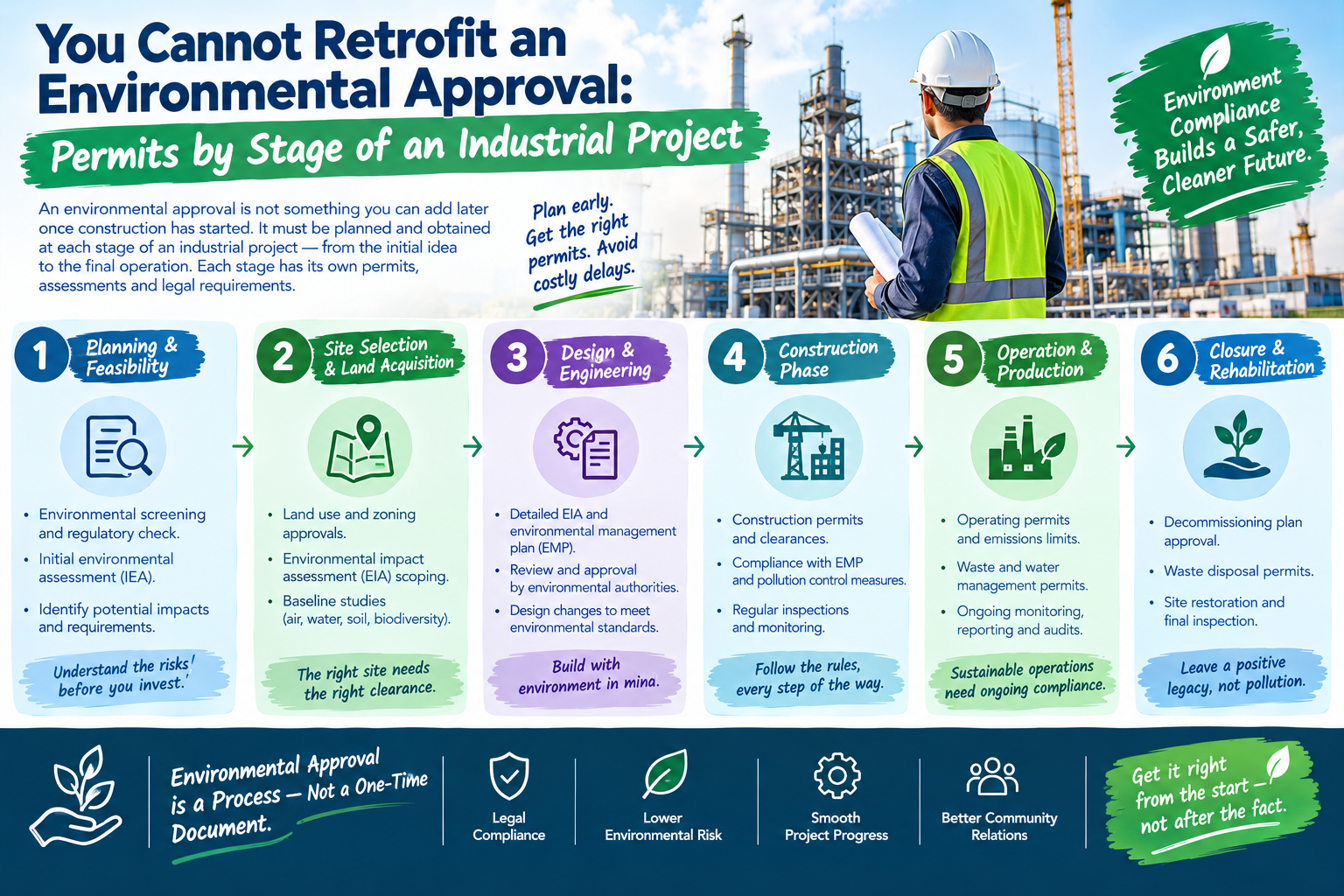
That is where the buyer’s attention is, and it is one stage too late. Before any of those decisions matter, your project needs environmental clearance, and the law requires it before the project proceeds rather than after it is built.
A plant constructed without it is not a plant with a paperwork gap. It is a facility an agency can order to stop operating, and the approval cannot be granted retrospectively in any meaningful sense, because the assessment it depends on was supposed to shape what you built.
This guide runs the permits by stage of the project, starting earlier than our other engineering articles do.
What the law requires
The Pakistan Environmental Protection Act 1997 is the primary federal legislation. Its section 12 is the provision that matters to a manufacturer: industrial projects must undertake an environmental assessment before proceeding, and the relevant agency must approve it.
Two assessments exist, and which applies is determined by expected impact rather than by your preference.
Initial Environmental Examination. The lighter route, for projects expected to have less significant adverse effects.
Environmental Impact Assessment. The heavier route, for projects categorised as potentially seriously affecting the environment. It is a substantially larger exercise, and it carries a public consultation stage that the lighter route generally does not.
That public hearing requirement is the single biggest practical difference between the two paths, and it is the main reason an assessment timeline stretches. Plan around it rather than being surprised by it.
Which schedule you fall into is a question of fact. Project categorisation rests on type and scale, and a growth in capacity can move a project from one route to the other. Establish your category before you commit to a site or a design, because the answer changes both.
The provincial problem
Here is what catches businesses operating in more than one province, and what a great deal of published guidance still gets wrong.
Following the Eighteenth Amendment to the Constitution in 2010, environmental regulation devolved substantially from federal to provincial control. Provinces now legislate and enforce their own environmental regimes, with their own agencies.
Punjab, for instance, has its own review regulations made in 2020, and the older federal regulations no longer apply there. The federal agency retains a role for projects of national scope.
Three consequences.
Your assessment route depends on where the plant is. Not on where your head office is, and not on what a national guide says.
Multi site operators face different processes in each province. Capacity, procedural detail and enforcement posture all vary.
Guidance written before 2010, or written federally without qualification, may not describe your position. Check against your own provincial agency.
Stage one: before you choose the site
The cheapest stage, and the one nobody treats as a compliance question.
Land use and zoning. Is industrial activity of your type permitted at that location by the relevant development authority?
Sensitivity of the surroundings. Proximity to residential areas, watercourses, agricultural land and protected areas all affect your assessment, and some affect it decisively.
Effluent and its destination. Where does your discharge go, and is that route available and acceptable? For a wet process plant this is close to determinative, and it is far cheaper to know before you buy land than after.
Utilities. Power, gas and water availability at the scale you need, and what connecting costs.
A site that is cheap because nobody else wanted it is sometimes cheap for a reason that will appear in your assessment.
Stage two: before you design
This is the sequencing point the whole article exists to make.
Your environmental assessment produces an Environmental Management Plan, setting out the mitigation measures your project commits to. Those measures are engineering. Effluent treatment, emissions control, noise attenuation, waste handling, spill containment.
Design the plant first and the assessment becomes an exercise in describing what you already decided, frequently with expensive additions bolted on. Run them together and the mitigation is designed in, which is both cheaper and more likely to work.
This applies across every plant type. Water plant installation projects generate a reject stream that has to go somewhere. Juice plant installation and vinegar plant installation produce organically loaded effluent. Cosmetics plant installation involves cleaning chemicals and surfactant loads. In each case the treatment requirement is a design input, not an afterthought.
Stage three: before you build
The approval itself, and this is where the clock lives.
Prepare the assessment. Baseline data, impact prediction, mitigation measures, and the management plan.
File with the correct agency. Federal or provincial, per the section above.
Review, and for the heavier route, public consultation. The agency examines the submission, may seek clarification, and where a public hearing applies, that has to be scheduled and held.
Approval with conditions. Clearance is rarely unconditional. The conditions attached become obligations, and they are checked later.
Two practical points. Agencies generally require confirmation on completion of construction that the project was built as approved, which means the approval is tied to what you actually construct rather than to what you drew. And the timeline is driven by the completeness of your submission and the route you are on, so a thin assessment on the heavier route is the slowest possible combination.
What the assessment actually involves
Worth setting out, because businesses treat it as a form to fill in and it is not.
Baseline data. What the site and its surroundings are like before you build. Air, water, noise, soil, ecology and the human environment, at a level of detail matching your route. Some of this requires sampling and takes elapsed time rather than effort, which is one reason assessments cannot be compressed indefinitely.
Project description. What you intend to build, at what capacity, with what inputs and what outputs. This has to be specific, which is why a project still at concept stage cannot be assessed properly.
Impact prediction. What your operation will do to that baseline. Effluent volume and load, emissions, noise, traffic, waste streams, water abstraction.
Mitigation. What you will do about each predicted impact. This is the engineering, and it is where costs appear.
The management plan. How mitigation will be operated, monitored and recorded once you are running, and who is responsible.
Two honest points about preparing one. It is normally done by a consultant, and the quality varies enormously, so ask to see previous submissions for projects like yours. And an assessment that describes a plant you have already designed will recommend the mitigation that plant happens to allow, rather than the mitigation the impact actually requires, which is the expensive version of getting the order wrong.
Stage four: the permits nobody lists
Environmental clearance is the heaviest, not the only one. A manufacturing facility typically needs several of the following, and businesses discover them one at a time, usually when something is already built.
- Factory registration under labour legislation, with the provincial labour department
- Boiler registration and periodic inspection, where you operate one, which most process plants do
- Hazardous substances handling and waste permits where applicable, under the relevant rules
- Fire safety clearance from the local authority
- Utility connections at industrial load, which can carry their own lead times and infrastructure costs
- Employee registrations for social security and old age benefits, which are provincial as well as federal
- Weights and measures verification for any instrument used in trade
- Local authority and development authority approvals for construction itself
None of these is difficult individually. Collectively they are a project, and they need an owner on your side rather than being discovered sequentially. This is the work our specialized industry licensing practice exists for.
The boiler line deserves emphasis. It is periodic rather than one off, it stops production when it lapses, and it is the permit most often forgotten in a commissioning plan. Put it in the compliance register on the day the boiler is installed, not the first time an inspector asks.
Stage five: commissioning, and the product side
Your environmental and factory position is only half of it. The product has its own regime, which our other guides cover in detail.
Product certification assesses the facility as well as the product, which is why PSQCA product certification should be designed for rather than applied for afterwards. Your quality control capability has to exist and work, which is a laboratory compliance question. And where your product sits under a health or therapeutic regime, its classification determines which regulator owns it.
The pattern across all of them is the same as the environmental one. Approvals that assess a facility are cheaper to design for than to retrofit.
Stage six: operating, where approval turns out not to be the end
This is the part most businesses do not expect.
Environmental approval carries continuing obligations. Agencies conduct post approval monitoring to check compliance with the environmental management plan you committed to. The commitments in your assessment are not a submission document. They are an operating standard.
Your discharges and emissions are measured against national quality standards. Meeting them is a continuing requirement rather than a commissioning test.
Non compliance has an operational remedy attached, not only a financial one. Agencies have power to issue orders requiring a facility to stop, alongside penalties that can include a continuing element for each day a contravention persists. The financial penalty is rarely the part that hurts.
Monitoring needs records. Discharge results, maintenance of treatment equipment, waste disposal documentation. The same discipline as any other compliance record, and the same failure mode: nobody owns it, so it stops.
Why this sequencing goes wrong so often
Four reasons, and they are consistent.
The project starts commercially rather than legally. Someone identifies an opportunity, finds a site, and gets a plant quotation. Environmental clearance enters the conversation when a bank or a contractor asks about it.
Equipment suppliers do not raise it. Reasonably, since it is not their scope. But it means the person you are speaking with most about the project is not the person who will mention the approval.
It looks like paperwork. It is not. It is an engineering commitment with a design consequence.
The consequence is invisible until it is severe. Nothing happens for months. Then an inspection happens, or a bank asks, or a buyer runs due diligence.
What to ask, and when
Before buying land. Is this use permitted here, where does effluent go, and what does the surrounding environment do to my assessment category?
Before appointing a plant supplier. Which assessment route am I on, and what mitigation will it require me to build?
Before construction. Is the approval granted, what conditions are attached, and does my construction drawing match what was approved?
Before commissioning. Which of the other permits do I still not hold, and which have lead times?
Once running. Who owns the monitoring, the records and the renewals?
Where PakCEC fits
PakCEC designs and installs plants and handles the licensing that sits around them, which makes this particular problem a natural one for us. The environmental management plan is an engineering document before it is a regulatory one, and treating those as one conversation rather than two is the difference between mitigation that is designed in and mitigation that is bolted on.
Twenty years, more than 3,000 completed registrations and certifications, and a preference for telling clients what they do not need. If your project falls under the lighter assessment route, we will say so rather than sell you the heavier one.
Tell us what you intend to build, where, and at what scale. See our engineering solutions in Pakistan and business consultancy in Pakistan ranges, or talk to the PakCEC team.
