

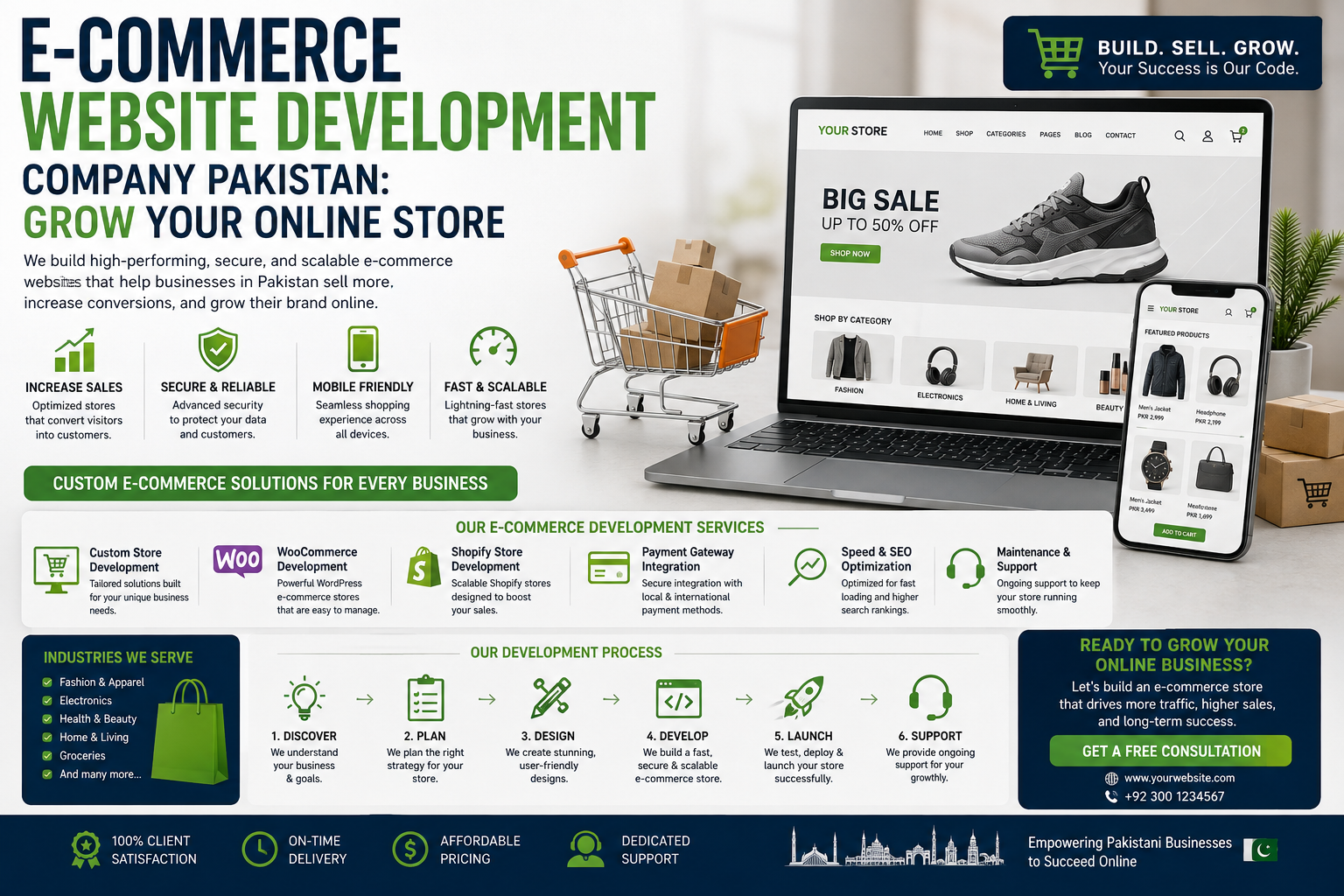
Choosing an E-commerce Website Development Company Pakistan side is not the same decision as hiring one in London or Dubai, and a developer who treats it as the same job will hand you something that looks correct and performs badly.
Card penetration is low and wallets dominate. Cash on delivery still carries a large share of orders, which makes your courier part of your payments stack whether you planned for that or not. And since 2025, tax is deducted before your money reaches you, which quietly breaks any store that was not built to reconcile it.
That last point is the one almost nobody covers. It is not a tax article footnote. It changes what your developer has to build.
E-commerce Website Development Services
Online store development covers the storefront your customers see, the systems behind it that actually run the business, and the integrations connecting the two. Most quotations describe the first, price the second vaguely, and leave the third to be discovered later.
A complete scope looks like this.
Storefront. Catalogue, search, product pages, cart, checkout, accounts, content pages.
Operations. Order management, inventory, fulfilment status, returns, refunds, customer records.
Integrations. Payment gateways, courier APIs, accounting or ERP, SMS and WhatsApp notifications, analytics.
Compliance. Tax handling, invoicing, record keeping, and the reconciliation that the current withholding regime demands.
Ask any prospective supplier which of those four they are quoting for. Most ecommerce developers Pakistan side price the storefront confidently and everything else in a single line. A number that covers only the storefront is not a lower price for the same thing. It is a price for a quarter of the thing.
Key Features
Features that matter in this market, as distinct from features that look good in a proposal.
| Feature | Why it matters in Pakistan |
|---|---|
| Cash on delivery workflow | Still a large share of orders, and it needs order confirmation, courier handoff, remittance tracking and a return path |
| Wallet checkout | Customers who will never enter a card number will pay from a wallet in seconds |
| Order confirmation by call or WhatsApp | Reduces the fake and abandoned orders that plague COD businesses |
| Courier integration with tracking | Booking, tracking and status writeback, not a manual spreadsheet |
| Return and refund handling | High COD return rates make this an operational core, not an edge case |
| Address handling that fits local reality | Many addresses are descriptive rather than structured, so rigid forms cause failed deliveries |
| Mobile first performance | Most traffic is mid range Android on mobile data |
| Withholding reconciliation | Covered below, and now unavoidable |
| Urdu or bilingual support | Decide early, because retrofitting is painful |
The return rate point deserves emphasis. A store that treats returns as an afterthought will discover within two months that returns are a large part of daily operations. Build the workflow, not a form.
Payment Gateway Integration
Pakistan is a wallet first market with a growing instant payments rail, and your checkout should reflect that rather than a card first assumption imported from elsewhere.
The methods worth understanding:
Mobile wallets. JazzCash and Easypaisa dominate, with others including NayaPay and SadaPay in the mix. For a large segment of customers this is the only digital payment they use.
Cards. Visa and Mastercard, with UnionPay in places. Lower usage, higher processing cost, and OTP based authentication that adds checkout friction.
Raast. The State Bank instant payment system. The person to merchant version is the one that matters for stores, and it rolled out commercially over recent years. Its advantages are real: the customer pays from any Pakistani bank account without needing a wallet, card details never touch your systems, and it carries the lowest processing cost of the mainstream options. It is best added alongside wallets and cards rather than offered alone, since adoption is still building.
Bank transfer and IBFT. Still used, particularly for larger baskets.
Cash on delivery. Not a gateway, but the biggest payment method in the country by volume for many categories.
On choosing a provider, three practical points.
Aggregator or direct. A single aggregator giving you wallets, cards and Raast through one integration means one contract, one dashboard and one reconciliation. Integrating each wallet directly gives you more control and more work. For most stores the aggregator is the right first move.
Processing costs are quoted per merchant. Most Pakistani providers do not publish their rates and will quote after a sales call, which means you cannot model unit economics from a website. Ask for the rate card in writing before you commit, and ask separately about wallets, cards and Raast, because they differ substantially.
Settlement timing is a cash flow decision. How many days until money reaches your account is often more important to a growing store than the headline rate. Ask, and get it in writing.
What the 2025 Tax Regime Means for Your Build
This is the section that makes this article different from every other e-commerce development page in Pakistan, and it is a build requirement rather than a tax footnote.
The Finance Act 2025 introduced a withholding regime for digitally ordered goods. In outline:
- Sales tax. Payment intermediaries and couriers withhold sales tax at 2 percent of the gross value of digitally ordered taxable goods supplied from within Pakistan, under the Eleventh Schedule of the Sales Tax Act 1990 as substituted by the Finance Act 2025.
- Income tax. Withholding runs at 1 percent on payments through digital or banking channels via a payment intermediary, and 2 percent on cash on delivery through a courier. Both rates double where the seller is not on the Active Taxpayer List.
- Who withholds. For online payments on your own store, the acquiring bank is the payment intermediary. Where an online marketplace is involved, it is the institution settling between vendor and buyer. For cash on delivery, the courier.
- Registration. Sales tax registration is now required for persons selling digitally ordered goods from within Pakistan through marketplaces, websites or applications, with narrow exceptions for cottage industry and retailers taxed through electricity bills.
- Reporting. The implementing notification issued in August 2025 sets monthly statement requirements with prescribed forms, due electronically early in the following month. Marketplaces file statements without withholding.
Now the part your developer needs to hear.
Your settlement will not equal your order value. Money arrives net of deductions, and if your system assumes gross equals received, your accounts will not reconcile from the first month.
Digital and COD are taxed differently, so your system has to distinguish them. That means the payment channel must be a first class field on every order, not something inferred later.
Withholding certificates have to be captured and matched. Where the deduction is adjustable rather than final, that documentation is what lets you claim credit. Chasing it retrospectively across a payment provider and three couriers is a job nobody enjoys.
Active Taxpayer List status has a direct financial consequence. Falling off it doubles what is deducted. That is a compliance task with an immediate cash cost, which is why FBR tax compliance is not a background chore for an online seller.
Registration comes before your first order, not after your first good month. Sort SECP corporate services and tax registration during the build.
A store built without this is not slightly incomplete. It produces numbers that do not tie out, and you discover that during your first reconciliation rather than during testing.
Choosing the Right Platform
Four realistic routes, and the honest case for each.
| Route | Suits | Strengths | Trade offs |
|---|---|---|---|
| Shopify | Brands wanting speed and low maintenance | Fast to launch, hosted, strong app ecosystem, several Pakistani gateways integrate cleanly | Recurring platform cost in foreign currency, limits on deep customisation, less control over checkout |
| WooCommerce | Businesses wanting control and local integration depth | Open source, plugins for most Pakistani gateways, full data ownership, cheaper at low volume | You own hosting, security, updates and performance, and plugin sprawl degrades speed |
| Headless or custom | Complex catalogues, unusual logic, ERP integration | Built exactly to your operation, performs at scale, no platform ceiling | Highest cost, needs ongoing developers, only justified by genuine complexity |
| Marketplace only | Testing demand before committing | No build, existing traffic | You own no customer relationship, you compete on price, and the marketplace owns the data |
How to choose without agonising:
Start with Shopify if you are a brand, want to launch quickly, and your requirements are standard. Most Pakistani direct to consumer brands land here for good reason.
Choose WooCommerce if you need particular local integrations, want to own everything, or are cost sensitive at low volume. Budget properly for maintenance. WooCommerce is cheap to start and not free to run.
Go custom only when you can name the specific requirement that neither platform can meet. If you cannot name it, you do not need it, and custom software development is better spent on the systems behind the store than on rebuilding a cart.
Use marketplaces for demand testing, not as your destination. Plenty of Pakistani brands run both, using marketplaces for reach and their own store for margin and customer data.
Cash on Delivery Is an Operating Model, Not a Checkbox
Treat COD as a payment option and it will hurt you. Treat it as an operating model and it becomes manageable.
What it actually requires:
- Order verification before dispatch, by call or WhatsApp, to filter fake and impulsive orders
- Courier remittance reconciliation, because your courier collects your money and remits it later, minus its charges and now minus withholding
- Return handling at volume, including restocking and refund logic
- Customer level risk signals, so repeat refusers can be flagged
- Partial digital incentives, since even a small nudge toward prepayment improves cash flow and cuts returns
The reconciliation point compounds with the tax section above. With COD you are matching order value against courier remittance against deductions, per consignment. Without a system, that is a person with a spreadsheet, and it stops scaling early.
Selling Abroad From a Pakistani Store
Worth being direct, because this is where advice gets vague.
Domestic and international selling are different technical and financial stacks, and trying to make one setup serve both usually does neither well. Your domestic stack needs wallets, local cards and ideally Raast. Cross border card acceptance and receiving foreign currency involve a different set of arrangements, and several of the international gateways Pakistani founders ask about are not straightforwardly available to a Pakistani entity.
If exporting is a real objective rather than an aspiration, plan the structure deliberately and take proper advice on the foreign exchange and entity side before building. It is a business structure question first and a checkout question second.
Also settle your brand position early. If you are building a direct to consumer brand, your name and logo are assets, and intellectual property services are cheaper before someone else registers your name than afterwards.
What to Get Right Before Launch
Six things, in order.
- Registration and tax status live, including Active Taxpayer List standing.
- Payment provider contracted, with rates and settlement timing in writing.
- Courier integrated and tested, including the remittance reporting you will reconcile against.
- Reconciliation designed, not improvised. Order value, settlement, deductions, certificates.
- Returns workflow built, because it will be used in week one.
- Analytics and redirects configured before you go live, particularly if you are replacing an existing site.
That last item is silent and expensive. A relaunch that drops the old URL structure without redirects can lose years of accumulated search visibility overnight, and the site will look better while traffic halves.
Questions to Ask Before You Sign
Seven questions that separate a real proposal from a confident one.
Which of the four scopes are you quoting? Storefront, operations, integrations, compliance. Get the answer in writing.
Have you integrated a Pakistani payment provider before, and which? Ask for the specific one. Experience with international gateways does not transfer cleanly.
How will settlement reconciliation work? If the answer does not mention deductions, they have not built a Pakistani store since 2025.
Which courier APIs have you worked with? Courier integration is where scopes quietly expand.
Who owns the code, the domain and the hosting accounts? Settle this before work starts, never at handover.
What happens after launch? Updates, security, backups, and who answers on a Sunday during a sale.
Can we edit products and content ourselves?
If every change needs a developer, the catalogue will go stale within a year.
Where PakCEC Fits
We are not a volume web shop. PakCEC builds e-commerce development, website development and mobile application development projects for businesses whose operations and compliance position we already understand, and we sit on the tax and registration side of the same client relationships.
For online store development in Pakistan right now, that combination is the useful part. The hard problems are not the cart. They are reconciliation, compliance and the operational load of cash on delivery.
Tell us what you sell, how you expect customers to pay, and whether you are exporting, and we will tell you what the build actually needs. See our IT and software solutions range, or talk to the PakCEC team.
