

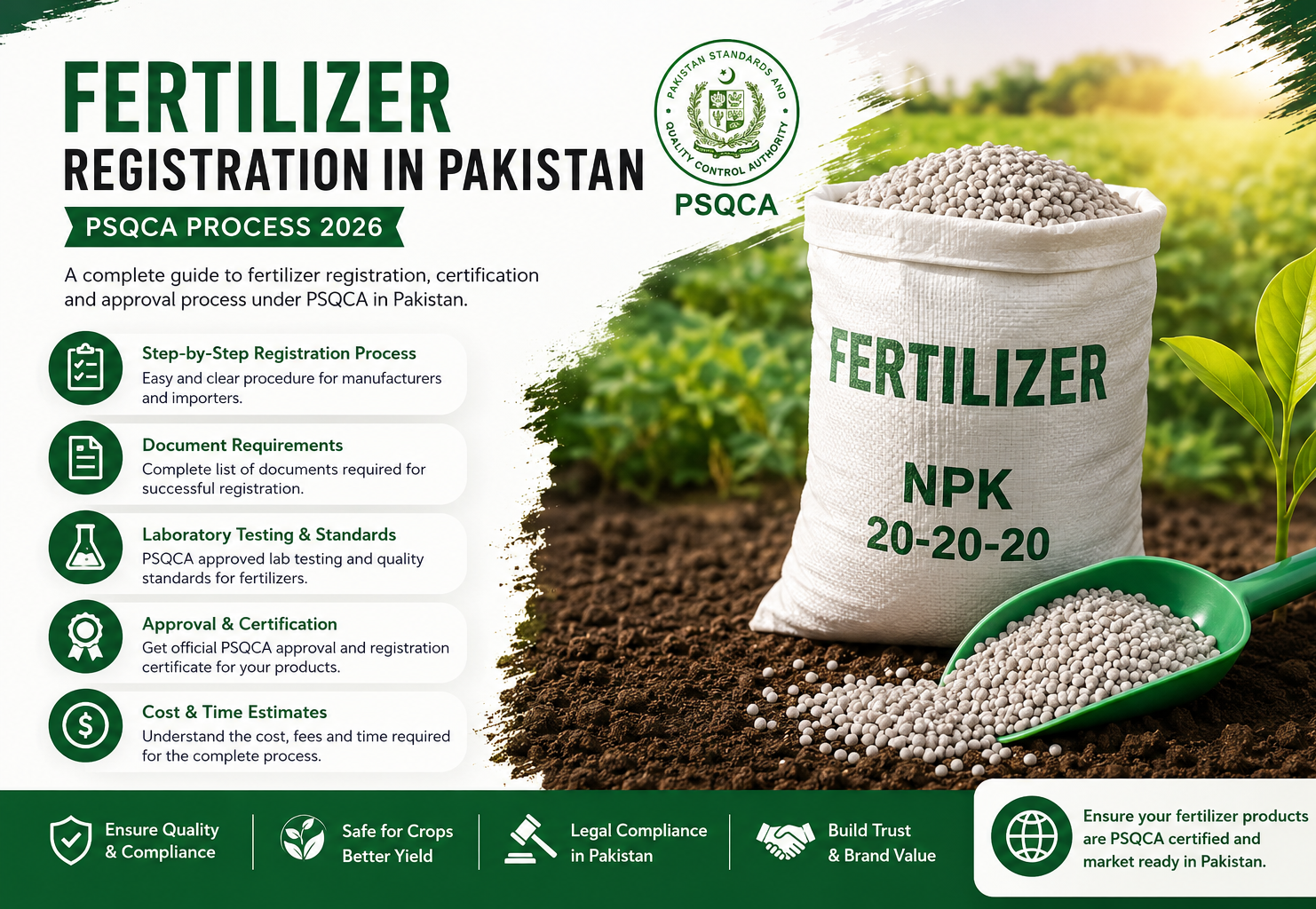
Introduction
Agriculture remains the backbone of Pakistan’s economy, contributing significantly to employment, exports, and food security. As the country’s agricultural sector continues to modernize, the demand for high-quality fertilizers has increased dramatically. Farmers rely on fertilizers to improve crop yield, enhance soil fertility, and meet the growing food requirements of an expanding population.
However, before any fertilizer can be manufactured, imported, distributed, or sold in Pakistan, it must comply with the country’s regulatory framework. Fertilizer registration is a legal requirement designed to ensure that products meet national quality standards, are safe for agricultural use, and provide the nutrients claimed by the manufacturer.
Whether you are a fertilizer manufacturer, importer, distributor, or entrepreneur planning to enter Pakistan’s agricultural market, understanding the registration process is essential for avoiding legal complications and ensuring smooth business operations.
This comprehensive guide explains everything you need to know about fertilizer registration in Pakistan in 2026, including regulatory authorities, eligibility requirements, documentation, testing procedures, approval timelines, common challenges, and how PakCEC (Connect Engineers & Consultants) can help simplify the entire process.
What Is Fertilizer Registration?
Fertilizer registration is the official approval process that authorizes a fertilizer product to be manufactured, imported, marketed, distributed, and sold in Pakistan.
The registration process verifies that:
- The fertilizer contains the nutrients stated on its label.
- The product complies with national quality standards.
- It is safe for agricultural use.
- Packaging and labeling meet regulatory requirements.
- Manufacturers and importers follow applicable laws and regulations.
Without proper registration, fertilizers cannot be legally introduced into the Pakistani market.
Why Is Fertilizer Registration Important?
Registering fertilizers provides several important benefits for businesses and farmers alike.
Ensures Product Quality
Registration ensures fertilizers contain the nutrients promised by the manufacturer.
Protects Farmers
Low-quality fertilizers can damage crops and reduce agricultural productivity.
Legal Compliance
Registered products comply with government regulations, helping businesses avoid penalties, product seizures, or legal action.
Market Access
Many distributors, agricultural organizations, and government procurement programs only purchase registered fertilizer products.
Builds Customer Trust
Registration demonstrates product quality and enhances credibility among farmers and distributors.
Regulatory Authorities Responsible for Fertilizer Registration
Fertilizer regulation in Pakistan involves several government departments depending on the product category and intended use.
These may include:
- Ministry of National Food Security & Research (MNFSR)
- Department of Plant Protection (where applicable)
- Provincial Agriculture Departments
- Accredited Testing Laboratories
- Customs Authorities (for imported fertilizers)
The exact approval pathway depends on the fertilizer type, formulation, and intended application.
Types of Fertilizers That Require Registration
Most commercial fertilizer products require registration before being sold.
These include:
Chemical Fertilizers
- Urea
- DAP
- NPK
- SSP
- TSP
- CAN
Organic Fertilizers
- Compost
- Vermicompost
- Organic manure
- Bio-organic fertilizers
Bio Fertilizers
Products containing beneficial microorganisms that improve nutrient availability.
Micronutrient Fertilizers
Products containing:
- Zinc
- Boron
- Iron
- Copper
- Magnesium
- Manganese
Liquid Fertilizers
Liquid nutrient solutions for foliar and irrigation applications.
Specialty Fertilizers
- Controlled-release fertilizers
- Water-soluble fertilizers
- Customized nutrient blends
Who Needs Fertilizer Registration?
Registration is required for:
- Fertilizer manufacturers
- Importers
- Private label companies
- Agricultural chemical suppliers
- Distributors introducing new fertilizer brands
- International fertilizer companies entering Pakistan
Eligibility Criteria
Applicants should generally meet the following requirements:
- Registered business entity
- Valid NTN
- Sales Tax Registration (if applicable)
- Import documentation (for imported products)
- Manufacturing facility information
- Product composition details
- Laboratory analysis reports
Documents Required
Although requirements may vary depending on the product, applicants are commonly asked to provide:
- Company registration certificate
- NTN certificate
- Sales Tax Registration
- Product formulation
- Product specifications
- Certificate of Analysis (COA)
- Safety Data Sheet (SDS/MSDS)
- Manufacturing process details
- Product labels
- Packaging artwork
- Import documents (for imported products)
- Authorization letter (for foreign manufacturers)
- Laboratory test reports
- Product application form
Submitting complete and accurate documentation helps avoid unnecessary delays.
Step-by-Step Fertilizer Registration Process
Step 1: Product Evaluation
Determine whether the fertilizer falls under existing regulations and identify the applicable registration category.
Step 2: Prepare Documentation
Compile all required technical, legal, and business documents.
Step 3: Laboratory Testing
Samples are submitted to approved laboratories to verify:
- Nutrient composition
- Purity
- Heavy metal limits
- Physical characteristics
- Moisture content
Testing ensures the product matches its declared specifications.
Step 4: Application Submission
The registration application is submitted along with supporting documents and laboratory reports.
Step 5: Technical Review
Regulatory experts evaluate:
- Product composition
- Manufacturing process
- Safety
- Effectiveness
- Label compliance
Step 6: Additional Clarifications (if required)
Authorities may request additional documents or product information.
Step 7: Approval
Once all requirements are met, the fertilizer receives registration approval, allowing it to be legally marketed in Pakistan.
Common Reasons for Registration Delays
Many applications experience delays due to avoidable mistakes such as:
- Missing documents
- Incorrect product labels
- Incomplete formulations
- Laboratory reports from unapproved facilities
- Mismatched nutrient values
- Packaging errors
- Poor document formatting
Working with experienced consultants significantly reduces these risks.
Fertilizer Labeling Requirements
Proper labeling is an essential part of compliance.
A fertilizer label should clearly include:
- Product name
- Brand name
- Nutrient composition
- Net weight
- Manufacturing date
- Batch number
- Expiry (where applicable)
- Manufacturer information
- Importer details (if applicable)
- Storage instructions
- Safety precautions
- Directions for use
Labels must accurately reflect the approved product formulation.
Quality Testing Requirements
Authorities may require testing for:
- Nitrogen content
- Phosphorus
- Potassium
- Micronutrients
- Organic matter
- pH value
- Moisture percentage
- Heavy metals
- Solubility
- Physical appearance
Accurate testing is essential for successful registration.
Benefits of Registering Fertilizers
Registered products enjoy several advantages:
- Legal market access
- Improved brand reputation
- Increased customer confidence
- Easier distribution
- Government procurement eligibility
- Export opportunities
- Reduced legal risks
Common Challenges Businesses Face
Many companies struggle with:
- Understanding regulatory requirements
- Preparing technical documentation
- Product testing coordination
- Label approval
- Import documentation
- Responding to regulatory queries
- Tracking application progress
Professional guidance can simplify the process and reduce approval times.
Why Choose PakCEC?
PakCEC (Connect Engineers & Consultants) is one of Pakistan’s trusted consultancy firms for regulatory approvals and compliance services. With extensive experience in industrial licensing and certification, PakCEC supports fertilizer manufacturers, importers, and distributors throughout the registration process.
Our services include:
- Eligibility assessment
- Complete documentation support
- Application preparation
- Coordination with accredited laboratories
- Regulatory submission
- Compliance review
- Label verification
- Follow-up with authorities
- Approval assistance
Our team works to ensure a smooth, efficient, and compliant registration experience.
Frequently Asked Questions
Is fertilizer registration mandatory in Pakistan?
Yes. Commercial fertilizers generally require registration before they can be legally manufactured, imported, or sold.
Can imported fertilizers be registered?
Yes. Imported fertilizer products can be registered, provided they meet regulatory requirements and are supported by the necessary documentation.
How long does the registration process take?
Processing time varies depending on the completeness of the application, laboratory testing, and regulatory review.
Are laboratory tests mandatory?
Yes. Product testing is typically required to verify composition and compliance with quality standards.
Can PakCEC assist with the complete process?
Yes. PakCEC provides end-to-end consultancy services, including documentation, application preparation, laboratory coordination, and regulatory support.
Conclusion
Fertilizer registration is a critical step for businesses looking to manufacture, import, or distribute fertilizer products in Pakistan. Compliance not only fulfills legal obligations but also builds trust among farmers, distributors, and regulatory authorities.
By preparing accurate documentation, completing required testing, and following the proper approval process, businesses can enter the market with confidence and establish a strong reputation for quality and reliability.
If you’re planning to launch a fertilizer product in Pakistan, partnering with experienced consultants can save valuable time and help avoid costly delays.
Contact PakCEC Today
Ready to register your fertilizer product in Pakistan?
PakCEC (Connect Engineers & Consultants) offers comprehensive support for fertilizer registration, regulatory approvals, laboratory coordination, and compliance. Contact our team today to streamline your registration process and bring your products to market with confidence.
