

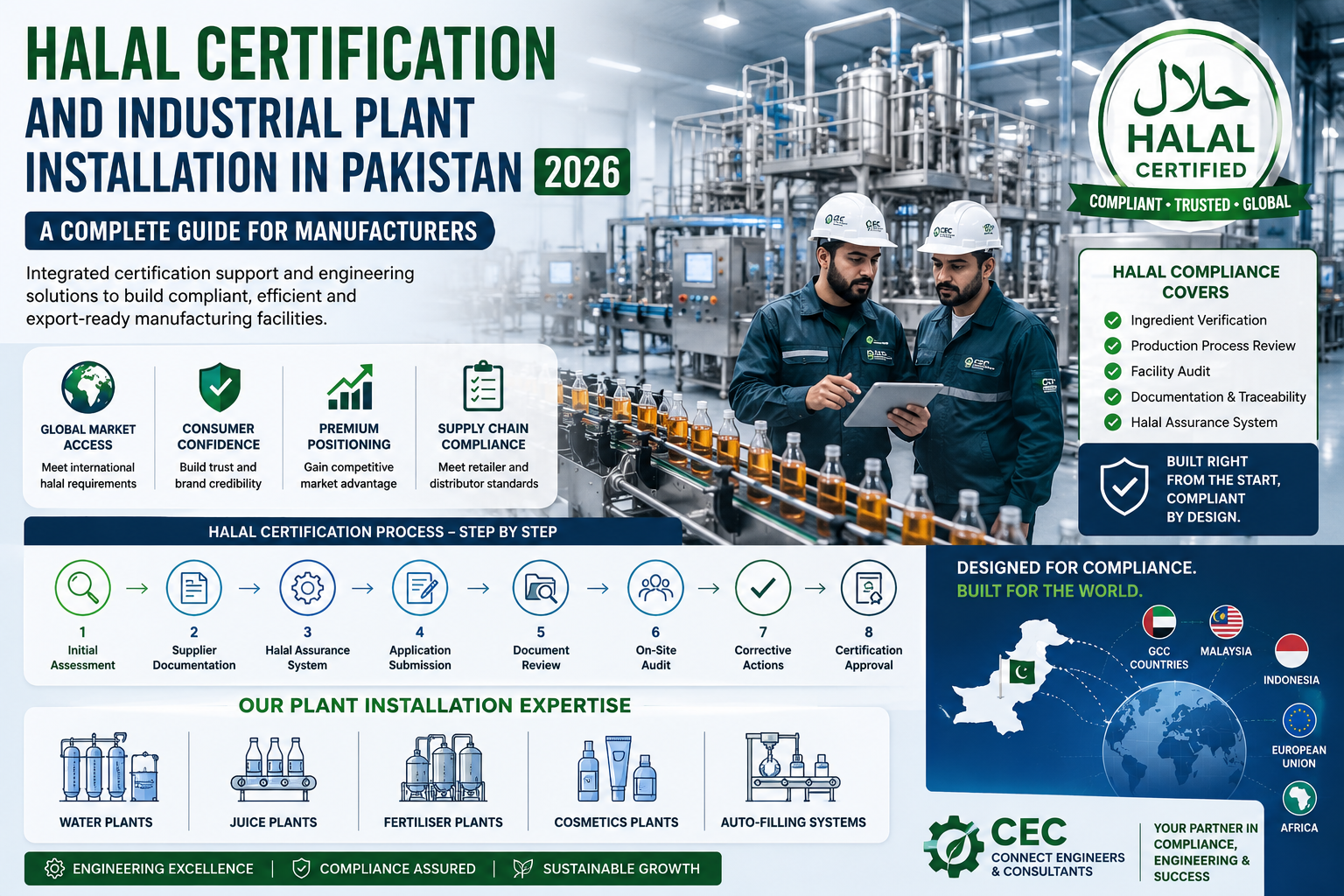
For manufacturers in Pakistan’s food, beverage, pharmaceutical, and consumer goods sectors, two of the most consequential decisions affecting market access and operational success are securing proper Halal certification and ensuring industrial production facilities are designed, equipped, and installed to meet both regulatory requirements and operational efficiency standards. These two areas certification compliance and physical plant infrastructure are deeply interconnected, since Halal certification audits frequently examine the very production processes, equipment, and facility design that engineering plant installation establishes from day one.
At Connect Engineers and Consultants (CEC), we offer a unique combination of services that few consultancies can match: comprehensive Halal certification support alongside hands-on engineering expertise in designing and installing water plants, juice plants, fertilizer plants, cosmetics plants, and auto-filling systems. This integrated approach ensures that facilities are built right from the start compliant, efficient, and certification-ready. This guide covers everything manufacturers need to know about both areas in 2026.
Why Halal Certification Matters More Than Ever
Halal certification has evolved from a niche religious compliance requirement into a major global market access credential. The global halal market spans food and beverages, pharmaceuticals, cosmetics, and personal care products, with significant demand not only across Muslim-majority countries in the Middle East, Southeast Asia, and Africa, but increasingly in Western markets where halal products are recognized for high standards of hygiene, traceability, and ethical sourcing.
For Pakistani manufacturers, Halal certification delivers several critical benefits:
- Export Market Access: Many countries, particularly in the Gulf Cooperation Council (GCC) region, Malaysia, Indonesia, and increasingly the European Union, require halal certification for food, beverage, and pharmaceutical imports.
- Domestic Market Confidence: With growing consumer awareness, halal certification on packaging builds trust with domestic consumers, particularly for processed foods, beverages, and pharmaceutical products where ingredient sourcing transparency matters.
- Supply Chain Requirements: Many large retailers, food service companies, and distributors both domestically and internationally increasingly require halal certification as a condition of supplier inclusion.
- Premium Positioning: Halal-certified products often command premium pricing and preferential shelf placement in key export markets.
Understanding the Halal Certification Process
Halal certification verifies that a product, and the entire process by which it is produced, complies with Islamic dietary and ethical laws. This goes far beyond simply avoiding pork and alcohol it encompasses ingredient sourcing, processing methods, equipment cleaning and dedication (avoiding cross-contamination with non-halal substances), packaging materials, and storage and transportation practices.
Key Components of Halal Certification
- Ingredient Verification: Every ingredient used in production including additives, flavorings, processing aids, and packaging materials that contact the product must be verified as halal-compliant, with documentation tracing back to source suppliers.
- Production Process Review: The certification body examines the entire production process, including equipment used, cleaning procedures between production runs (particularly important for facilities that may also process non-halal products), and any risk of cross-contamination.
- Facility Audit: An on-site audit assesses the physical facility, equipment, storage areas, and overall hygiene and segregation practices to verify compliance with halal requirements.
- Documentation and Traceability Systems: Manufacturers must maintain documentation systems that allow full traceability of ingredients and production batches essential both for certification maintenance and for responding to any compliance queries from certification bodies or export market authorities.
- Halal Assurance System (HAS): Many certification schemes require manufacturers to implement an internal Halal Assurance System an internal management system (similar in structure to ISO management systems) that ensures ongoing compliance is maintained between certification audits, not just at the time of the audit itself.
Step-by-Step Halal Certification Process
- Initial Assessment: Evaluate your current production processes, ingredient sourcing, and facility setup against halal certification requirements to identify any gaps that need to be addressed before applying.
- Supplier Documentation Collection:Gather halal certificates or compliance declarations from all ingredient and packaging material suppliers, building a complete traceability chain.
- Halal Assurance System Development: Develop and document an internal Halal Assurance System covering ingredient approval procedures, production controls, cleaning and segregation protocols, and internal audit processes.
- Application Submission: Submit a formal application to the chosen halal certification body, including product information, ingredient lists, supplier documentation, and facility details.
- Document Review: The certification body reviews submitted documentation to verify completeness and identify any areas requiring clarification or additional information.
- On-Site Audit: Certification body auditors conduct an on-site facility audit, examining production areas, storage facilities, equipment, cleaning practices, and staff understanding of halal procedures.
- Addressing Non-Conformities: If the audit identifies any non-conformities, the manufacturer must implement corrective actions and provide evidence of resolution before certification can be issued.
- Certificate Issuance: Upon successful completion of the audit and resolution of any non-conformities, the halal certificate is issued, typically valid for a defined period subject to surveillance audits.
- Ongoing Surveillance: Certification bodies conduct periodic surveillance audits to verify continued compliance throughout the certification period.
Halal Certification Challenges for Manufacturers
- Mixed-Use Facilities: Manufacturers who produce both halal and non-halal products in the same facility face significant challenges in demonstrating adequate segregation, dedicated equipment or thorough cleaning validation between production runs, and preventing cross-contamination.
- Complex Supply Chains: Products with many ingredients particularly processed foods with numerous additives, flavorings, and processing aids require extensive supplier documentation that can be time-consuming to collect, especially from international suppliers.
- Imported Ingredients: Ingredients sourced from international suppliers may have halal certificates from certification bodies that are not recognized by the certification body or target export market your business is working with, requiring additional verification or alternative sourcing.
- Maintaining Compliance Between Audits: Without a properly implemented Halal Assurance System, facilities can drift out of compliance between audits using a new supplier without verification, introducing a new ingredient without checking halal status, or allowing cleaning protocols to lapse creating risk of non-conformities at the next surveillance audit.
Industrial Plant Installation: Building Facilities Right from the Start
For manufacturers establishing new production facilities or expanding existing operations, the design and installation of production plants directly shapes both operational efficiency and regulatory compliance including halal certification readiness, where applicable. CEC’s engineering solutions team provides design, supply, and installation services for several categories of industrial plants.
Water Plant Installation
Mineral water and packaged drinking water production facilities require carefully designed treatment systems including filtration, reverse osmosis, UV sterilization, and ozonation systems to meet both quality standards and PSQCA (Pakistan Standards and Quality Control Authority) certification requirements for packaged water products. Proper plant design also considers bottle washing, filling, capping, and labeling line integration for efficient end-to-end production.
Juice Plant Installation
Fruit juice and beverage production plants involve specialized equipment for fruit washing, pulping, pasteurization, and aseptic or hot-fill packaging systems. For manufacturers pursuing halal certification, juice plant design must carefully consider any flavoring agents, preservatives, or processing aids used, ensuring these are halal-verified and that equipment cleaning protocols prevent cross-contamination if the facility also processes other product lines.
Fertilizer Plant Installation
Fertilizer production facilities involve complex chemical processing equipment, and plant installation must address not only production efficiency but also environmental compliance often requiring ISO 14001 environmental management system implementation alongside the physical plant setup, as well as coordination with relevant environmental regulatory approvals.
Cosmetics Plant Installation
Cosmetics manufacturing facilities require equipment for mixing, emulsification, filling, and packaging of creams, lotions, and other personal care products. For manufacturers targeting halal-certified cosmetics an increasingly significant export category facility design must address ingredient segregation and equipment dedication considerations similar to food production facilities.
Auto-Filling Systems and Vinegar Plant Installation
Automated filling systems improve production efficiency and consistency across multiple product categories, while vinegar plant installation involves specialized fermentation, filtration, and bottling equipment tailored to the specific production process for vinegar and related condiment products.
The Integrated Advantage: Why Plant Design and Certification Compliance Should Go Together
One of the most costly mistakes manufacturers make is treating facility design and certification compliance whether Halal, ISO, or PSQCA as separate, sequential processes. A plant designed without certification requirements in mind often requires expensive retrofitting: adding segregation walls, replacing equipment that cannot be adequately cleaned or dedicated, redesigning material flow to prevent cross-contamination, or adding documentation and traceability systems after the fact.
By contrast, when plant design and certification compliance planning happen together from the outset, facilities can be designed with appropriate segregation, equipment selection that supports required cleaning and validation protocols, and material flow designs that naturally support traceability documentation avoiding costly retrofits and accelerating the path to certification once the facility becomes operational.
How CEC Provides End-to-End Support
Connect Engineers and Consultants brings together our business consultancy expertise and our engineering solutions capabilities to provide manufacturers with truly integrated support:
- Halal Certification Consultancy: We guide manufacturers through the complete halal certification process, including supplier documentation collection, Halal Assurance System development, and certification body liaison.
- Plant Design with Compliance in Mind: Our engineering team designs water, juice, fertilizer, cosmetics, and other production plants with certification requirements halal, ISO, PSQCA integrated into the design from the start.
- Equipment Supply and Installation: We supply and install production equipment suited to your specific product lines and certification objectives, from filtration and filling systems to processing and packaging lines.
- Multi-Certification Coordination: For manufacturers pursuing multiple certifications halal, ISO 9001, ISO 22000, PSQCA we coordinate the various requirements to avoid duplication of effort and ensure all certification needs are addressed cohesively.
- PSQCA Product Certification: For products requiring Pakistan Standards and Quality Control Authority certification, we provide complete support through the PSQCA certification process alongside other regulatory requirements.
Positioning Your Manufacturing Business for 2026 and Beyond
As global demand for halal-certified products continues to grow and as Pakistan’s manufacturing sector increasingly targets export markets across the Middle East, Southeast Asia, and beyond, manufacturers who invest in both proper facility design and comprehensive certification compliance position themselves to access these growing markets. Conversely, manufacturers who treat certification as an afterthought often find themselves facing costly facility modifications, delayed market entry, and lost opportunities with buyers who require certification as a baseline requirement.
Whether you are establishing a new production facility, expanding existing operations, or working to achieve halal or other certifications for an existing facility, the combination of experienced engineering plant design and certification consultancy expertise can significantly streamline your path to a compliant, efficient, and export-ready operation.
Get Started with CEC Today
Connect Engineers and Consultants offers manufacturers across Pakistan a unique combination of regulatory consultancy and hands-on engineering expertise. Whether your priority is achieving halal certification for an existing facility, designing and installing a new production plant with compliance built in from the start, or navigating multiple certification requirements simultaneously, our team is ready to support your business.
Contact CEC today to discuss your halal certification needs, your industrial plant installation project, or both and discover how an integrated approach can accelerate your path to compliant, efficient, market-ready production.

[…] If you are registered with PSEB as an IT or IT-enabled services company, ISO 27001 also strengthens your profile with foreign buyers. See our PSEB registration guide. […]