

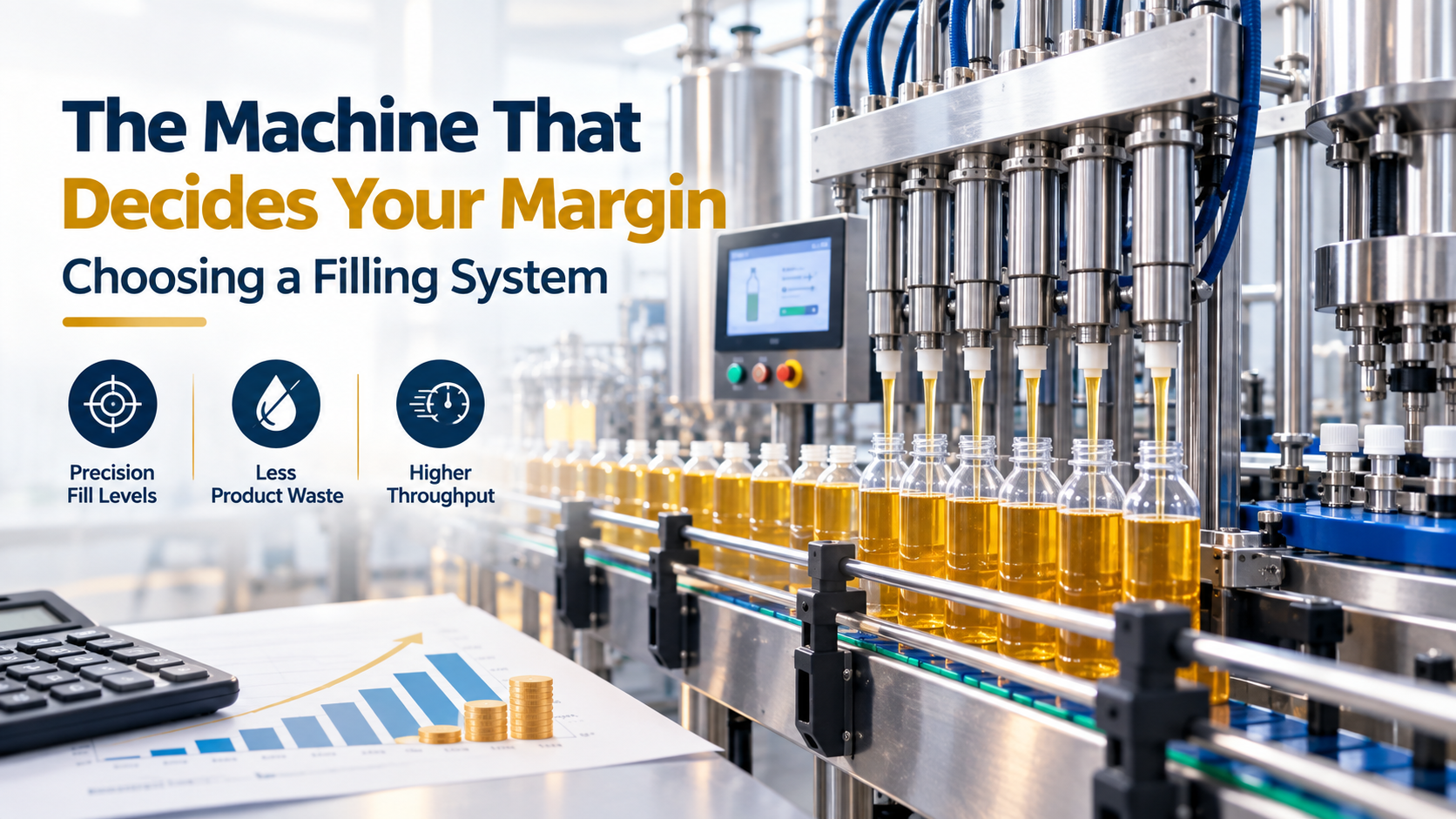
Every machine in your plant affects your costs. Only one of them affects your margin on every single unit you will ever sell.
If your filler runs two percent over target, you are giving away two percent of your product. Not once. On every pack, every shift, for the life of the line. Nobody notices, because a slightly generous bottle looks like a normal bottle, and the loss never appears as a line item anywhere.
The industry has a word for it. Giveaway, meaning product you put into a pack beyond the quantity you declared and were paid for.
This guide starts with that number and works backwards to the machine.
The arithmetic nobody runs before buying
Take a product you sell in a one litre pack. Set your filler to average one point zero two litres, which is a modest and extremely common safety margin.
You have now built a permanent two percent discount into your cost of goods. At ten thousand units a day, you are producing the equivalent of two hundred free units daily. Over a year that is a material number in any currency, and it is money that never appears in a management account because it left as product rather than as cash.
Now run it the other way. Tighten the average to one point zero zero five and you have recovered most of that, provided your machine can actually hold that tolerance. That is the entire commercial case for a better filler, and it is the case that almost never gets made in a quotation, because quotations compare speed and price.
Two things make this real rather than theoretical.
The saving is permanent. Unlike most efficiency gains, it does not decay.
It scales with product value. On bottled water the percentage matters less in absolute terms. On a cosmetic serum, an essential oil or a concentrated product, the same percentage is a significant sum.
But underfilling is not a saving
Before anyone reaches for the adjustment, the other side.
The quantity on your label is a declaration. Underfilling is not thrift, it is a failure to deliver the declared contents, and in regulated markets it is treated as misbranding and attracts enforcement rather than a warning.
So your target is not the lowest possible fill. It is the tightest possible distribution around the declared quantity. Every serious filling decision follows from that sentence.
Giveaway is a variability problem before it is a setting problem. A machine with wide scatter must be set high, because the low tail has to stay above your declared quantity. A machine with tight scatter can sit close to target. Buying accuracy is buying the right to run closer to the line.
Four ways a machine decides how much to put in
Fillers differ in what they actually measure, and that distinction decides what they can and cannot guarantee.
| Type | What it measures | Strength | Weakness |
|---|---|---|---|
| Gravity or timed flow | Time, at an assumed flow rate | Simplest and cheapest | Least accurate. Anything that changes flow changes the fill |
| Overflow or level fill | Liquid level in the container | Every bottle looks identical on shelf | Volume varies with container variation. Cannot report mass |
| Piston or pump | A displaced volume per cycle | Good volumetric repeatability, handles thicker products | Still volume, so weight drifts when density moves |
| Net weight or gravimetric | The mass in the container, on a load cell | The most accurate, reported at around a tenth of a percent, and independent of density, viscosity and foam | Slower, since load cells need settling time, and more expensive |
The line to understand in that table is the last one in the second column.
Only gravimetric filling measures mass. Mass is what most labels declare. Every other family measures something correlated with mass and assumes the relationship holds. When density shifts, because of temperature, batch variation or formulation change, that assumption quietly stops being true and your declared quantity drifts with it.
This is also why net weight filling is the only one of the four that international legal metrology has a dedicated recommendation for, covering automatic gravimetric filling instruments that fill containers to a predetermined mass from bulk.
The trade nobody warns you about: looking right versus being right
Here is a genuine tension rather than a right answer.
A row of clear bottles with the liquid at exactly the same height reads as quality. A row where the levels sit slightly differently reads as a defect to a customer, even when every bottle contains the declared quantity or more.
Level filling gives you the first. Weight filling gives you the second. They are not the same goal, and in clear packaging they can actively conflict, because containers themselves vary and a constant level in a varying container is a varying volume.
How to resolve it:
Clear pack, appearance sensitive, stable low viscosity product. Level filling is often correct, and the fill line consistency has real commercial value.
Opaque pack, or high value product, or variable density. Weight filling, because nobody sees the level and the quantity is where the money is.
Both concerns at once. Level fill for appearance and verify quantity downstream, which brings us to the next point.
The checkweigher question
A volumetric or level filler cannot tell you the mass it just dispensed. So plants that declare net contents commonly place a checkweigher after the capper, catching under and over filled packs before they are labelled.
That is a legitimate design and it is widely used. Understand what it is, though. It is a detection step, not a correction step. It finds the problem after you have made it, and every rejected pack is product and packaging already consumed.
The design question is therefore where you want to spend. Accuracy at the filler costs more capital and less product. Detection after the filler costs less capital and more rejects. Neither is wrong, and the right answer depends on your product value and your volume.
What is not acceptable is having neither. A line that declares a net quantity, fills by level, and never weighs anything is running on faith.
What your product decides for you
Some of this is not a choice.
Foaming products defeat level sensing and confuse timed flow. Weight filling is largely indifferent to foam, which is one of its strongest practical arguments.
High viscosity products such as creams, gels and pastes need piston filling or weight filling. Gravity and overflow do not move thick product usefully.
Variable density products, including anything where temperature or batch composition moves, are the clearest case for weight filling, because volume and mass stop tracking each other.
Particulates and pulp need nozzle and valve geometry that will pass them without blocking or shearing.
Hot fill products need equipment rated for temperature and containers designed for it.
Aseptic products need the filling environment itself controlled, which is a different class of machine entirely.
This is why the filler cannot be specified before the product range is settled, a point we make in our guides to juice plant installation and cosmetics plant installation for exactly this reason.
Changeover, the cost that decides your real capacity
Rated speed is what suppliers sell. Actual output is rated speed multiplied by how much of the day the machine is running.
On a single product line, changeover barely matters. On a line running several products, several pack sizes or several container shapes, it becomes the dominant factor in real capacity, and it is almost never quantified in a proposal.
Ask specifically:
- How long to change from product A to product B, including cleaning
- What change parts are needed for each container, and are they included
- Is the changeover tool free or does it need a technician
- Can recipes be stored and recalled, or is every change a manual reset
A faster machine with a three hour changeover can produce less in a week than a slower machine with a twenty minute one. Work out your real weekly output before comparing headline speeds.
Keeping it accurate after commissioning
A filler is accurate on the day it is commissioned. Whether it is accurate in month eight is a procedural question.
Weigh samples and record them. The standard verification method is gravimetric: weigh filled containers on a calibrated balance and convert to volume using product density. It works regardless of how the machine itself meters.
Sample on a schedule, not on suspicion. End of shift checks, with the results written down, so drift is visible as a trend rather than discovered as a complaint.
Calibrate the instruments the machine depends on. Balances, flow meters, load cells, pressure sensors. A machine measuring accurately against a drifting sensor is measuring nothing.
Requalify after changes. New product, new container, major maintenance. Each one invalidates your previous verification.
Own the records. Fill weight data is evidence that you delivered what you declared, and it is exactly the kind of record an inspection examines. This is why we treat lab equipment specification as part of line design, and why PSQCA product certification files are easier when the verification routine already exists.
Where turnkey projects fracture
We have said this in every plant guide we publish and it belongs here most of all.
Processing and filling are frequently quoted by different suppliers. Processing ends at the treated product tank. Filling starts at the filler infeed. Between them sits a transfer that somebody has to own: pumping, buffering, temperature holding, and the control logic that stops the filler when the tank runs low and stops the tank when the filler stops.
When that interface has no owner, commissioning becomes a dispute. Each supplier has delivered what they quoted and the line does not run.
Establish the boundary in writing before either contract is signed. If one supplier owns both, say so. If two do, name who owns the interface and make it somebody’s deliverable. Our auto filling systems work exists partly because so many plants arrive at us with exactly this gap, whether the upstream side is water plant installation, juice, or vinegar plant installation.
The rest of the line, which is where the delays come from
A filler rarely arrives alone, and the machines around it decide whether it ever reaches its rated speed.
Container handling in. Unscrambler, air conveyor or manual loading. A filler starved of containers runs at the speed of whoever is loading it.
Rinsing. Many lines rinse containers immediately before filling. On a monobloc this is combined with filling and capping in one frame, which saves space and removes two transfers.
Capping or sealing. Screw capping, induction sealing, crimping. Torque control matters more than people expect, because an under torqued cap leaks and an over torqued one cracks, and both are discovered by customers rather than by you.
Conveying and accumulation. Buffer between stages so a brief stop downstream does not halt the filler. Lines with no accumulation stop as a unit, and a thirty second cap jam becomes a thirty second whole line stop.
Labelling and coding. Batch and date coding is usually a regulatory requirement rather than a preference, and a coder that stops takes the line with it.
The pattern across all of them is the same. The filler is rarely the bottleneck people expect it to be. The bottleneck is whichever machine around it has the least capacity or the most frequent stoppages, and a line specified as a set of separately chosen machines tends to discover this only after commissioning.
Ask any supplier quoting a full line which machine they expect to be the constraint, and what happens to the others when it stops. A supplier who has thought about the line rather than the machines will answer immediately.
What to ask before you sign
What accuracy does this hold, on my product, at my speed? Not a laboratory figure on water. Yours.
Does it measure volume or mass, and what does my label declare? If those two answers do not match, ask how the gap is covered.
What happens when my product density changes?
What is the changeover time between my products and my container sizes?
What change parts are included, and what are extra?
How is accuracy verified in routine operation, and does the machine record it?
Where does your scope start and end, and who owns the transfer from processing?
What is the lead time on spares, and from where? A filler waiting two months for a part is a plant not producing.
Where PakCEC fits
PakCEC designs, installs and commissions turnkey plants across water, juice, vinegar, cosmetics and process industries, including the filling end rather than stopping at the product tank. We also handle the certification and licensing work those plants sit inside.
For filling specifically, the useful thing we bring is that we think about the declared quantity on your label and the machine that delivers it as one problem. Those are usually two different conversations with two different suppliers, and the gap between them is where money leaks.
Twenty years, more than 3,000 completed registrations and certifications, and a preference for telling clients what they do not need. If a simpler filler suits your product and your volume, we will say so.
Tell us your product, your pack sizes and your declared quantities. See our full engineering solutions in Pakistan range, or talk to the PakCEC team.
