

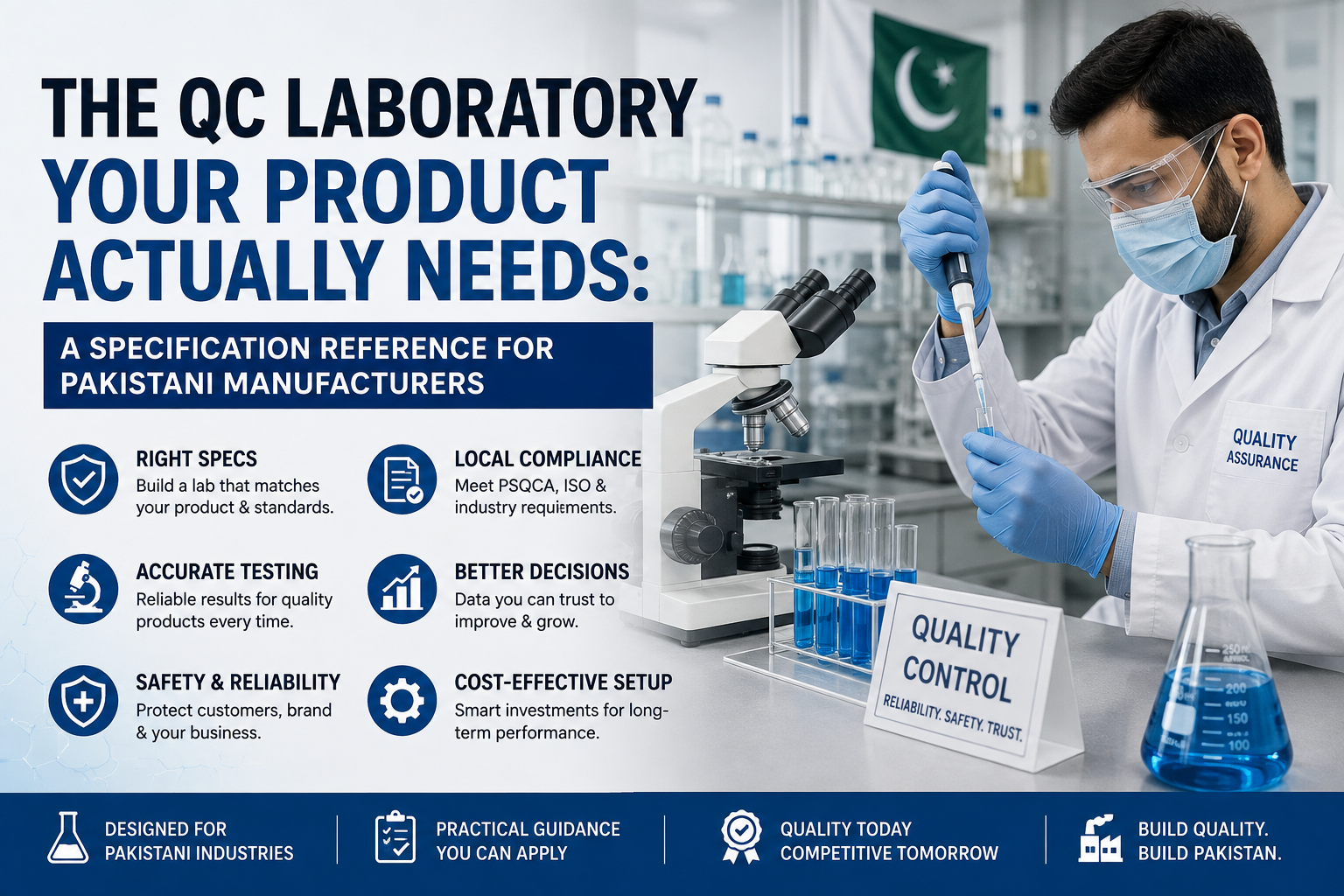
Most quality control laboratories in Pakistani factories were specified by whoever had budget left at the end of the build. That is why so many of them have an expensive instrument nobody is trained on, and no reliable way to run the one test their licence actually depends on.
This is a reference rather than an argument. Find your product category, read what the parameters demand, and check it against whatever you were quoted. PakCEC specifies and supplies laboratory setups alongside plant installation, and the lists below reflect what inspections and licence files actually ask for rather than what looks impressive on a bench.
First, the distinction that decides everything
Two different things get called a laboratory, and confusing them is the most expensive mistake in this whole area.
| In house QC laboratory | Accredited testing laboratory | |
|---|---|---|
| Purpose | Control your own production, batch by batch | Issue test reports others rely on |
| Who it serves | You | Third parties, regulators, customers |
| Standard it runs against | Your product standard and internal limits | ISO/IEC 17025, assessed by PNAC |
| What it needs | Right instruments, trained staff, calibration, records | All of that plus a documented management system, method validation, proficiency testing |
| Typical build time | Weeks | Many months |
Almost every manufacturer needs the first. Very few need the second. Businesses that confuse them either overbuild and stall, or underbuild and discover at inspection that their records will not hold.
The practical middle path is common and perfectly legitimate. Run a competent in house laboratory for routine control, and send the parameters you cannot reliably do yourself to an accredited laboratory on a named, documented arrangement. What matters at inspection is that the arrangement exists in writing and is actually used.
Lookup: bottled drinking water
Your product sits under a national bottled water standard and is legally categorised as a food. Both facts shape the bench.
| Parameter | Why it earns bench space | Instrument |
|---|---|---|
| pH | Standard limit and product consistency | pH meter with traceable buffers |
| TDS and conductivity | Membrane performance and product consistency | Conductivity and TDS meter |
| Turbidity | Earliest indicator that filtration is drifting | Nephelometric turbidity meter |
| Hardness, alkalinity, chlorides | Feed control and standard limits | Titration bench, burettes, reagents |
| Sodium and potassium | Repeatedly a failure parameter in national bottled water monitoring | Flame photometer |
| Arsenic and heavy metals | Documented failure parameter with health consequences | Atomic absorption spectrophotometer, or an accredited laboratory on retainer |
| Total coliform, E. coli, plate count | The parameters that close a plant rather than fine it | Membrane filtration set, incubator, autoclave, colony counter |
Sodium and arsenic deserve emphasis. National quarterly monitoring samples bottled brands from the open market, and in one widely reported round covering 176 samples across 20 cities, 28 brands were flagged. Sodium above permissible limits and arsenic were among the recurring reasons. Both are controllable at plant level. Neither is visible without testing.
Lookup: food and beverage
Juice, dairy, sauces, packaged foods. The parameter set widens because composition claims on the label become testable assertions.
| Parameter | Why it earns bench space | Instrument |
|---|---|---|
| Soluble solids, degrees Brix | Batch consistency and product identity | Refractometer |
| Titratable acidity and pH | Stability, shelf life, taste | pH meter and titration bench |
| Moisture | Shelf life, weight declarations, caking | Moisture balance or drying oven |
| Ash content | Composition verification | Muffle furnace |
| Fat content | Label claims | Soxhlet extraction apparatus |
| Protein content | Label claims | Kjeldahl digestion and distillation assembly |
| Microbiological limits | Safety and shelf life | Incubator, autoclave, laminar flow cabinet |
If you make a nutrition claim on a label, plan to be able to test it. Provincial food authorities sample at the point of sale, and a claim you cannot substantiate is a slower problem than a contamination finding but a more embarrassing one.
Lookup: fertiliser
Grade claims are the whole product here. A bag marked with an NPK ratio is a testable promise, and disputes over nitrogen content are common enough that the capability pays for itself.
| Parameter | Why it earns bench space | Instrument |
|---|---|---|
| Nitrogen | The most disputed grade parameter in the sector | Kjeldahl assembly |
| Phosphorus as P2O5 | Grade claim | UV visible spectrophotometer |
| Potassium as K2O | Grade claim | Flame photometer |
| Moisture | Caking, storage life, delivered weight | Moisture balance or oven |
| Particle size distribution | Spreading behaviour and blend uniformity | Sieve shaker with graded sieve set |
| pH in solution | Compatibility and application safety | pH meter |
Blending operations need particle sizing more than they expect. Uneven granule size causes segregation in transit, so a blend that was correct at the plant arrives at the field as three separate products. PakCEC builds quality control benches into fertiliser plant installation projects for exactly this reason.
Lookup: cosmetics and personal care
Smaller instrument list, heavier microbiological load, and the tightest tolerance for getting it wrong because the product goes onto skin.
| Parameter | Why it earns bench space | Instrument |
|---|---|---|
| pH | Skin safety and formulation stability | pH meter |
| Viscosity | Batch to batch consistency, and the thing customers notice first | Viscometer |
| Fill weight and volume | Label accuracy | Analytical balance |
| Heavy metals | Regulatory limits on pigments and raw materials | Atomic absorption spectrophotometer, or outsourced |
| Microbial limits and preservative efficacy | Safety and shelf life | Incubator, laminar flow cabinet, autoclave |
Preservative efficacy testing is the one most small manufacturers skip. It is also the one that determines whether your product is still safe in month nine.
The shared bench, whatever you make
Every category above assumes this exists underneath it. Quoting the category instruments without the shared bench produces a laboratory that cannot actually run a test start to finish.
- Analytical balance with appropriate readability, on a stable surface away from air movement
- Volumetric glassware, pipettes, and a glassware washing and drying arrangement
- Hot plates and magnetic stirrers
- Drying oven
- Distilled or deionised water source at the bench, not carried in from elsewhere
- Reagent storage with proper segregation, including a flammables arrangement
- Fume extraction over any bench where acids or solvents are used
- Certified reference materials and calibration standards
- Sample retention storage with a defined retention period
- A records system, on paper or software, that survives staff turnover
The microbiology room is a separate build
This is not a bench in the corner of the chemistry lab. It needs its own space, its own airflow logic, and its own discipline.
- Laminar flow cabinet
- Autoclave sized for your media and waste volumes
- Incubators at more than one temperature, because different organisms need different conditions
- Colony counter
- Membrane filtration assembly for water testing
- Media preparation area with its own storage
- A sterile disposal route that does not cross the clean path
The airflow point matters more than people expect. Microbiology sharing air with a chemistry bench gives you contamination in both directions, and it is close to impossible to retrofit once the walls are up. Decide the layout while the building is still on paper. Lab equipment specification at PakCEC starts from the floor plan rather than from a catalogue.
What PNAC accreditation actually covers
Accreditation is widely misunderstood, in a way that costs money in both directions.
The Pakistan National Accreditation Council is the government body that accredits testing and calibration laboratories against ISO/IEC 17025, medical laboratories against ISO 15189, and inspection and certification bodies against their own standards. It accredited its first laboratory in 2004 and has run the scheme since.
Here is the part that surprises people. Accreditation is granted against a defined scope of tests, not to the laboratory as an entity. A laboratory accredited for microbiological testing of water is not automatically accredited for heavy metals in cosmetics. When you send samples out, ask for the scope document and check that your specific test appears on it. A report from an accredited laboratory on a test outside its scope is not an accredited result.
The assessment itself involves submitting your quality manual and technical procedures, then an assessor visit where the work is observed and records examined. Nonconformities have to be cleared before accreditation is granted, and it is maintained through surveillance visits, re assessment, method validation and participation in proficiency testing or inter laboratory comparison.
That last item is the honest test of whether accreditation is right for you. Proficiency testing is ongoing, not a one off. If you cannot commit to it indefinitely, an in house laboratory plus a named accredited partner is the better structure, and ISO certification work on your wider management system will deliver more value for the same effort.
Calibration is a running cost, not a purchase
An instrument is only as good as its last calibration, and this is where laboratory budgets quietly fail. Balances, pH meters, spectrophotometers and thermometers all drift. Autoclaves and incubators need their temperatures verified rather than assumed.
Three things to fix at specification stage rather than later. Decide which instruments need external calibration against traceable standards and at what interval. Buy the certified reference materials and buffers that let you verify performance between external calibrations. And set up the log before the first sample arrives, because a calibration record created retrospectively is worth nothing at inspection.
Budget for this annually. A laboratory that was affordable to build and impossible to maintain is a common outcome, and it usually shows up in the second year when the first calibration cycle comes due and nobody planned for it.
Who actually runs it
Equipment is the easy half. The harder question is who operates it, and inspections look at competence as closely as they look at instruments.
At minimum you want an analyst with relevant qualifications who has been trained on your specific instruments, not just on the general technique. Microbiological work needs someone comfortable with aseptic method, which is a habit rather than a certificate. And you need documented evidence that training happened, because verbal competence is not assessable.
Two structural points. Avoid single person dependency, since a laboratory that stops when one analyst takes leave is not a control system. And separate the person releasing product from the person under pressure to ship it, because quality control that reports to production is quality control with a conflict built into the reporting line.
PakCEC includes operator training in laboratory commissioning rather than treating it as an optional extra, for the straightforward reason that untrained staff on good instruments produce worse data than trained staff on modest ones.
Seven things that get designed wrong
The laboratory gets the leftover space. It ends up next to a compressor, or with a window that heats the bench through the afternoon. Instruments drift, and nobody connects the two.
Calibration is treated as optional. Uncalibrated instruments produce numbers, not results. Inspections check calibration records, and traceable calibration is a recurring cost you should budget from year one.
Microbiology shares air with chemistry. Covered above, and worth repeating because it is the error that cannot be fixed later.
No sample retention. When a customer complains about a batch from four months ago, retained samples are the difference between an investigation and an apology.
Records live in notebooks. They walk out with the analyst who kept them. Batch records, calibration logs and test results need a system, which is increasingly where our custom software development team gets pulled into plant projects.
Nobody is trained on the expensive instrument. An atomic absorption spectrophotometer with no competent operator is furniture. Specify training as part of procurement, not as a follow up purchase.
The certification file and the laboratory are built separately. Product certification involves testing and factory inspection, and inspection assesses your quality control capability alongside the plant. Running PSQCA product certification as a paperwork exercise after the laboratory is finished usually reveals a gap that costs more to close than it would have cost to design in.
How to use this reference
Take your category table, add the shared bench, add the microbiology room if your product has a microbiological limit, and compare that against whatever quotation you are holding. Anything missing is either a genuine outsourcing decision you have made deliberately, or a gap nobody flagged.
If you are still at design stage, decide the laboratory footprint before the building is finalised. It is the cheapest possible moment to get it right.
PakCEC specifies laboratory setups as part of engineering solutions in Pakistan projects and as standalone builds, and we will review an equipment list you already have. Talk to the PakCEC team with your product category and your standard, and we will tell you what the bench actually needs.
