

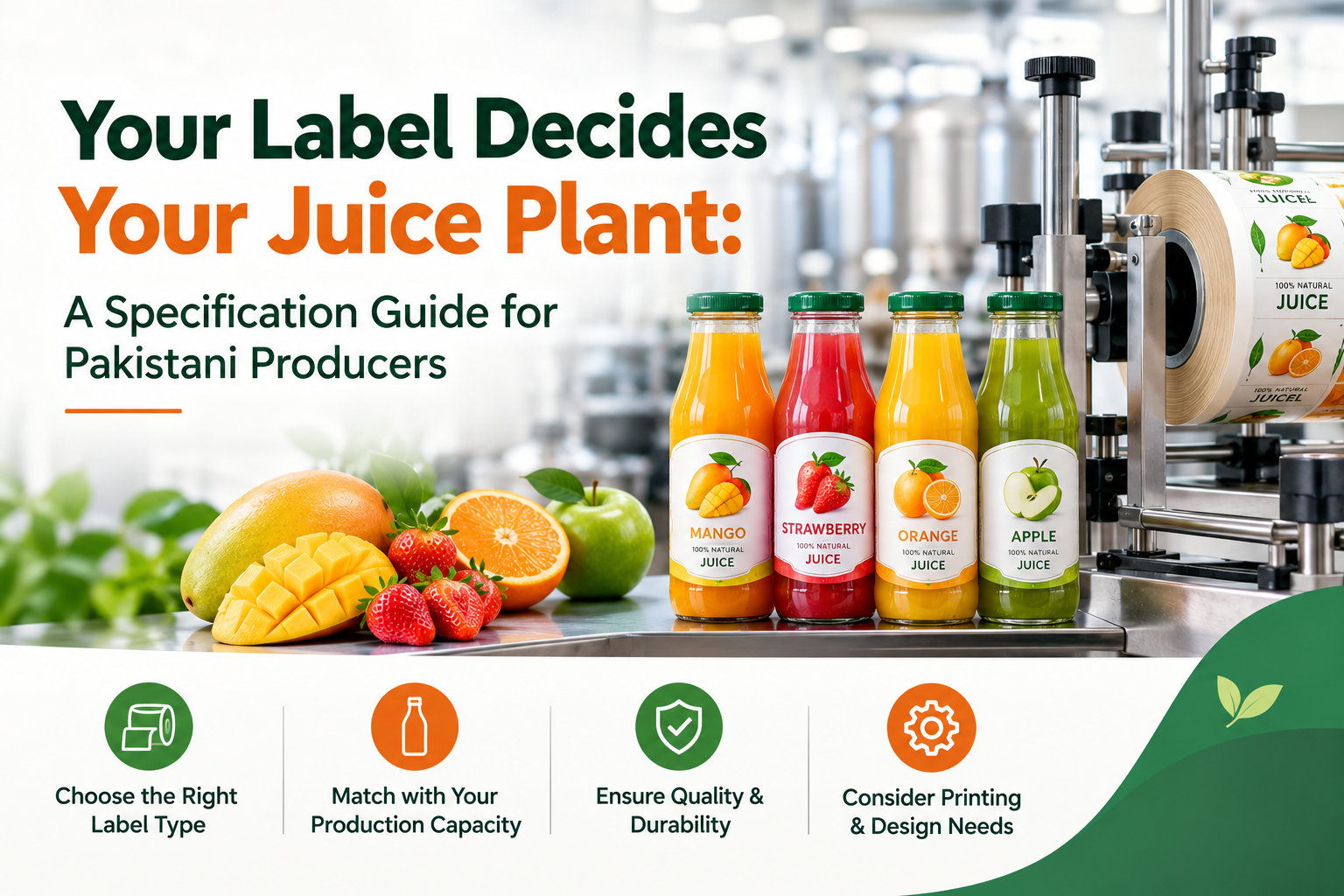
Most juice plant enquiries in Pakistan start in the wrong place. Someone asks for a quotation on a line of a certain capacity, receives one, and starts comparing prices.
The capacity is not the specification. The label is.
Whether your pack legally says juice, nectar or drink is fixed by what is inside it. That single fact determines your ingredient cost, your processing route, your shelf life, your packaging options and the equipment you need to buy. Decide it late and you will either rebuild the line or relabel the product, and neither is cheap.
This guide runs the decisions in the order they actually cascade.
Decision one: what are you allowed to call it?
This is a legal question with a technical answer, not a marketing choice.
The Pakistan Standard for fruit juices and nectars, PS 4973, sets out the requirements for these products, including minimum Brix levels for reconstituted juices from different fruits and the fruit content required for a product to be sold as a nectar. Labelling then follows the prepackaged foods standard, PS 1485. Carbonated products sit under their own standard.
In practice the market splits three ways, and the boundary between them is fruit content.
Juice. The highest fruit content tier, essentially the fruit itself, whether pressed directly or reconstituted to the correct Brix. Reconstituted product must be brought back to the Brix level the standard sets for that fruit.
Nectar. A diluted product with a defined minimum fruit content, which varies by fruit because different fruits produce different purées and acidities.
Drink. Everything below the nectar threshold. Legitimate, widely sold and often the commercially sensible choice, but it may not be labelled as juice.
Three details that catch producers out.
Blends are named by the dominant fruit. Where a product contains more than one fruit, the standard directs that it be named after the fruit present in the higher percentage, or described as a mixed or blended product. Naming your blend after the fruit customers find most appealing rather than the one that dominates is not available to you.
Added sugar can change what the product is. International guidance underlying the Pakistani standard treats a product sweetened beyond a defined threshold as a different product requiring different labelling. Sweetening is a formulation decision with a labelling consequence.
Reconstitution water is regulated. Water used to bring a concentrate back to strength has to meet drinking water quality expectations. That means your juice plant contains a water treatment plant, whether or not anyone quoted you for one. Our water plant installation work is frequently the first stage of a beverage project for exactly this reason.
Write your intended label wording down before you go further. Every decision below depends on it.
Decision two: not from concentrate, or from concentrate?
This determines your raw material handling, your storage, and your seasonality exposure.
Not from concentrate. Fruit is pressed and the juice is processed without removing water. Better flavour perception and a premium position. But you need fruit intake, washing, sorting, extraction and finishing capability on site, plus the capacity to handle a crop that arrives in a season rather than year round.
From concentrate. You buy concentrate, store it, and reconstitute with treated water. Far less intake equipment, year round production, easier consistency, and a supply chain you can plan. The line is simpler and the product is positioned differently.
Mango is the Pakistani special case. Mango pulp and purée behave differently from clear juices, need different handling, and carry a seasonal intake pattern that shapes the whole plant if you are processing fresh fruit rather than buying pulp.
Most first plants in Pakistan start from concentrate or purchased pulp. It is a smaller capital commitment, it removes the agricultural risk, and it lets you learn the market before you commit to fruit intake infrastructure.
Decision three: shelf life and how you distribute
Now the technical fork that decides the most expensive equipment on your line.
Your shelf life target is not a wish. It is the consequence of your thermal process, your packaging and your distribution chain, and it has to be validated rather than assumed.
Chilled, short shelf life. Lighter thermal treatment, better flavour retention, and a cold chain from your plant to the consumer. In a market where retail refrigeration is inconsistent, that cold chain is a real operational risk and a real cost.
Ambient, long shelf life. Heavier thermal treatment or aseptic processing, no cold chain, and distribution reach across the country. This is what most Pakistani producers need, because ambient distribution is what the market can actually support.
The thermal routes:
| Route | What it involves | Typical outcome |
|---|---|---|
| Pasteurisation then hot fill | Heat the product, fill hot into the container, invert to sterilise the closure | Ambient shelf life, container must tolerate heat |
| Aseptic processing | Sterilise product and packaging separately, fill in a sterile environment | Long ambient shelf life, best flavour retention, highest capital cost |
| Tunnel pasteurisation | Fill cold, then pasteurise the sealed container | Simpler line, suits glass and cans, slower |
One technical point worth understanding, because it separates real suppliers from resellers. Most fruit juices are high acid products, and acidity does a great deal of the preservation work. That is why pasteurisation is generally sufficient. Products that are less acidic, or blends that raise the pH, change the microbiological picture and can demand a much heavier process. If you are formulating anything unusual, particularly vegetable blends or dairy containing beverages, establish the acidity position before anyone specifies equipment.
Decision four: the pack
Packaging is where the previous three decisions meet, and it is frequently chosen last when it should be chosen early.
PET bottles. Dominant in the Pakistani market, familiar to consumers, and compatible with hot fill where the bottle is specified for it. Hot fill PET is a specific bottle design. An ordinary bottle will deform.
Carton. The aseptic standard for ambient juice, excellent shelf life, but tied to specific filling systems and supplier relationships.
Glass. Premium positioning, tolerates tunnel pasteurisation well, heavy and expensive to distribute.
Can. Good barrier properties, strong for the nectar and drink segment, tolerates thermal processing.
Pouch. Low cost, strong in the children’s drink segment, and widely used in the Pakistani market.
Your filling equipment follows this choice, which is why filling is quoted separately and why the interface between processing and filling is where turnkey projects fracture. Establish who owns that boundary before you sign anything. PakCEC handles auto filling systems alongside juice plant installation because a plant that ends at the treated product tank is half a plant.
Now the line follows
With those four decisions made, the plant almost specifies itself.
Water treatment, sized to your reconstitution and cleaning demand.
Ingredient handling. Concentrate or pulp storage and thawing, or fruit intake, washing, sorting and extraction if you are processing fresh.
Blending and standardisation. Where Brix, acidity and formulation are brought to specification. This is the heart of consistency, and it is where cheap lines cut corners.
Homogenisation and deaeration, where the product needs it.
Thermal treatment, per decision three.
Filling and sealing, per decision four.
Clean in place. Not optional. A beverage line that cannot be cleaned reliably will fail microbiologically, and retrofitting proper cleaning is far harder than specifying it.
Utilities. Steam, chilling, compressed air, effluent. Frequently underestimated, and frequently the reason a commissioned plant cannot run at rated capacity.
The quality control bench your label commits you to
Every claim on your pack is a testable assertion, and the market samples finished product.
At minimum a juice plant needs to measure soluble solids as degrees Brix, pH and titratable acidity, and to run microbiological checks including yeast and mould, which are the organisms that spoil juice. Beyond that, your specific product may require pulp content, viscosity, colour, ascorbic acid where you make a vitamin claim, and preservative levels where you use them.
The Brix measurement deserves particular attention, because it is how anyone checks whether your reconstituted juice actually meets the standard for that fruit. It is the cheapest instrument on the bench and the one your legal position rests on.
Two practical points. Allocate laboratory space in the plant layout rather than finding room later, and budget for calibration as a recurring cost. We handle lab equipment specification and laboratory compliance as part of plant design because a line you cannot test is a line you cannot defend.
Sizing the plant, and why most first plants are too big
Capacity is the number buyers fixate on and the one they most often get wrong, in the same direction every time.
The temptation is to size for the market you hope to have in year three. The problem is that an oversized line runs badly at low volume. Thermal equipment has a minimum throughput below which it does not hold its process properly, cleaning consumes the same water and chemicals whether you produced a full shift or an hour, and your cost per litre climbs rather than falls.
Three questions give you a realistic number.
What can you actually sell in the first twelve months? Not the addressable market. Your distribution, your customers, your shelf space.
What is your minimum viable batch? Blending and thermal stages have a floor. A line that cannot run a small batch cleanly forces you to make more than you can sell.
Where does the line expand? A well designed plant has an identified bottleneck and a planned upgrade path. Ask which stage you would uprate first and what that would involve, because the answer tells you whether the design was thought about or assembled.
Phasing is usually the better answer. Build for realistic near term volume with the layout, utilities and floor space to expand, rather than buying capacity that sits idle while you pay to clean it.
Where juice projects go wrong
The label is decided after the line is bought. The whole point of this article. A plant specified for a drink cannot suddenly make a juice, because the constraint is the fruit content and the Brix, not the machinery.
Shelf life is assumed rather than validated. You do not know your shelf life until you have run it, at temperature, on your actual product in your actual pack.
The processing and filling interface has no owner. Two suppliers, one gap, and a commissioning dispute.
Utilities are undersized. The line is capable and the boiler is not.
Cleaning is an afterthought. This shows up as microbiological failures in month three, and by then the plant is built.
Regulatory work starts after commissioning. Product certification involves testing and factory inspection, and inspection assesses the facility. PSQCA product certification should be designed for, not applied for afterwards. If you intend to export, halal certification services belong in the same early conversation, since ingredient documentation and segregation are design questions.
What to ask before you sign
What product are you specifying this line for, in label terms? If the answer is a capacity figure rather than a product definition, they are quoting a catalogue.
What shelf life does this design deliver, in what pack, and how will that be validated?
Where does your scope end? Water treatment, processing, filling, utilities, effluent. Name each one as in or out.
What is the clean in place design?
What laboratory capability does this plant assume I have?
What utilities does it require at full rate? Steam, power, chilled water, compressed air, with numbers.
Who commissions it, trains my operators, and answers the phone in month eight?
Where PakCEC fits
PakCEC designs, installs and commissions turnkey plants across juice, water, vinegar, cosmetics and process industries, and we handle the certification and licensing that sits alongside them. For a beverage project that combination matters, because your label, your process and your regulatory file are one problem rather than three.
Twenty years, more than 3,000 completed registrations and certifications, and a preference for asking what your pack will say before quoting anything. We will also review a quotation you have received from someone else. Bring the document and your intended label wording.
See our full engineering solutions in Pakistan range, or talk to the PakCEC team.
