

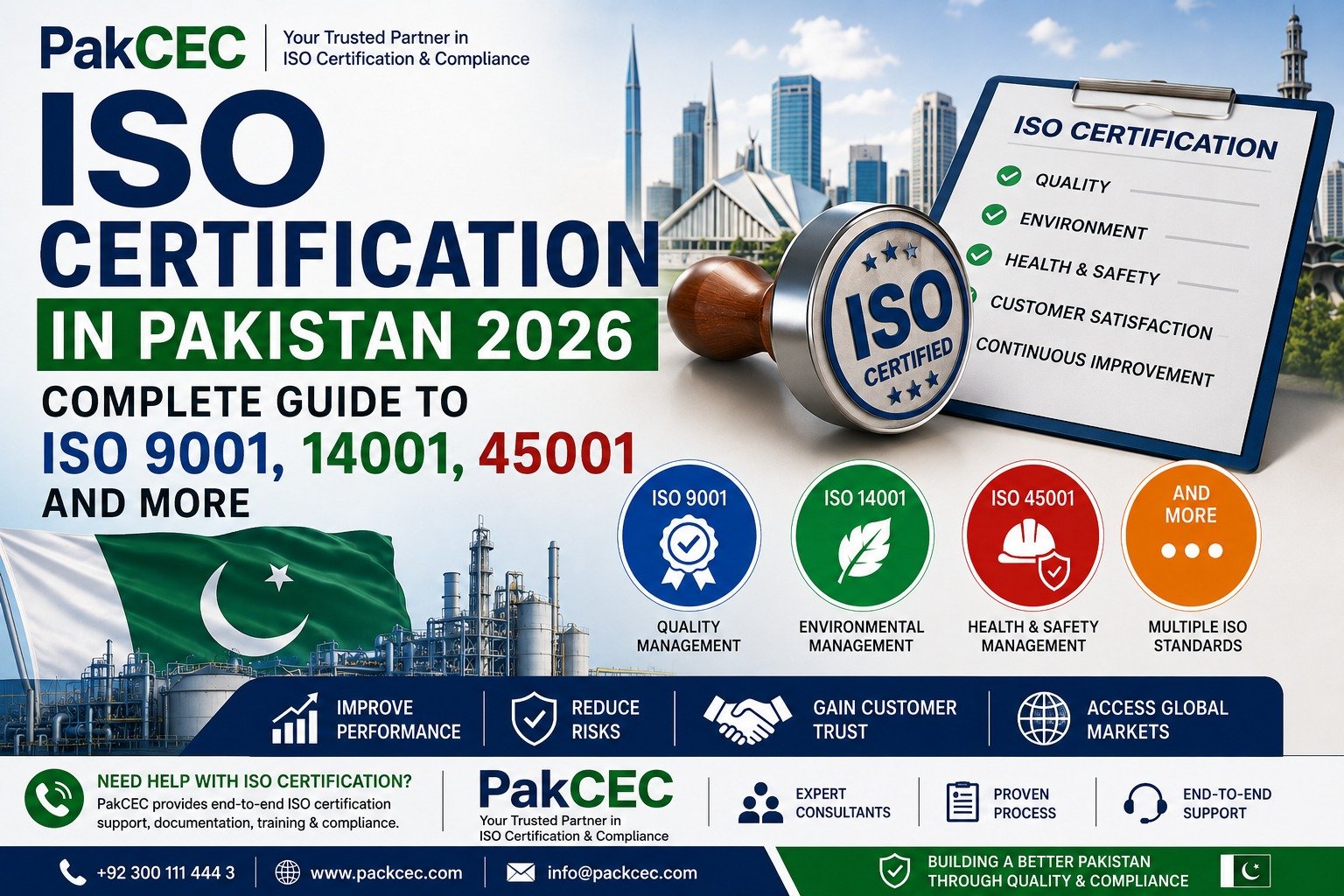
In an increasingly competitive global marketplace, ISO certification has become one of the most powerful tools a Pakistani business can use to demonstrate quality, reliability, and operational excellence to customers, partners, and regulators both domestically and internationally. Whether you are a manufacturer seeking to export to international markets, a service provider aiming to win larger corporate contracts, or an organization looking to improve internal processes and reduce waste, ISO certification provides a globally recognized framework for achieving these goals.
Yet for many businesses, ISO certification feels like an abstract, bureaucratic exercise a certificate to display on a wall rather than a meaningful business improvement tool. At Connect Engineers and Consultants (CEC), we help businesses across Pakistan understand and implement ISO standards in ways that deliver real operational value while achieving certification efficiently. This comprehensive guide covers everything you need to know about ISO certification in Pakistan in 2026.
What Is ISO Certification and Why Does It Matter?
ISO (International Organization for Standardization) develops and publishes international standards that define best practices across a wide range of management systems and technical specifications. ISO certification means an independent, accredited certification body has assessed your organization’s management systems and confirmed they meet the requirements of a specific ISO standard.
For businesses, ISO certification delivers value across multiple dimensions:
- Market Access: Many international buyers, particularly in Europe, North America, and the Gulf region, require ISO certification as a precondition for doing business particularly ISO 9001 for general quality management.
- Government and Corporate Tenders: A growing number of government procurement processes and large corporate supply chains require bidders to hold relevant ISO certifications.
- Operational Improvement: Implementing an ISO management system requires organizations to document processes, identify inefficiencies, and establish continuous improvement mechanisms — delivering real operational benefits beyond the certificate itself.
- Risk Reduction: Standards like ISO 45001 (occupational health and safety) and ISO 14001 (environmental management) help organizations systematically identify and manage risks that could otherwise result in accidents, regulatory violations, or environmental incidents.
- Customer Confidence: ISO certification signals to customers that your organization has invested in establishing reliable, consistent processes building trust and competitive differentiation.
ISO 9001: Quality Management Systems
ISO 9001 is the world’s most widely adopted management system standard, applicable to organizations of any size and in any industry. It establishes a framework for consistent quality in products and services through documented processes, defined responsibilities, customer focus, and continuous improvement.
Core Requirements of ISO 9001
- Establishing a quality policy and measurable quality objectives aligned with the organization’s strategic direction
- Documenting key processes, including process inputs, outputs, responsibilities, and controls
- Implementing a system for managing customer requirements and customer satisfaction monitoring
- Establishing supplier evaluation and management processes to ensure quality inputs
- Conducting internal audits to verify the management system is functioning as designed
- Implementing corrective action processes to address nonconformities and prevent recurrence
- Conducting management reviews to assess the system’s overall effectiveness and identify improvement opportunities
ISO 9001 is particularly valuable for manufacturing companies, engineering and construction firms (where it is often a prerequisite for PEC-registered firms bidding on larger projects), exporters seeking to meet international buyer requirements, and service organizations of all types looking to formalize and improve their service delivery processes.
ISO 14001: Environmental Management Systems
ISO 14001 provides a framework for organizations to manage their environmental responsibilities systematically, helping reduce environmental impact while improving resource efficiency and regulatory compliance. As environmental regulations in Pakistan become increasingly enforced particularly for manufacturing, chemical processing, and industrial operations ISO 14001 certification helps organizations stay ahead of compliance requirements while often reducing costs through improved resource and waste management.
Key Elements of ISO 14001
- Identifying environmental aspects of the organization’s activities, products, and services, and assessing their potential environmental impacts
- Establishing compliance obligations related to applicable environmental laws and regulations
- Setting environmental objectives and targets, such as reducing energy consumption, water usage, or waste generation
- Implementing operational controls to manage significant environmental aspects
- Establishing emergency preparedness and response procedures for potential environmental incidents
- Monitoring and measuring environmental performance against established objectives
For manufacturing facilities, particularly those involved in chemical processing, food production, textiles, and similar sectors, ISO 14001 certification is increasingly requested by international buyers as part of their supply chain sustainability requirements making it an important certification for export-oriented businesses.
ISO 45001: Occupational Health and Safety Management Systems
ISO 45001 is the international standard for occupational health and safety management systems, providing a framework for organizations to proactively improve worker safety, reduce workplace risks, and create better, safer working conditions. For industries with significant physical hazards construction, manufacturing, oil and gas, and chemical processing among them — ISO 45001 certification represents a structured approach to managing risks that can otherwise result in accidents, injuries, regulatory penalties, and reputational damage.
Key Elements of ISO 45001
- Hazard identification and risk assessment processes covering all workplace activities
- Establishing health and safety objectives and programs to eliminate hazards and reduce risks
- Worker participation and consultation in health and safety matters
- Operational controls for managing identified hazards, including personal protective equipment requirements, safe work procedures, and permit-to-work systems
- Incident investigation processes to identify root causes and prevent recurrence
- Emergency preparedness and response planning
ISO 45001 certification is particularly valuable for construction and engineering firms (often required alongside PEC registration for larger contracts), manufacturing facilities with significant machinery and process hazards, and any organization seeking to demonstrate its commitment to worker safety to clients, regulators, and insurance providers.
Other Important ISO Standards for Pakistani Businesses
ISO 22000: Food Safety Management
For food manufacturers, processors, and exporters, ISO 22000 provides a framework for managing food safety hazards throughout the supply chain. This certification is often essential for companies seeking to export food products to international markets with stringent food safety requirements.
ISO 27001: Information Security Management
As Pakistani IT and software companies increasingly serve international clients, ISO 27001 certification which establishes a framework for managing information security risks has become an important differentiator, particularly for companies handling sensitive client data or seeking contracts with clients that have strict data security requirements.
ISO 17025: Laboratory Competence
For testing and calibration laboratories, ISO 17025 accreditation demonstrates technical competence and the validity of test results critical for laboratories supporting quality control in manufacturing, environmental testing, and product certification processes.
The ISO Certification Process: What to Expect
- Gap Analysis: An initial assessment compares your organization’s current practices against the requirements of the target ISO standard, identifying areas that need development or improvement.
- Documentation Development: Based on the gap analysis, your organization develops or updates the documented policies, procedures, and records required by the standard. This typically includes a quality/environmental/safety manual, process procedures, work instructions, and record-keeping templates.
- Implementation: The documented management system is implemented across the organization, with employees trained on new or updated procedures and responsibilities.
- Internal Audit: A trained internal auditor (or external consultant acting in this role) conducts an internal audit of the management system to verify it is functioning as documented and to identify any remaining gaps before the certification audit.
- Management Review: Senior leadership formally reviews the management system’s performance, including internal audit results, to ensure organizational commitment and identify any final adjustments needed.
- Certification Audit (Stage 1): An accredited certification body conducts a documentation review to verify that your management system documentation meets the standard’s requirements and that the organization is ready for the on-site assessment.
- Certification Audit (Stage 2): The certification body conducts an on-site audit, verifying that the management system is implemented effectively in practice observing actual operations, interviewing employees, and reviewing records.
- Certification Decision and Issuance: Following a successful Stage 2 audit (and resolution of any identified nonconformities), the certification body issues the ISO certificate, typically valid for three years subject to ongoing surveillance audits.
- Surveillance Audits: Certification bodies conduct periodic surveillance audits (typically annually) throughout the three-year certification cycle to verify continued compliance.
Choosing an Accredited Certification Body
Not all ISO certificates carry equal weight. For certification to be internationally recognized and accepted by major buyers, regulators, and supply chains, it must be issued by a certification body accredited by a recognized accreditation body such as those operating under the International Accreditation Forum (IAF) framework. Working with accredited certification bodies ensures that your ISO certification will be recognized and accepted wherever it matters most for your business whether that is a European buyer’s supply chain audit or a government tender evaluation in Pakistan.
Common Challenges Businesses Face with ISO Certification
- Treating ISO implementation as a documentation exercise rather than an operational improvement opportunity, resulting in systems that exist on paper but are not genuinely followed in practice
- Underestimating the time required for proper implementation and employee training before pursuing certification audits
- Selecting certification bodies based solely on cost without verifying accreditation status, resulting in certificates that may not be recognized by key buyers or regulators
- Failing to maintain the management system after initial certification, leading to nonconformities at surveillance audits and potential certificate suspension
- Attempting to implement multiple ISO standards simultaneously without adequate resources, leading to incomplete or superficial implementation across all standards
How CEC Supports Your ISO Certification Journey
At Connect Engineers and Consultants, we provide comprehensive support for organizations pursuing ISO certification across multiple standards:
- Standard Selection Advisory: We help you identify which ISO standards are most relevant to your industry, customer requirements, and business objectives.
- Gap Analysis: Our consultants conduct thorough gap analyses comparing your current practices against target ISO standard requirements.
- Documentation Development: We develop customized management system documentation manuals, procedures, and templates tailored to your organization’s actual operations rather than generic templates that don’t reflect how your business really works.
- Implementation Support and Training: We provide hands-on support during implementation, including employee training to ensure the management system is genuinely understood and followed.
- Internal Audit Services: We can conduct internal audits as an independent function, providing objective assessment of your readiness for certification audits.
- Certification Body Liaison: We help you select appropriately accredited certification bodies and coordinate the certification audit process.
- Ongoing Compliance Support: We provide continued support to help your organization maintain its management system and prepare for surveillance audits throughout the certification cycle.
ISO Certification as a Competitive Advantage in 2026
As Pakistani businesses increasingly compete for international contracts, supply chain inclusion, and government tenders, ISO certification has shifted from a nice-to-have credential to an essential business requirement in many sectors. Companies that proactively pursue relevant ISO certifications position themselves to access opportunities that remain closed to non-certified competitors — while also gaining the genuine operational benefits of more structured, efficient, and risk-managed operations.
Whether your goal is export market access, government tender eligibility, supply chain inclusion with major corporate buyers, or simply building a more efficient and well-managed organization, ISO certification provides a proven framework for achieving these outcomes.
Begin Your ISO Certification Journey with CEC
Connect Engineers and Consultants brings practical, experienced guidance to organizations across Pakistan pursuing ISO 9001, ISO 14001, ISO 45001, and other relevant certifications. We focus on implementations that deliver real business value not just paperwork while ensuring your certification is issued by accredited bodies that will be recognized wherever your business needs it most.
Contact our team today to discuss which ISO certifications are right for your business and how we can support you through every stage of the certification process.

[…] If you are registered with PSEB as an IT or IT-enabled services company, ISO 27001 also strengthens your profile with foreign buyers. See our PSEB registration guide. […]