

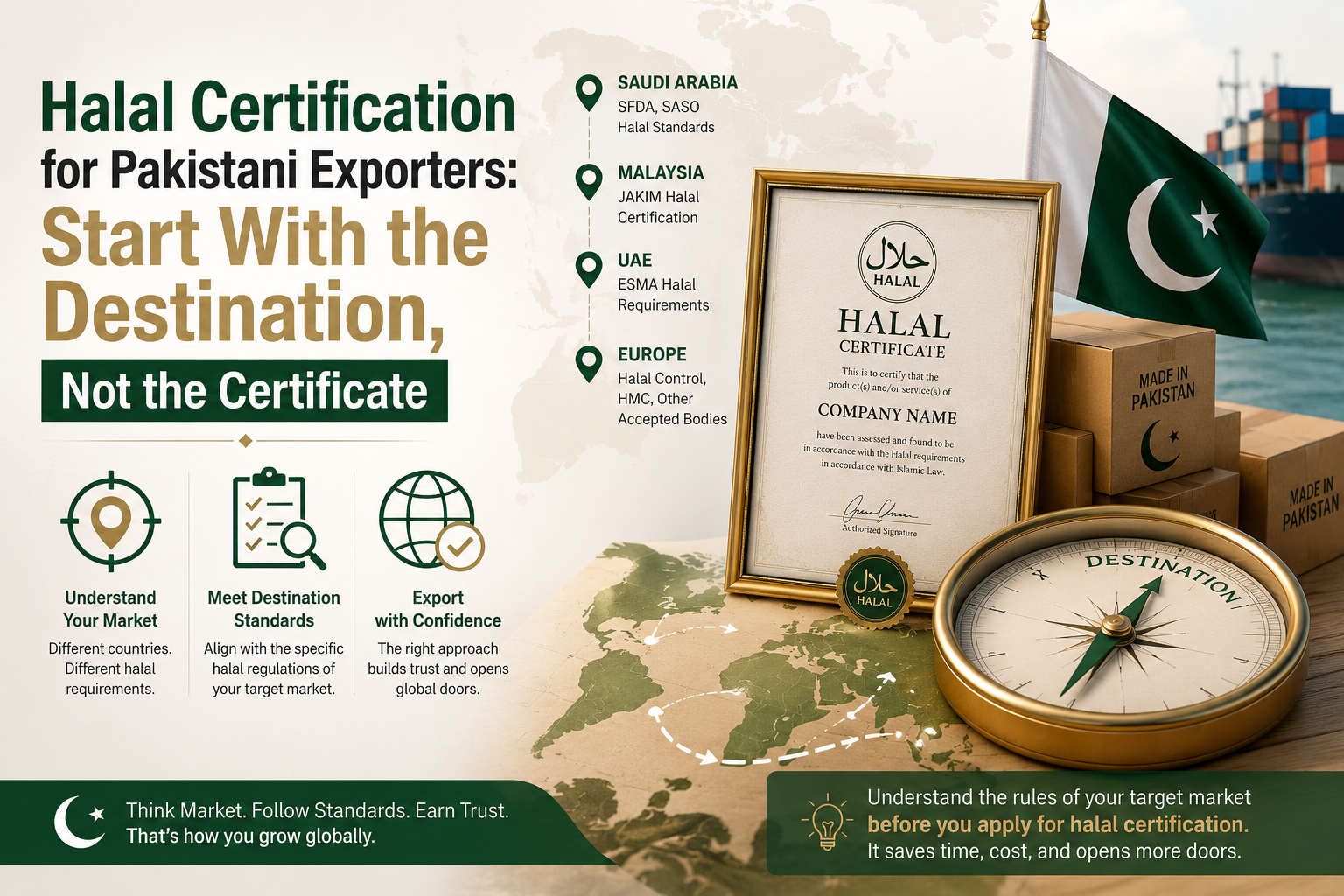
A Pakistani food exporter holding a halal certificate asked us a reasonable question last year. The buyer in Jakarta had rejected the paperwork. Why?
Because halal certification is not one thing, and the certificate was never the question. What matters is whether the specific body that issued it is recognised by the specific authority in the destination country, for the specific product category being shipped. Miss any one of those three and you have a document your buyer cannot use.
Most guidance written in Pakistan explains how to get certified here. This one starts at the other end, with the market you are selling into, because that is the end that decides whether your consignment clears.
The rule that governs everything
Recognition is granted body by body and category by category.
That sentence is the whole article. A certifier recognised by an authority for food may not be recognised by the same authority for cosmetics. A certifier recognised in Malaysia may have no standing in Indonesia. And a product that clears one border on its documents can be detained at the next on exactly the same documents.
So the first question is never which halal certificate should I get. It is which authority does my buyer answer to, and which certifiers does that authority accept for what I make.
The Pakistani side, briefly
You need to know who does what at home before the destination question makes sense.
Pakistan Halal Authority was established under Act VIII of 2016, sits under the Ministry of Science and Technology, and is the statutory body for determining halal status of products and processes, domestically and for imports and exports. Certification bodies operating here are registered with it. The authority has also approved operationalisation of a national halal certification mark scheme, which is worth watching if you sell domestically as well as abroad.
Pakistan National Accreditation Council accredits the certification bodies themselves. It does not certify your product. It assesses whether the organisation certifying your product is competent to do so, against PS 4992 and OIC/SMIIC 2, the conformity assessment standard for halal certification bodies issued through the Organisation of Islamic Cooperation.
One point of national credit that is genuinely relevant to exporters, not just flattering. PNAC was the first accreditation body in the world to launch a halal accreditation scheme, back in 2012. That history is part of why Pakistani certification carries weight in OIC forums.
PS 3733 is the Pakistani halal food standard, aligned with OIC and SMIIC guidance. It is what your certifier assesses you against here.
Accreditation of a certification body is granted for a defined scope and a defined period, typically running a few years before reassessment. Which brings us straight back to the rule. Ask your certifier for their accreditation scope document and check that your product category is on it. Do not assume.
Reasoning backward: the destination matrix
| Destination | Authority | Reference standard | What a Pakistani exporter needs to check |
|---|---|---|---|
| Indonesia | BPJPH | National halal assurance framework under Law 33 of 2014 | Whether your certifier holds a mutual recognition arrangement with BPJPH covering your category. If not, you certify with BPJPH directly |
| Malaysia | JAKIM | MS 1500 | Whether your certifier appears on the recognised foreign halal certification body list, and whether your company registration satisfies the foreign applicant route |
| UAE | Ministry of Industry and Advanced Technology | UAE.S 2055 series, under Cabinet Decree 10 of 2014 | Whether your certifier is registered under the national halal mark scheme, and whether the mark is required for your product |
| Saudi Arabia and wider Gulf | Saudi Halal Center, SFDA, GSO framework | GSO 2055 series | Facility registration with a body accredited under the Gulf framework |
| Turkey | HAK | OIC/SMIIC | Alignment with SMIIC is generally the route |
| Singapore | MUIS | Own scheme | Frequently used as an ASEAN gateway |
Two things follow from that table.
There is no single global halal certificate. Any certifier claiming universal acceptance is describing a portfolio of separate recognitions, not one thing. That is fine, and it is what you want, but ask them to show you which recognitions actually cover your category.
The Gulf is not a shortcut into Southeast Asia. Clearing Dubai does not clear Jakarta. Exporters assume regional momentum carries across and it does not.
Indonesia is the urgent one right now
If you make cosmetics, traditional medicine or chemical products and you sell into Indonesia, this section is the reason to read the article today rather than next quarter.
Indonesia made halal certification mandatory for imported food and beverage products from October 2024 under its halal product assurance law. The requirement extends to further categories including cosmetics, traditional medicine and chemical products with a deadline falling in October 2026. That is weeks away, not quarters.
The mechanics matter. If your Pakistani certifier holds a mutual recognition arrangement with BPJPH covering your category, you do not repeat the audit. You register the existing certificate through the foreign certificate route on the SiHalal portal. Recognition removes the audit. It does not remove the registration step, and products still have to be registered before they reach the border.
If no arrangement covers your situation, you apply to BPJPH directly, which means an audit, laboratory testing, an inspection report, and a fatwa stage before the certificate issues. Reporting suggests the official service standard for that route has been shortened considerably under reformed rules, but plan on the full process rather than the headline timeline.
One operational detail Pakistani exporters routinely miss. You generally need a local representative in Indonesia to manage the portal account. That is a commercial arrangement to sort before you start, not during.
For cosmetics plant installation clients in particular, this deadline should already be in your plan. If it is not, that is the call to make this week.
Four questions to put to a certifier before you sign
The certifier you choose determines which markets your certificate is worth anything in. Treat the selection as a procurement decision, not a formality.
Show me your accreditation scope document. It names the categories the body is competent to certify. If your product category is not on it, nothing else in the conversation matters. A certifier who hesitates at this request has answered it.
Which destination authorities recognise you, and for which categories? Note the second half. Recognition for food does not extend to cosmetics, and a general claim of international recognition is not an answer to this question.
When does your own accreditation expire? Certification bodies are reassessed on a cycle. If theirs lapses while your certificate is running, you have a problem you did not cause and will still have to solve.
What happens if a destination queries a consignment? Ask specifically who responds, how fast, and whether that support is included. A certificate is a document. Support during a border query is a service, and the two are often priced as one thing and delivered as neither.
The mistake that costs the most
Certifying first and choosing markets afterwards.
It feels efficient. Get the certificate, then go find buyers. In practice it means you selected a certifier without knowing which recognitions you needed, and you find out which markets are closed to you after you have paid and audited.
The reverse order costs nothing extra. Decide the destinations, then buy the certification that serves them. PakCEC asks about destination markets in the first conversation for exactly this reason, and it occasionally means telling a client that the certificate they were about to buy would not have helped.
What actually gets shipments detained
Certification failures are rarely about the big principle. They are about specific technical divergences between standards, and these are the ones that decide consignments.
- Gelatin and enzyme sources. Where they came from, and whether that source itself holds a certificate from a body the destination recognises.
- Stunning parameters for meat. Standards diverge on what is acceptable. A slaughter method that passes one market’s rules may not pass another’s.
- Ethanol thresholds in flavourings. Flavour carriers are a common failure point, and the acceptable level is not universal.
- Additives that look innocent. Natural flavours, synthetic vitamins and processing aids using animal derived stearates get flagged, and the manufacturer is often unaware the ingredient has an animal origin at all.
- Raw material certificate provenance. Your ingredient supplier’s halal certificate has to come from a body your destination accepts. Your own certificate does not launder an unrecognised input.
- Packaging materials. Animal derived components in packaging are within scope, and this surprises people.
- Cross contamination controls. Shared lines, shared storage, shared transport. The audit looks at segregation, not intention.
The pattern is consistent. Halal compliance runs through the supply chain, not just the process. You inherit your suppliers’ documentation problems.
What to fix in the plant before you apply
An audit assesses the facility, not the paperwork about the facility. Five things worth sorting first.
Traceability that actually works. You need to trace a finished batch back to the raw material lot and forward to the customer. If that is a manual reconstruction taking two days, it will not survive an audit.
Ingredient documentation, complete. A halal certificate for every input, held on file, current, and from an acceptable source. Gaps here are the commonest single finding.
Segregation, physically. Storage, production lines, utensils, and cleaning between runs where lines are shared. Documented, not just practised.
Testing capability. Some destination processes involve laboratory testing, and having in house capability changes how quickly you respond to a query. This is why we treat lab equipment specification and laboratory compliance as part of export readiness rather than a separate project.
An internal owner. Someone accountable for halal compliance who is not also accountable for shipping volumes. The conflict is obvious once stated and common in practice.
Businesses running juice plant installation projects or similar food lines should build these in at design stage. Retrofitting segregation into a finished plant is expensive and usually compromised.
The sequence that works
- Identify your destination markets, specifically. Not the Middle East. Which countries, which buyers, which authorities.
- Find out what those authorities require for your category. Categories are treated separately, so a food answer does not cover cosmetics.
- Choose a certifier whose recognitions match. Ask for the accreditation scope document and the list of destination recognitions. A certifier who cannot produce these on request is telling you something.
- Audit your supply chain before your certifier does. Ingredient certificates, sources, packaging.
- Fix the plant. Segregation, traceability, documentation, testing.
- Certify, then register in the destination. Certification and destination registration are two separate steps, and exporters regularly stop after the first.
- Diarise everything. Your certificate expires. So does your certifier’s accreditation. So do your suppliers’ certificates.
Point six is where most of the wasted money in this area sits. A certificate that was never registered with the destination authority is a certificate that does nothing at the border.
Halal is not a food-only question
Worth stating because it costs businesses opportunities. Halal certification scope covers cosmetics and personal care, pharmaceuticals and nutraceuticals, packaging materials, logistics and warehousing, and chemical and processing inputs.
If you manufacture packaging and sell to a certified food producer, your customer increasingly needs you certified too. That is a commercial opening rather than a burden, and it is currently under exploited by Pakistani suppliers.
Many exporters pair this with ISO certification and food safety management systems, because the underlying disciplines overlap heavily and buyers frequently want both. Your PSQCA product certification position sits alongside all of it, and covers a different question again.
Where PakCEC fits
We work the plant side and the certification side of the same projects, which is a useful place to stand for this particular problem. Segregation, traceability and testing capability are engineering decisions before they are compliance decisions, and they are much cheaper to build in than to retrofit.
Twenty years, more than 3,000 completed registrations and certifications, and a preference for asking where you are selling before recommending anything. Tell us your destination markets and your product categories, and we will map what those markets actually require.
See our halal certification services, our wider business consultancy in Pakistan range, or talk to the PakCEC team.
