

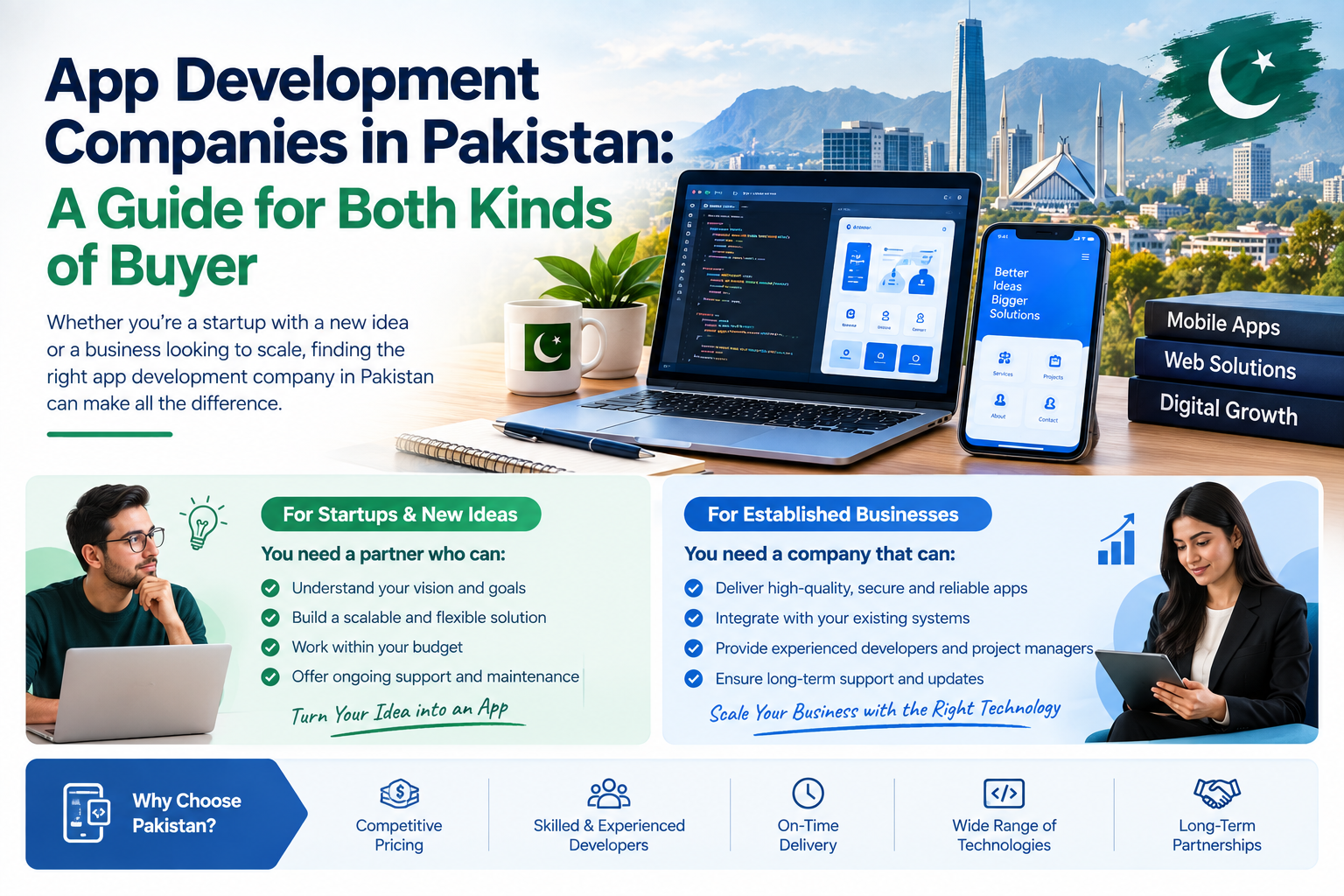
App development companies in Pakistan are searched for by two very different people, and most pages ranking for the phrase serve neither of them properly.
The first is a Pakistani business that needs an app built. A retailer, a logistics operator, a clinic, a manufacturer with field staff. They want to know who can build it, what it involves, and how not to get it wrong.
The second is a company in London, Dubai, Toronto or Dallas evaluating Pakistan as a place to have software built. They are comparing countries as much as companies, and their questions are about risk, contracting and whether the arrangement will survive contact with reality.
Those are different problems. This guide takes them one at a time.
If you are a Pakistani business that needs an app
Start with a question nobody selling you an app will ask: do you need one?
Apps earn their cost through repeat use, notifications and offline capability. If your customers will interact with you twice a year, a fast mobile website serves them better at a fraction of the cost, and our website development team says so regularly. If your users are your own staff, doing the same task daily in the field, an app is usually the right answer and often the highest return software a business builds.
The scope that actually gets quoted. App projects have four parts, and proposals routinely price the first.
- The app. Screens, navigation, offline behaviour, notifications.
- The backend. APIs, database, authentication, admin tooling. Usually larger than the app.
- Integrations. Payments, maps, messaging, analytics, and whatever internal systems you run.
- Publishing and release. Store accounts, listings, review submissions, and the update pipeline afterwards.
Ask which of the four a number covers. A quotation for the app alone is not a cheaper price for the same thing.
Publishing is now a compliance project. Organisation accounts on both major stores require a verified business identity, which means a registered legal entity and a D-U-N-S record whose name and address match exactly what you enter. That takes weeks rather than days, and it is a documentation problem before it is a technical one. If you have not incorporated, SECP corporate services come before anything else in the sequence.
Build for the devices your users actually hold. Mid range Android over mobile data is the baseline in this market, not a flagship on office wifi. App size affects retention because storage is contested. Connectivity drops. Decide what the app does offline and make failures recoverable.
If you are evaluating Pakistan from abroad
The honest case for Pakistan, and the honest caveats.
The sector is real and growing. Information and communications technology export remittances reached roughly 3.38 billion dollars over the first nine months of the 2025-26 fiscal year, up close to twenty percent year on year, against a government target of fifteen billion by 2030. Freelance technology exports grew by around half over the same period. This is not a cottage industry.
The supplier base is large. The Pakistan Software Export Board reports well over seventeen thousand active registered IT and IT enabled services companies. So the constraint on app development in Pakistan is not availability. It is selection.
The commercial fundamentals. Cost advantage against Western rates, a substantial English speaking technical workforce, and a time zone that overlaps a European working day comfortably and an American one partially.
The caveats, stated plainly. Quality varies enormously across those seventeen thousand companies. Written contracting discipline is inconsistent at the smaller end. And infrastructure interruptions are a real operational factor that serious firms have engineered around and casual ones have not. Ask how, specifically.
The registration that tells you something
There is one signal available to a foreign buyer that most do not know to look for.
Companies exporting IT services from Pakistan can register with the Pakistan Software Export Board. Registration is tied to a preferential tax treatment on export proceeds, to receiving payments through formal banking channels, and to facilities including access to government run technology parks.
Why that matters to you as a buyer. A registered exporter is receiving its money through documented banking channels and is operating inside a formal tax regime rather than around it. It does not prove technical competence, and you should not treat it as a quality mark. But it does tell you the company is structured to export properly, which is a different and useful question.
Two cautions if you go looking. Registration status is checkable, so ask rather than assume. And the tax treatment attached to it has been repeatedly amended and extended through successive finance legislation, so any specific rate you read online may already be superseded. That is a question for your supplier’s accountant, not for a blog.
Engagement models, and which one fits
| Model | How it works | Suits |
|---|---|---|
| Fixed price | Agreed scope, agreed price | Well defined projects where the specification is genuinely stable |
| Time and materials | You pay for effort as it is spent | Evolving products where scope will change, provided you have someone to manage it |
| Dedicated team | You retain named engineers ongoing | Continuous product work rather than a one off build |
| Staff augmentation | Individuals join your existing team | You have technical leadership and need capacity |
The common error is choosing fixed price for a project whose scope is not actually fixed. It feels safe and it produces the worst outcomes, because every change becomes a negotiation and the supplier’s incentive is to deliver the letter of a specification that has stopped describing what you want.
If your requirements are genuinely settled, fixed price is fine. If they are not, say so and structure accordingly.
Evaluating a company, either way
This is where mobile app development companies in Pakistan separate from each other. Eight questions, and the first two do most of the work.
Show me an app you shipped that is live in a store now. Not screenshots, not a case study page. A listing anyone can open. This single filter removes a surprising proportion of candidates in thirty seconds.
Whose name will the store accounts and repositories be in? The correct answer is your company’s, with them added as team members. Anything else is a hostage position waiting to happen.
Who specifically works on this, and are they employees? Named people, with their actual role. A proposal showing a team you never meet again after signing is a familiar pattern.
How do you handle handover? Documentation, credentials, a working build environment, and a knowledge transfer session. Agree it before work starts, because after final payment your leverage is gone.
What happens after launch? Operating system releases, store policy changes, and crash fixes are recurring work. Get the arrangement named in writing with a response time.
Which devices do you test on? If mid range Android is not in the answer, your users will find the problems your developer did not.
What is your contracting and IP position? Covered below, and for foreign buyers it is the most important item on this list.
What is your reference, and may I speak to them unaccompanied? Willingness matters as much as the answer.
The contracting points that matter offshore
If you are engaging from outside Pakistan, four things deserve explicit attention.
Intellectual property assignment must be written and signed. This is not a formality anywhere, and under Pakistani law an assignment of copyright is invalid unless it is in writing and signed by the assignor, with the author as first owner by default. Code, designs and documentation are all covered. Paying an invoice does not transfer ownership. Our intellectual property services work exists substantially because of how often this is missed.
Confidentiality and data handling. Where your data sits, who can access it, and what happens to it at the end of the engagement. If you are subject to data protection obligations at home, they follow your data.
Governing law and dispute resolution. Agree it at the start. Discovering you disagree about jurisdiction during a dispute is the expensive version.
Payment mechanics. Formal banking channels, proper invoicing, and documentation that satisfies both your accounts department and their tax position. Suppliers registered as formal exporters are generally set up for this, which is part of why the registration question is worth asking.
What drives cost and timeline
Five variables, and only two belong to the developer.
Screen and feature count. The most visible driver, and the easiest to control by cutting the first release rather than compressing the testing.
Backend complexity. Simple content delivery against real time updates, role based access and third party integrations. Usually the larger half of the work and the half nobody looks at in a demo.
One platform or two. Doubling the platforms does not double everything, but it is not free either.
Integration count. Each payment provider, courier or internal system adds work and adds a dependency whose timeline you do not control.
Your decision speed. Projects with one empowered decision maker move. Projects with four approvers and no owner stall in review, and the delay is invariably attributed to the developer.
If you want a shorter timeline, reduce the first release. Ship something narrow that works and add to it once real users have told you what matters.
What goes wrong in offshore engagements
Five patterns, drawn from projects that arrive needing rescue rather than starting clean.
No written specification. Without an agreed scope, every disagreement becomes a negotiation and the project stops having an end.
Communication that is all written and all asynchronous. Text is a poor medium for design judgement. Schedule regular calls with cameras on, and expect fewer misunderstandings for it.
Nobody on the client side who can make technical decisions. Offshore teams need a counterpart who can answer questions in hours rather than weeks. Without one, the team either stalls or guesses.
Payment terms weighted entirely to the end or entirely to the start. Both create bad incentives. Milestone payments against agreed deliverables serve both sides.
Handover treated as a final email. Credentials, documentation, a working build environment and a live knowledge transfer session. Agreed before work starts, while you still have leverage.
If you are a Pakistani development company reading this
A third audience finds this page, and the answer for them is short.
If you export software services, your commercial position depends on being structured to do it properly. Company registration, export registration, tax standing, banking channels and contracting discipline. Foreign clients increasingly run supplier due diligence, and the firms that lose deals on that basis rarely find out that is why.
That side of the work is FBR tax compliance and corporate registration rather than engineering, and it is worth getting right before a large client asks rather than during their onboarding.
Where PakCEC fits
PakCEC builds mobile application development and custom software development projects from Islamabad, and handles the corporate registration, tax and licensing work that sits underneath software businesses on both sides of an export relationship.
We are not a volume development shop and we say so. What we bring is that the awkward parts of an app project in Pakistan, meaning store verification, entity documentation, IP assignment and export structuring, are things we do anyway.
Twenty years, more than 3,000 completed registrations and certifications, and a preference for telling clients what they do not need. If a mobile website would serve your users better than an app, we will say that too.
Whether you are a Pakistani business choosing among app development companies in Pakistan or a foreign buyer evaluating the country, tell us what the app has to do and who will use it. See our IT and software solutions range, or talk to the PakCEC team.
