

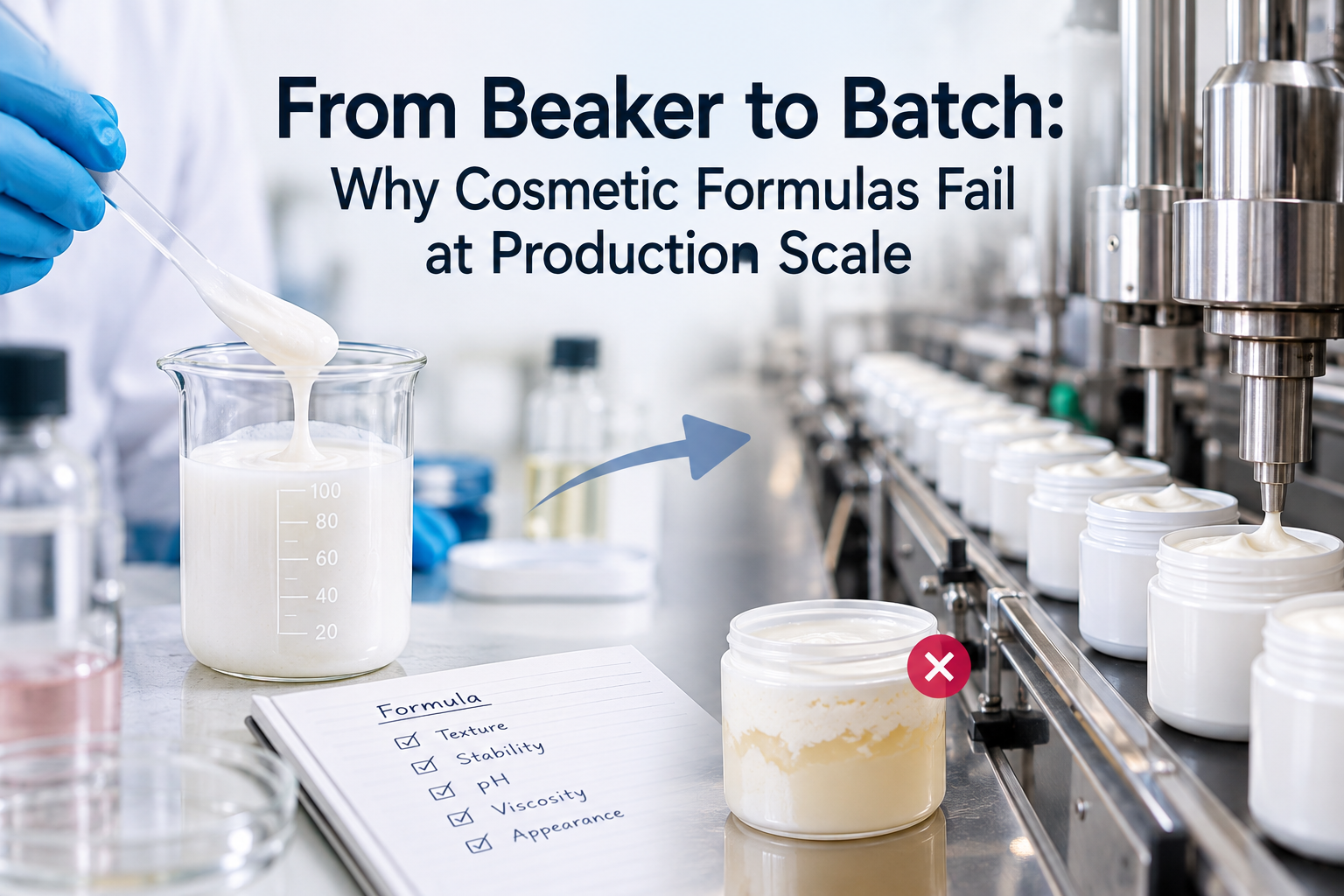
The formula worked. Your formulator made it in a beaker, it was stable, the texture was right, and everyone agreed you had a product.
Then the first production batch separated.
This is the most common story in Pakistani cosmetics manufacturing, and it is almost never a formulation failure. It is a scale-up failure, which is a different problem with a different fix. A cosmetics plant is not a large beaker. It is a machine for reproducing a formula reliably, and the things that make that hard are physical.
This guide follows a formula from the bench to the batch and looks at what breaks along the way.
What actually changes when you scale up
Four things behave differently at two hundred kilograms than at two hundred grams, and each one can ruin a batch.
Shear. This is the big one, and it is the least intuitive. Your emulsion depends on droplets of one phase being broken up and dispersed through the other, and that is done by shear. A laboratory homogeniser spinning at ten thousand revolutions per minute does not produce the same shear conditions as a production homogeniser at the same speed, because shear depends on geometry and volume as well as rotation. Published guidance on cosmetic scale-up notes that matching a lab unit at ten thousand revolutions may require something closer to three thousand at two hundred kilograms.
Run the production machine at the number written on the lab sheet and you will over process or under process the emulsion. Either way the batch is not the product you approved.
Heat transfer. A small vessel heats and cools quickly and evenly. A large one does not. Your emulsification temperature is reached at different times in different parts of the tank, and your cooling ramp, which is where texture is set, takes far longer. Cooling rate is a formulation parameter, not a waiting period.
Time. Every step takes longer. Ingredients sit at temperature for longer, and heat sensitive actives, fragrances and preservatives care about that.
Addition order and point. In a beaker you add something and it disperses in seconds. In a tank it does not. Where in the vessel you add an ingredient, and at what stage, becomes a real variable. Guidance on cosmetic manufacturing notes that preservative systems such as phenoxyethanol are generally added after emulsification rather than before, to avoid degrading them.
None of this is exotic. It is simply the difference between chemistry and process engineering, and it is the gap a plant has to close.
The emulsion is the product
Most cosmetics are emulsions. Creams, lotions, conditioners, many cleansers. Oil and water do not want to stay mixed, and your entire product is an arrangement to keep them that way.
That is why the mixing vessel is the most important piece of equipment you will buy, and why the cheap and expensive versions look similar from the outside.
What a proper emulsification vessel does:
- Vacuum. Removes entrained air. Air in an emulsion means bubbles in the fill, inconsistent weights, oxidation of sensitive ingredients, and a product that looks wrong.
- Homogenisation. High shear mixing to form the emulsion, with controllable speed.
- Anchor or scraped surface agitation. Keeps the bulk moving and prevents product baking onto the heated wall.
- Jacketed heating and cooling. Controlled ramps in both directions, not just the ability to get hot.
- Separate phase vessels. Oil phase and water phase prepared separately at temperature, then combined.
- Instrumentation and recording. Temperature, speed, vacuum and time, logged rather than remembered.
A vessel that stirs and heats is not an emulsification vessel. It will make something. It will not make the same thing twice.
Materials, and the mistake that shows up in month nine
Cosmetic formulations are chemically varied, and the plant has to tolerate all of them.
Two specific points from published manufacturing guidance, both worth raising with any supplier.
Avoid aluminium in contact with acidic formulations. Below roughly pH 4, aluminium surfaces can leach metal into product. Plenty of cosmetic formulations sit in that range.
Specify stainless steel appropriate to your formulations. Guidance points to 316L for resistance to ethanol based actives and preservative systems, which covers a great deal of what a modern cosmetics range contains.
Then the requirement that decides your daily operating life:
Everything must come apart for cleaning. Homogeniser heads, valves, transfer lines, filling nozzles. A cosmetics plant runs multiple products through the same equipment, and equipment that cannot be fully cleaned will eventually put traces of one product into another. Fragrance and colour are the usual culprits and they are unmistakable to a customer.
Contamination, and why preservation is tested rather than assumed
Cosmetics are water based, warm during processing, nutrient rich and handled by consumers with their fingers. That is a favourable environment for microorganisms, and preservation is what stands between your product and a recall.
The important point is that a preservative system is validated, not selected. The recognised method is an antimicrobial challenge test, carried out under ISO 11930, which deliberately inoculates the product and measures whether the preservative system controls the organisms under conditions representing real consumer use.
The plant side of this is straightforward and frequently skipped. Water quality has to be controlled, because your largest ingredient by volume is water and untreated water introduces the contamination your preservative then has to fight. Sanitisation between batches has to be real. And the microbiological limits you set have to be tested batch by batch rather than assumed from the validation.
Stability, and the test most brands skip
Stability testing tells you whether the product survives its shelf life. It is also where claims and reality meet, because the durability date on your pack is an assertion you should be able to support.
The protocol usually includes accelerated storage at elevated temperature, real time storage tracked in parallel, and light exposure for products with photosensitive actives, since ingredients like ascorbic acid degrade under UV.
The test most often omitted is freeze thaw cycling. Published protocol guidance describes a minimum of three cycles between roughly five and forty degrees, holding around forty eight hours at each step, and notes that this exposes emulsion instability and ingredient incompatibilities that steady temperature studies simply do not find.
For a Pakistani manufacturer this is not a theoretical European concern. Product moves across a country with large temperature swings, sits in unconditioned warehouses, and travels in vehicles that get extremely hot. If you export to the Gulf, thermal excursion in transit is routine. A product that has only been tested at a constant temperature has not been tested for the journey it will actually take.
Two practical points. Test in the final packaging, because interaction between product and container is part of what you are testing. And track the same parameters each time, meaning appearance, pH, viscosity, microbial counts and active content, so that a change is visible rather than debatable.
We build lab equipment specification and laboratory compliance into cosmetics plant installation projects because none of the above is possible without a working bench.
The batch record is the formula
The document that turns a formula into a manufacturable product is the master batch record, and it is more than an ingredient list.
It should carry full ingredient names in standard nomenclature, exact quantities, the order and point of addition, process parameters including mixing speed, temperature and hold times, target pH and viscosity ranges, and the in process checks with their acceptance limits.
Two reasons this matters more than it sounds. It is what lets a different operator make the same product next month. And it is what an auditor examines, because documentation is assessed as closely as premises.
Calibration sits underneath all of it. Published guidance makes the point starkly: a scale reading half a percent out on a fifty kilogram batch introduces enough error to destabilise a formulation. Weighing is not a rough operation in this industry, and calibration is a recurring cost you budget for rather than a one off purchase.
How to scale up without ruining three batches
Scale-up is a process with a method, not a leap of faith. The businesses that get there cheaply follow roughly this sequence.
Stabilise the laboratory formula first. A formula that is marginal at bench scale will not survive scale-up. If your sample only works when your formulator makes it personally, you do not yet have a formula.
Record everything at bench scale. Temperatures, times, speeds, addition points, order. Not so the plant can copy the numbers, but so it can understand what the formula needs. Those are two different things and confusing them is the root error.
Run a pilot batch. Something between the beaker and full production, on equipment of the same type as the plant. This is where process parameters get re-established, and it is worth doing even though it feels like a delay.
Expect the first production batch to be a trial. Budget for it. A supplier who promises saleable product from batch one either has not scaled a cosmetic before or is telling you what you want to hear.
Compare against the bench sample properly. Same tests, same parameters, side by side. Appearance, pH, viscosity, microbial counts. Impressions are not data.
Lock the parameters, then leave them alone. Once a batch matches, the process parameters become the record. Changes after that point are formal changes, not adjustments somebody makes on a shift.
The businesses that struggle are the ones that skip the pilot to save a few weeks, then spend three production batches discovering what the pilot would have told them.
The multi-product problem
A juice plant makes juice. A cosmetics plant makes creams, lotions, serums, shampoos and perhaps soaps, on shared equipment, in batches.
That changes the design question from throughput to flexibility, and it introduces two costs nobody quotes.
Changeover time. Cleaning between products is not overhead. It is a significant share of your operating hours, and it grows with the breadth of your range.
Filling is viscosity specific. A thin toner, a thick cream and a hair gel do not fill on the same equipment without change parts, and some combinations do not share equipment at all. Decide your product range before specifying filling, not after. Our auto filling systems work sits at exactly this interface, which is where turnkey cosmetics projects most often fracture.
The design principle is simple. Specify the plant against the widest product you intend to make and the narrowest margin you intend to accept. Then be honest about whether the range is worth the complexity.
GMP, and the regulatory fork
GMP. The international benchmark for cosmetics manufacturing practice is ISO 22716, prepared by the ISO technical committee for cosmetics and written to follow product flow from receipt through to shipment. It addresses personnel, premises, equipment, raw materials, production, finished product, laboratory, waste, subcontracting and documentation.
It is a guideline rather than a licence, and it carries commercial weight rather than legal force. Buyers ask for it, export customers frequently require it, and it is the framework a serious facility is designed around. ISO certification work is easier when the plant was built with it in mind.
The regulatory fork. In Pakistan, whether your product is a plain cosmetic or a medicated one changes which authority regulates you and what your facility must satisfy. That decision is driven by your claims and your active ingredients, and it should be settled before the plant is designed rather than after. Our healthcare licensing work covers that classification question, and PSQCA product certification covers the standards route for products outside it.
What to ask before you sign
What is the emulsification vessel, specifically? Vacuum, homogeniser, agitation type, jacket, instrumentation. If the answer is a capacity figure, ask again.
How will my lab formula be translated to this equipment? The right answer involves trial batches and process parameters being re-established at scale, not copying the lab sheet.
What material specification is proposed for product contact surfaces, and why?
How does everything come apart for cleaning?
What is the changeover procedure between products?
What laboratory capability does this plant assume?
Where does your scope end? Preparation, emulsification, storage, filling, packing. Name each one.
Where PakCEC fits
PakCEC designs, installs and commissions turnkey plants across cosmetics, water, juice, vinegar and process industries, and handles the licensing and certification that runs alongside them.
For cosmetics that combination is useful, because your classification, your claims and your facility are one decision rather than three, and because the plant has to be able to make what your label promises.
Twenty years, more than 3,000 completed registrations and certifications, and a preference for telling clients what they do not need. We will also review a quotation you have received from someone else. Bring the document and your formula brief.
See our full engineering solutions in Pakistan range, or talk to the PakCEC team.
