

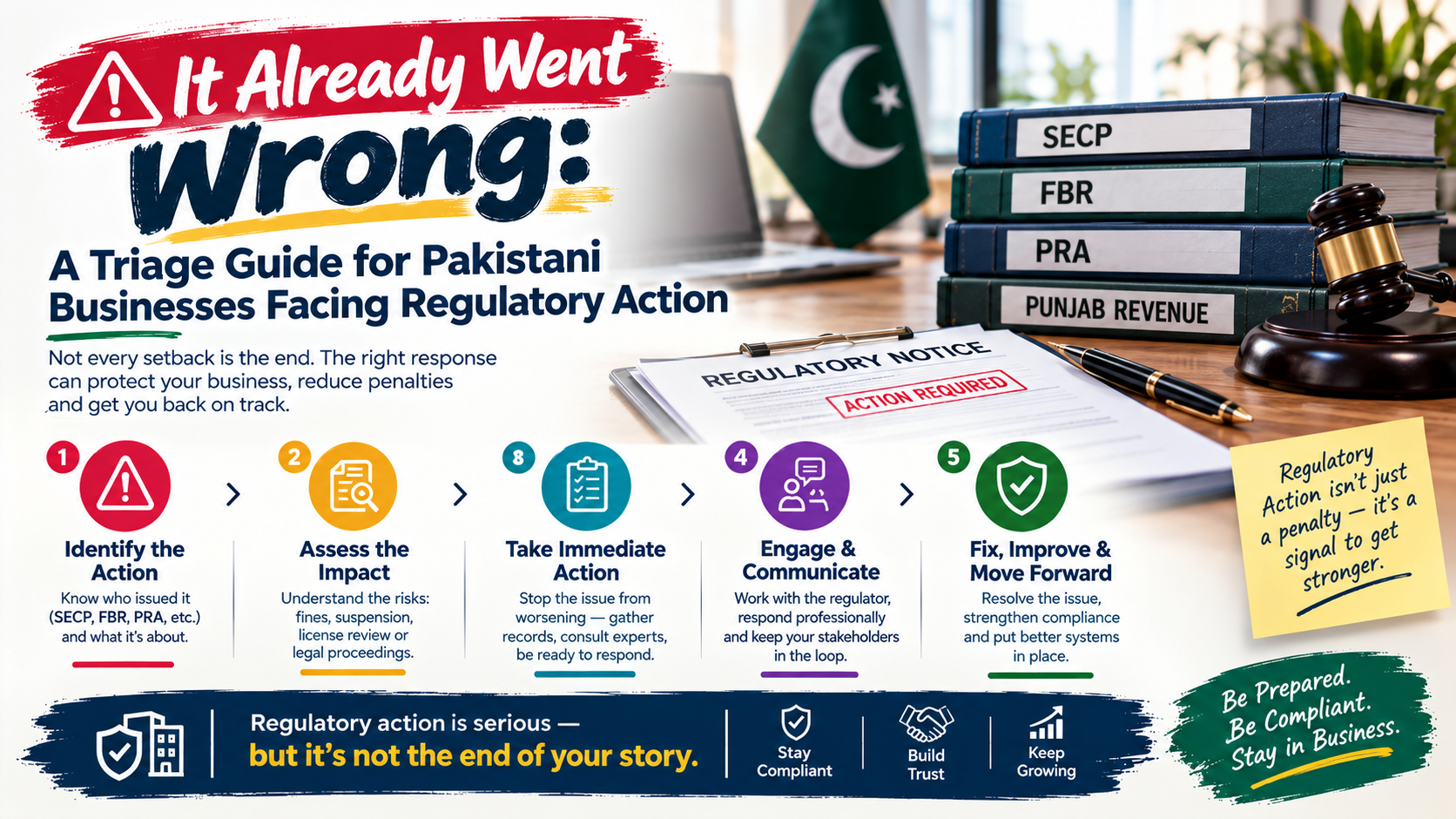
Everything else we publish is about preventing this. This article is for the day prevention did not work.
Your firm has been blacklisted by a procuring agency. Your product was named in a market monitoring report. A consignment is sitting at the port. A regulator has issued an order against your company. Your certificate has been suspended.
The instinct in all of these is to react immediately, usually by explaining. That is almost always wrong, and it is usually the thing that makes the file worse. Here is what to do instead.
The first forty eight hours
Six rules, and they apply across every scenario below.
Find out what actually happened before you respond. Read the notice properly. What is alleged, under what provision, by whom, and what is the deadline. Half of all panic responses answer a case nobody made.
Do not touch the records. Not to tidy, not to correct, not to complete something that was left incomplete. A gap in your records is a problem. A gap that appears to have been filled after the fact is a much larger one.
Appoint one voice. Regulators, agencies and auditors should hear from one named person. Three people giving slightly different accounts of the same facts creates a credibility problem that did not exist before.
Separate the immediate from the root cause. The immediate problem is the notice, the deadline and the consequence. The root cause is why it happened. Both need attention and they are different workstreams, and conflating them produces a response that is half apology and half defence.
Assume the file will be read by someone who was not there. Everything you write is now evidence. Write it accordingly.
Find the clock. Which brings us to the section that matters most.
The clocks are short, and they start without you
This is the single most useful thing in this article, because these windows close quietly and most businesses do not know they exist.
Blacklisting or debarment in public procurement. A bidder may file a review petition with the regulator within thirty days of communication of the blacklisting or debarment action, on payment of the prescribed fee and following the Authority’s procedure. The Authority then evaluates and decides within ninety days of filing.
Thirty days. From communication, not from when you noticed. Businesses that spend the first month negotiating informally with the procuring agency frequently discover that their formal remedy has expired while they were being reasonable.
Orders by the corporate regulator. Appeals against orders passed by a Commissioner or an authorised officer go to the regulator’s Appellate Bench under the enabling Act, and must be filed within thirty days of the order. Procedure rules govern the filing, deficient appeals are returned for correction within a stated time, the respondent files written comments, and final orders are targeted within forty five days where possible.
Again thirty days, with a correction stage that will consume part of it if your filing is deficient.
Everything else has a clock too, even where it is not an appeal. Notices carry response dates. Detained consignments accrue storage from day one. Suspended certificates have a remediation window. The rule is the same: find the date before you do anything else.
Scenario: blacklisted or debarred from public procurement
This is the most damaging of the common scenarios, because it is public and it travels.
Understand which tier you are in, because the consequences differ enormously. Under the current framework, debarment runs up to ten years and applies across all public procurement where corrupt or fraudulent practice is established. It runs up to three years within the relevant category where a bidder fails to perform contractual obligations or breaches a contract through capacity or capability. And it runs up to six months within the category where a bidder fails to abide by a bid securing declaration without any corrupt or fraudulent practice being involved.
Those are very different situations, and the first task is establishing which one has been asserted against you.
Cross debarment means it is not confined to one agency. A debarment imposed by one procuring agency bars you across the relevant scope rather than only from that agency’s tenders.
It is published. The regulator maintains a public list of currently blacklisted and debarred firms, alongside an archive of firms delisted after their period expired. So do the provincial authorities, and international development banks publish their own debarment lists. Your customers and competitors can see it.
There is a procedural precondition worth knowing. Where the contract provides for arbitration and the alleged failure falls within its dispute settlement clauses, the procuring agency is expected to exhaust that forum before initiating blacklisting proceedings. If that did not happen, it is a point to raise.
Delisting is not only automatic. Firms are removed when the period expires, and they may also be removed earlier by the authorised agency. That is a path worth pursuing rather than simply waiting.
If public sector work matters to your business, treat this as urgent from hour one. Our PPRA public procurement registration work covers eligibility restoration alongside registration.
Scenario: an order or notice from the corporate regulator
Read what the order actually says. Which provision, what finding, what penalty or direction, and what the compliance requirement is.
Note the thirty day appeal window and decide deliberately whether to appeal or comply. Appealing everything is not a strategy, and neither is complying with an order you believe is wrong without thinking about it.
Fix the underlying position regardless. If the order arose from a filing gap, close the gap. An appeal that succeeds on procedure while the underlying non compliance continues buys you very little.
This is where SECP corporate services work usually starts as remediation and turns into maintenance, because most orders of this kind are the visible end of something that had been drifting.
Scenario: your product failed a market sample
Market monitoring in Pakistan is real, it is published, and it names brands.
Get the analysis. Which parameter, what result, which sample, from where, tested by whom.
Check it against your own retained sample. If you retain samples per batch, this is the moment they earn their cost. If you do not, start, because the alternative is having no independent account of what you produced.
Establish whether it is a batch problem or a process problem. A single parameter out on one batch is different from a systematic drift, and the response differs completely.
Do not comment publicly until you know the answer. A denial that is later contradicted by your own investigation is worse than silence.
Then look upstream. Failures of this kind frequently trace back to raw material, water quality, a calibration drift or a process change nobody documented. Our guidance on laboratory compliance exists largely because businesses cannot answer these questions without a functioning bench.
Scenario: a licence or certificate is suspended or lapsed
Establish the difference immediately. A lapse is administrative and usually recoverable by doing the thing you did not do. A suspension is a decision against you and has conditions attached.
Find out what stops. Can you continue trading, manufacturing, selling, bidding? The answer is rarely obvious and acting on an assumption is dangerous.
Ask what restoration requires, in writing, from the body that issued it.
Check what else depended on it. This is the part businesses miss. A suspended product certification affects sales. A lapsed engineering licence affects tender eligibility. A withdrawn management system certificate affects customer contracts that referenced it. Our guides to PSQCA product certification, PEC engineering services and ISO certification each set out what rests on what.
Scenario: a consignment is detained
Cost accrues from day one, so speed matters more here than anywhere else.
Identify which authority is holding it and why. A customs question and a regulatory agency question have different answers.
Establish whether it is fixable in place. Missing documentation can sometimes be supplied. Missing registration usually cannot, because the requirement attached before arrival.
Know your options honestly. Correction, re export, or abandonment. All three are real outcomes and the first is not always available.
Then fix the path, not just the shipment. A consignment detained for a reason that will recur on every future order is a process problem wearing a shipment’s clothes. Clearance under a risk managed system also means the file can be examined later, so how you resolved this one matters beyond this one.
Scenario: a retrospective question
The hardest category, because it is about the past rather than the present. An instrument returned out of tolerance. An expired supplier certificate discovered in an audit. A registration gap found during due diligence.
The question is always the same: what else was affected while nobody was looking?
Scope it by date. From the last known good point to now.
Be honest about what you cannot rule out. An investigation that concludes everything was fine without evidence is not an investigation.
Document the reasoning, not just the conclusion. The reasoning is what a reviewer assesses.
Scenario: your taxpayer status lapsed and something else broke
Worth its own section because it is the most common version of this whole article, and the least dramatic.
Nobody sends a notice. You discover it when a sector licence application fails, a tender submission is refused, or a settlement arrives lighter than expected.
Confirm the status rather than assuming. Check it directly, today, before you do anything else.
Establish when it lapsed, because that dates every consequence downstream.
File and restore. There is a route back onto the list after a missed deadline, and it involves filing plus the applicable surcharge.
Then go and look at what failed while you were off it. This is the part people skip. Applications refused during the gap do not restore themselves, and transactions processed during it were treated differently. Work out what needs resubmitting and what needs recovering.
Finally, ask why nobody noticed. A lapse of this kind is almost always an ownership failure rather than a knowledge failure, and it will recur unless somebody’s name is against it. Our FBR tax compliance work is mostly this: not the filing, but making sure somebody owns the filing.
What makes recovery harder, and is entirely self inflicted
Responding before you know the facts. Covered above and worth repeating.
Altering records. The single fastest way to turn a compliance problem into a conduct problem.
Missing the appeal window while negotiating informally. Pursue both. An informal conversation does not pause a statutory clock.
Treating it as one person’s problem. Regulatory action affects contracts, banking, insurance and customer relationships. The people who manage those need to know.
Fixing the symptom only. If the root cause survives, so does the exposure.
When you need a lawyer rather than a consultant
Worth saying plainly, because the distinction matters and not everyone will tell you.
Get legal representation where corrupt or fraudulent practice is alleged, where criminal liability is possible, where an appeal or review petition is being filed, where a contract dispute is running alongside the regulatory action, or where the amounts at stake justify it.
A compliance consultant is the right resource for establishing what the requirement actually was, assembling the technical and documentary position, fixing the underlying process, and managing restoration once the decision is made.
Those roles are complementary rather than competing, and the strongest responses use both. Anyone who tells you that you never need the other one is selling.
Where PakCEC fits
PakCEC works the compliance side of these situations: establishing what the requirement was, reconstructing the documentary position, fixing what caused it, and handling restoration across registration, licensing and certification. We work alongside legal counsel where the matter needs it, and we will say when it does.
Twenty years, more than 3,000 completed registrations and certifications, and a preference for telling clients what they do not need. If your problem is administrative and you can fix it yourself in an afternoon, we will tell you that rather than open a file.
If something has already gone wrong, the first useful conversation is short. What happened, what does the notice say, and what is the date on it. See our business consultancy in Pakistan range, or talk to the PakCEC team.
