

Tax compliance is one of the most consequential and most often neglected aspects of running a business in Pakistan. The Federal Board of Revenue (FBR) oversees a complex framework of registration requirements, filing deadlines, and compliance obligations that apply to every business operating in the country, regardless of size or sector. Failing to meet these obligations does not just risk penalties it can result in being placed on the Inactive Taxpayer List, which triggers higher withholding tax rates on virtually every business transaction, from banking to property purchases to vehicle registration.
At the same time, achieving and maintaining FBR compliance unlocks significant benefits: lower withholding tax rates as an Active Taxpayer, eligibility for government contracts and tenders, smoother banking relationships, and the ability to claim tax refunds and adjustments that non-compliant businesses simply cannot access. At Connect Engineers and Consultants (CEC), our FBR tax compliance team helps businesses across Pakistan navigate this regulatory landscape efficiently. This comprehensive 2026 guide covers everything you need to know about NTN registration, sales tax compliance, and ongoing filing obligations.
Understanding the National Tax Number (NTN)
The National Tax Number is the foundational tax identifier for every individual and business entity in Pakistan. Without an NTN, you cannot legally conduct most forms of business activity, open a corporate bank account, or appear on FBR’s Active Taxpayer List (ATL).
Who Needs an NTN?
- Every registered company, partnership, and sole proprietorship operating a business in Pakistan
- Individuals earning taxable income above the prescribed threshold, including salaried employees, freelancers, and self-employed professionals
- Property owners involved in buying, selling, or renting property above certain value thresholds
- Importers and exporters, who require an NTN as a prerequisite for customs registration
- Anyone seeking to be listed on the Active Taxpayer List to benefit from reduced withholding tax rates
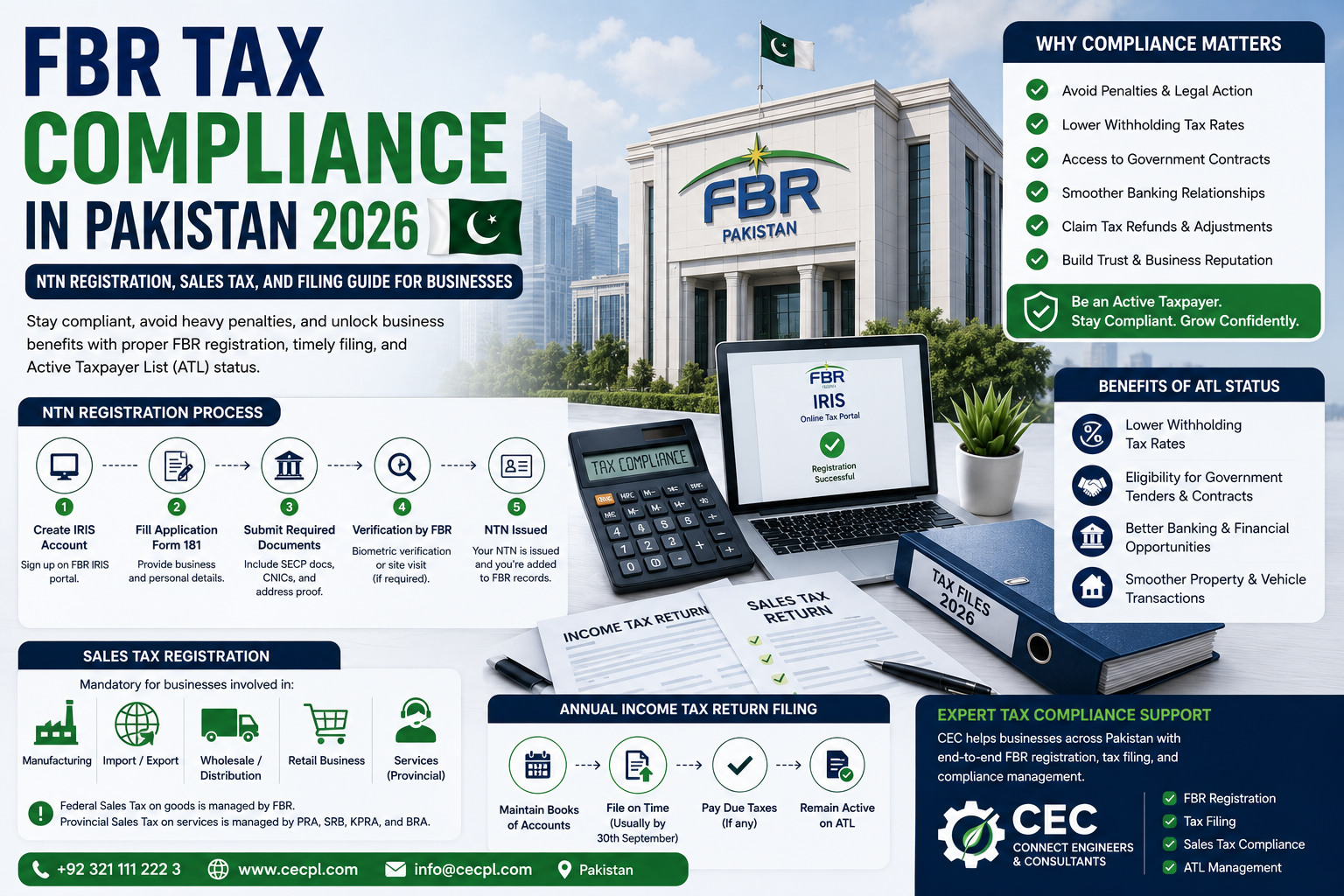
NTN Registration Process
- Create an account on FBR’s online IRIS portal using your CNIC (for individuals) or company registration details (for businesses).
- Complete the registration form (Form 181 for businesses), providing details about your business activity, address, bank account information, and ownership structure.
- For companies, submit your SECP Certificate of Incorporation, Memorandum and Articles of Association, and director/shareholder CNIC details.
- Provide proof of business address, such as a utility bill or lease agreement.
- Submit the application and await verification. FBR may conduct a biometric verification or site visit for certain categories of registration.
- Upon approval, your NTN is issued and your business is added to FBR’s taxpayer database.
Sales Tax Registration: When and Why It’s Required
Sales tax registration with FBR is mandatory for businesses engaged in the supply of taxable goods or services above certain turnover thresholds, and for specific categories of businesses regardless of turnover including manufacturers, importers, wholesalers, distributors, and certain categories of retailers and service providers.
Operating without sales tax registration when required exposes a business to significant penalties, including fines, default surcharge on unpaid sales tax, and potential legal action. Conversely, registered businesses can claim input tax adjustments on their purchases, reducing their effective tax burden a benefit unavailable to unregistered businesses.
Sales Tax Registration Process
- Determine whether your business activity falls under mandatory sales tax registration categories based on FBR’s classification of goods and services
- Register through the IRIS portal, providing business details, bank account information, and details of business premises
- Provide details of all business locations, including manufacturing units, warehouses, and retail outlets, as each may require separate registration in certain provinces
- Note that provincial sales tax on services (administered by provincial revenue authorities such as PRA in Punjab, SRB in Sindh, KPRA in Khyber Pakhtunkhwa, and BRA in Balochistan) is separate from federal sales tax on goods administered by FBR service-based businesses must determine their provincial registration obligations as well
The Active Taxpayer List (ATL): Why Your Status Matters
FBR maintains an Active Taxpayer List that is updated regularly based on timely filing of income tax returns. Your inclusion on this list has direct, tangible financial implications for your business:
- Withholding Tax Rates: Active taxpayers benefit from significantly lower withholding tax rates on banking transactions, property purchases, vehicle registration, contracts, and dozens of other transaction types. Non-active taxpayers can face withholding rates that are double or in some cases even higher than those applied to active taxpayers.
- Government Contracts: Many government tenders and contracts require bidders to be on the Active Taxpayer List as a basic eligibility criterion.
- Banking Relationships: Banks increasingly factor ATL status into their assessment of business customers, particularly for larger transactions and credit facilities.
- Property Transactions: Both buyers and sellers of property face different withholding tax rates depending on their ATL status, making this particularly relevant for businesses involved in real estate.
Maintaining ATL status requires timely filing of your annual income tax return even a single missed or late filing can result in removal from the ATL until the return is filed and, in some cases, until a surcharge is paid for late inclusion.
Annual Income Tax Return Filing
Every NTN holder whether an individual, partnership, or company is required to file an annual income tax return with FBR, declaring their income, expenses, assets, and tax liability for the relevant tax year. The filing deadline for companies typically falls several months after the close of their financial year, while individuals and AOPs (Associations of Persons) generally have a deadline later in the calendar year though FBR periodically extends these deadlines, making it important to stay updated on current-year announcements.
What Your Tax Return Should Include
- Complete declaration of all sources of income, including business income, salary, rental income, capital gains, and any other taxable receipts
- Allowable business expenses and deductions that reduce taxable income
- Wealth statement (for individuals and AOPs) declaring assets and liabilities as of the tax year end
- Tax already paid through withholding at source, advance tax payments, or other mechanisms which is adjusted against your final tax liability
- Computation of final tax payable or refundable based on the above
Withholding Tax Obligations for Businesses
Beyond filing their own returns, businesses in Pakistan often act as withholding agents required to deduct tax at source on certain payments they make, such as salaries to employees, payments to suppliers and contractors, rent payments, and professional service fees. Businesses acting as withholding agents must:
- Deduct the correct withholding tax rate based on the nature of the payment and the recipient’s tax status (active or inactive taxpayer)
- Deposit withheld tax with FBR within the prescribed timeframe
- File periodic withholding tax statements detailing all deductions made
- Issue tax deduction certificates to recipients, who use these to claim credit for tax already withheld when filing their own returns
Failure to properly withhold and deposit tax can result in the withholding agent themselves becoming liable for the unpaid tax, along with penalties and default surcharge making accurate withholding tax compliance a significant risk area for businesses with substantial supplier and contractor payments.
Common FBR Compliance Mistakes Businesses Make
- Delaying NTN registration until a transaction (such as opening a bank account or signing a major contract) makes it urgently necessary, resulting in rushed and error-prone applications
- Failing to register for sales tax when required, often due to misunderstanding which business activities trigger mandatory registration
- Missing income tax return filing deadlines, resulting in removal from the Active Taxpayer List and higher withholding tax rates on all subsequent transactions
- Inconsistent record-keeping that makes accurate return preparation difficult and increases audit risk
- Incorrect withholding tax deductions on supplier and contractor payments, creating liability exposure for the business as withholding agent
- Failing to reconcile sales tax input and output correctly, leading to either overpayment of tax or compliance issues during audits
- Not maintaining proper documentation to support claimed expenses and deductions, which becomes critical in the event of an FBR audit
FBR Audits: What Businesses Need to Know
FBR conducts audits of taxpayer returns based on a combination of risk-based selection criteria and random selection. Businesses selected for audit are required to provide supporting documentation for the income, expenses, and tax positions declared in their returns. Common audit focus areas include large or unusual expense claims, discrepancies between declared income and visible business activity or lifestyle indicators, sales tax input/output reconciliation issues, and withholding tax compliance gaps.
Maintaining organized financial records throughout the year rather than attempting to reconstruct documentation after an audit notice is received is the single most important practice for managing audit risk effectively. Businesses with professional bookkeeping and tax compliance support are significantly better positioned to respond to audit queries promptly and favorably.
How CEC Supports Your FBR Compliance
At Connect Engineers and Consultants, our FBR tax compliance services are designed to take the stress and risk out of tax compliance for businesses of all sizes:
- NTN Registration: We handle the complete NTN registration process for individuals, partnerships, and companies, ensuring accurate and complete documentation from the start.
- Sales Tax Registration: We assess your business activities to determine sales tax registration obligations both federal and provincial and manage the registration process accordingly.
- Annual Return Filing: Our tax team prepares and files accurate income tax returns, ensuring all income, expenses, and deductions are properly declared and your Active Taxpayer status is maintained.
- Withholding Tax Compliance: We help businesses establish correct withholding tax procedures, ensuring accurate deductions, timely deposits, and proper statement filings.
- Sales Tax Return Filing: We manage monthly and periodic sales tax return filings, including input/output reconciliation to optimize your tax position while maintaining full compliance.
- Audit Support: If your business is selected for an FBR audit, our team provides documentation support and represents your interests throughout the audit process.
The Cost of Non-Compliance vs. the Value of Compliance
Many business owners view tax compliance as a cost center a necessary but unwelcome expense. In reality, the cost of non-compliance is almost always significantly higher than the cost of proper compliance. Higher withholding tax rates on every transaction, lost eligibility for government contracts, banking relationship complications, penalties, default surcharge, and the stress and disruption of audits and notices all represent costs that far exceed the investment required to maintain proper FBR compliance from the outset.
Proper tax compliance is not just about avoiding penalties it is a strategic business asset that reduces your effective tax burden, opens doors to opportunities reserved for compliant businesses, and provides the financial credibility that banks, investors, and government agencies look for.
Get Your FBR Tax Compliance in Order Today
Whether you are registering a new business for the first time, addressing gaps in your existing tax compliance, or looking for ongoing tax filing and advisory support, Connect Engineers and Consultants is ready to help. Our team understands the practical realities of FBR compliance for businesses across Pakistan’s diverse sectors from manufacturing and engineering to services and trading.
Contact CEC today to discuss your tax compliance needs and take the first step toward a stress-free, fully compliant tax position for your business.

[…] If you are registered with PSEB as an IT or IT-enabled services company, ISO 27001 also strengthens your profile with foreign buyers. See our PSEB registration guide. […]