

Introduction
Starting a business is one of the most important financial decisions an entrepreneur can make. However, before launching operations, business owners must decide which legal structure best suits their goals.
In Pakistan, the two most common options are:
- Sole Proprietorship
- SECP Registered Company
While both structures allow individuals to operate legally, they differ significantly in terms of legal protection, taxation, compliance requirements, credibility, funding opportunities, and long-term growth potential.
Many startups begin as sole proprietorships because of their simplicity and lower setup costs. On the other hand, businesses aiming for expansion, government contracts, investors, or corporate clients often choose SECP company registration due to its professional structure and legal advantages.As Pakistan’s business environment becomes increasingly regulated and competitive in 2026, understanding the differences between these two structures is essential.
This guide explains everything entrepreneurs need to know about SECP company registration versus sole proprietorship and helps determine which option is best for different business needs.
Understanding Sole Proprietorship in Pakistan
A sole proprietorship is the simplest form of business ownership.Under this structure, a single individual owns and operates the business. Legally, there is no distinction between the owner and the business.
The proprietor is personally responsible for:
- Business debts
- Financial liabilities
- Tax obligations
- Legal disputes
Most freelancers, consultants, small retailers, traders, and service providers start as sole proprietors.
Key Characteristics of a Sole Proprietorship
- Single owner
- Easy setup process
- Minimal compliance requirements
- Lower startup costs
- Direct control over operations
- Personal liability for business obligations
What Is SECP Company Registration?
SECP company registration refers to registering a business entity with the Securities and Exchange Commission of Pakistan. The most common structure is a Private Limited Company (Pvt. Ltd.). Unlike a sole proprietorship, a company exists as a separate legal entity from its owners.
This means:
- The company can own assets
- The company can enter contracts
- The company can sue or be sued
- Shareholders enjoy limited liability protection
Company registration provides a stronger legal framework for business growth.
Types of Companies Registered with SECP
Private Limited Company
The most popular business structure for startups and SMEs.
Single Member Company (SMC)
Suitable for entrepreneurs who want limited liability protection while maintaining sole ownership.
Public Limited Company
Designed for larger organizations seeking public investment.
Non-Profit Company
Registered for charitable, educational, or social welfare purposes. For most businesses, the Private Limited Company or Single Member Company is the preferred choice.
Sole Proprietorship Registration Process in Pakistan
Although sole proprietorships are not registered through SECP, certain registrations may still be required.
Common Requirements
- CNIC of owner
- Business bank account
- NTN registration
- Sales tax registration (if applicable)
- Local business licenses
- Professional permits (industry-specific)
The process is generally simple and affordable.
SECP Company Registration Process in Pakistan
The SECP registration process involves several steps.
Step 1: Name Reservation
Select and reserve a company name through SECP’s online portal.
Step 2: Documentation Preparation
Required documents include:
- Directors’ CNIC copies
- Memorandum of Association
- Articles of Association
- Registered office details
Step 3: Company Incorporation
Submit incorporation documents to SECP.
Step 4: Obtain Certificate of Incorporation
SECP issues the company’s incorporation certificate.
Step 5: NTN Registration
Register the company with FBR for tax purposes.
Step 6: Corporate Bank Account
Open a business bank account in the company’s name.
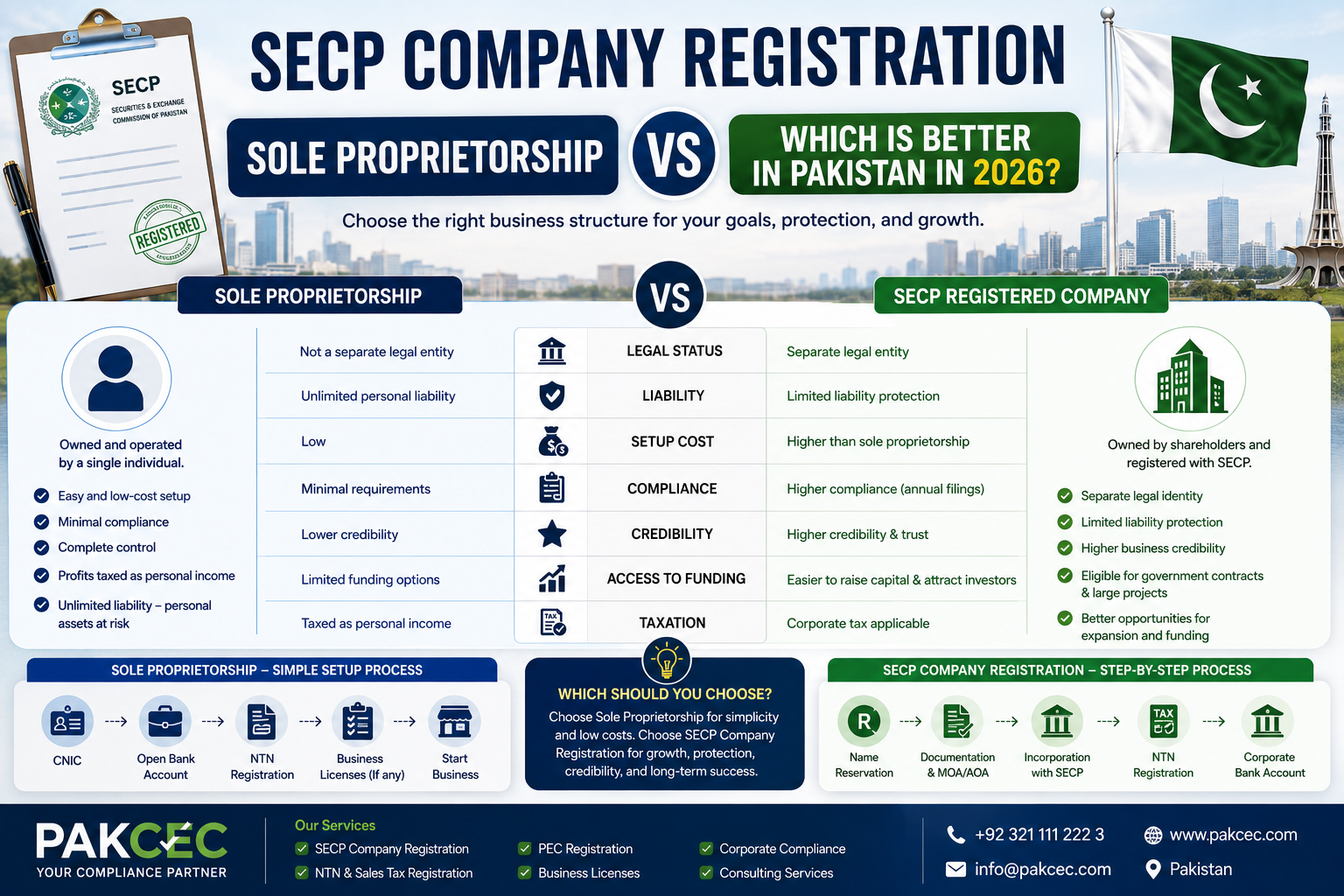
SECP Company vs Sole Proprietorship: Detailed Comparison
Legal Status
Sole Proprietorship
The owner and business are legally the same.
SECP Company
The company is a separate legal entity.
Winner: SECP Company
Liability Protection
Sole Proprietorship
Unlimited personal liability.
Personal assets may be at risk.
SECP Company
Limited liability protection. Shareholders are generally protected from business debts.
Winner: SECP Company
Setup Cost
Sole Proprietorship
Lower registration and compliance costs.
SECP Company
Higher setup and documentation costs.
Winner: Sole Proprietorship
Compliance Requirements
Sole Proprietorship
Minimal regulatory obligations.
SECP Company
Annual returns, statutory filings, and corporate compliance requirements.
Winner: Sole Proprietorship
Business Credibility
Corporate clients often prefer working with registered companies. Government departments and large organizations may require formal company registration.
Winner: SECP Company
Access to Funding
Sole Proprietorship
Funding options are limited.
SECP Company
Companies can:
- Add shareholders
- Attract investors
- Raise capital
- Secure financing more easily
Winner: SECP Company
Taxation Comparison
Sole Proprietorship Taxation
Business income is generally taxed as the owner’s personal income.
Tax obligations depend on:
- Revenue
- Industry
- Registration status
Company Taxation
Companies are subject to corporate tax regulations.
Corporate entities often benefit from:
- Better record keeping
- Structured financial reporting
- Improved tax planning opportunities
Professional tax consultation is recommended for both structures.
Which Option Is Best for Freelancers?
For freelancers, consultants, and independent professionals:
A sole proprietorship may be sufficient if:
- Revenue is relatively low
- Operations are simple
- Growth plans are limited
However, freelancers with growing businesses may consider company registration to improve credibility and protect personal assets.
Which Option Is Best for Startups?
Most scalable startups benefit from SECP registration.
Reasons include:
- Investor readiness
- Legal protection
- Corporate image
- Easier expansion
- Better partnership opportunities
For startups seeking long-term growth, a Private Limited Company is often the preferred choice.
Which Option Is Best for Government Contractors?
Government procurement frequently requires:
- Formal business registration
- FBR compliance
- PEC registration (where applicable)
- Corporate documentation
SECP-registered companies generally have a significant advantage when bidding for government projects.
Common Mistakes Entrepreneurs Make
Many business owners make avoidable mistakes such as:
- Choosing a sole proprietorship despite long-term expansion plans
- Delaying tax registration
- Mixing personal and business finances
- Ignoring compliance obligations
- Operating without proper licenses
Professional guidance can help avoid these issues.
Why Businesses Choose PakCEC
PakCEC helps entrepreneurs and companies navigate the business registration process efficiently.
Our services include:
- SECP Company Registration
- NTN Registration
- Sales Tax Registration
- Business Compliance Consulting
- PEC Registration Support
- Corporate Documentation
- Regulatory Advisory Services
Our experienced consultants help businesses select the most appropriate legal structure based on their goals and industry requirements.
Conclusion
Choosing between SECP company registration and a sole proprietorship is one of the most important decisions a business owner will make. A sole proprietorship offers simplicity, lower costs, and fewer compliance requirements, making it suitable for small businesses and individual professionals. However, for entrepreneurs seeking growth, liability protection, corporate credibility, investor opportunities, and government contracts, SECP company registration provides significant long-term advantages.
In 2026, as Pakistan’s business environment continues to evolve, selecting the right legal structure can play a critical role in a company’s success. Before making a decision, consult with business registration experts to ensure your chosen structure aligns with your operational needs, financial goals, and future growth plans.
