

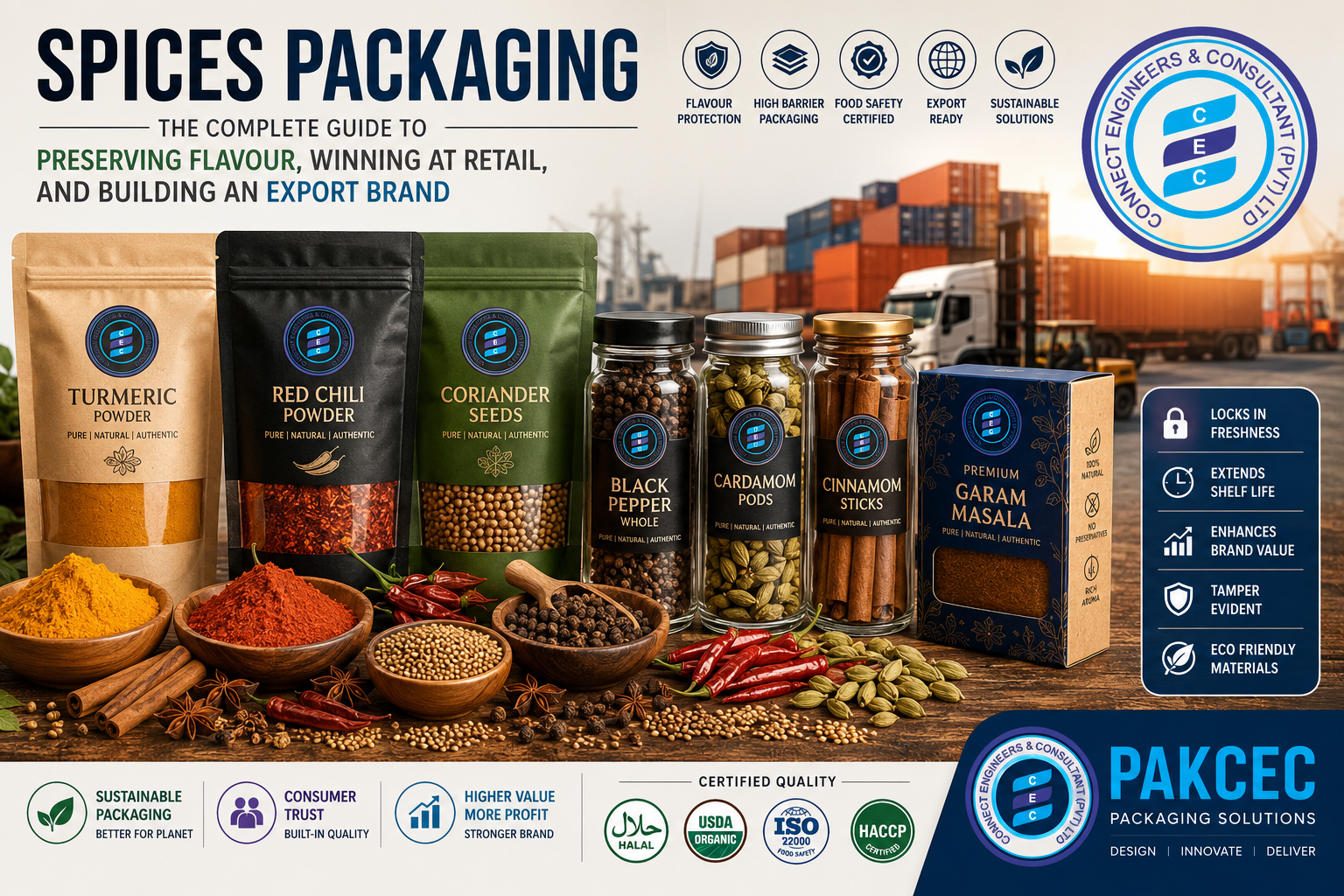
From the ancient Silk Road to the modern global supermarket, spices have been among humanity’s most treasured and most packaging-challenged commodities. A poorly packaged spice is not just a quality failure; it is a waste of everything that went into producing it: the agricultural knowledge, the harvest labour, the processing expertise, and the branding investment. At PackCec.com, we believe every packaging decision for spices should start with the product’s chemistry and end with the consumer’s experience.
1. The Global Spice Market: Understanding the Opportunity
USD 22.7 billion Global spice and herb market value in 2024.
5.8% CAGR projected through 2030 driven by growing global interest in authentic flavors and functional food ingredients.
Pakistan Is one of the world’s top exporters of chilli, cumin, coriander, and turmeric with significant growth opportunity in value-added packaged spice exports.
42% Premium price differential that sustainably certified and properly packaged spices command over commodity equivalents.
The shift from commodity bulk spice trading to branded, traceable, sustainability-certified packaged spice represents the defining commercial opportunity for producers and exporters across South Asia, the Middle East, and Africa.
2. Spice Chemistry and the Science of Packaging Requirements
2.1 Essential Oils: The Heart of Spice Value
- Monoterpenes and Sesquiterpenes: The primary aroma compounds in most spices cumin’s cuminaldehyde, coriander’s linalool, cardamom’s 1,8-cineol. These are volatile at room temperature and migrate through permeable packaging materials.
- Capsaicinoids: The heat compounds in chilli capsaicin and dihydrocapsaicin. Relatively stable but can degrade the polymer matrix of thin flexible packaging over time.
- Curcuminoids: Turmeric’s bioactive pigments responsible for its characteristic yellow colour. Highly sensitive to light (particularly UV and blue light) and alkaline pH.
- Piperine: Black pepper’s heat compound the volatile aroma compounds in pepper (beta-caryophyllene, limonene) degrade rapidly in oxygen and light.
- Allicin precursors: Garlic and onion powder highly volatile sulfur compounds that will transfer odour through inadequately sealed packaging to adjacent products.
2.2 Moisture Activity and Microbial Safety
- Target water activity for ground spices: below 0.7 Aw to prevent mould growth
- Target water activity for whole spices: 0.6–0.7 Aw
- Moisture ingress from poorly sealed packaging can raise water activity to mould-enabling levels within weeks
- High moisture activity also causes caking in powdered spices a significant consumer complaint and quality defect
Note: Aflatoxin risk: chilli, turmeric, and paprika are susceptible to aflatoxin contamination from Aspergillus mould. Packaging that allows moisture ingress creates both quality and food safety compliance risk. EU maximum: 10 ppb total aflatoxins. US action level: 20 ppb.
2.3 Foreign Odour Absorption
Many spices particularly cardamom, vanilla, saffron, and star anise readily absorb foreign odours. Packaging design must:
- Provide complete barrier to external odour migration aluminium foil laminate is the most effective material
- Ensure filling environment is free from competing odours dedicated spice filling lines are best practice for premium products
- Not itself impart odour printing inks, adhesives, and sealant layers in direct contact with spice must be odour-neutral
3. Spice Packaging Formats: Technical Specifications
3.1 Flexible Pouches: The Dominant Retail Format
Stand-Up Pouches (SUPs)
- Bottom gusset creates a stable standing base; commonly fitted with a zipper reseal closure
- Typical sizes: 50g, 100g, 200g, 500g for consumer retail
- Film structure for maximum barrier: PET 12mic / AL 7mic / LLDPE 50mic achieves OTR < 1 cc/m²/day and WVTR < 0.5 g/m²/day
- Zipper specification: zip-lock (press-to-close) for most ground spices; slider zipper for consumers with dexterity limitations
- Printing: up to 10-colour rotogravure on the outer PET layer excellent colour fidelity for product photography
Flat-Bottom Pouches (Box Pouches)
- Four sealed edges with a flat bottom stands on shelf with four visible faces for maximum branding impact
- Projects 3x the shelf presence of an equivalent stand-up pouch
- Used by premium spice brands globally as a differentiation strategy against commodity competitors
Pillow Pouches and Quad-Seal Pouches
- Pillow pouches: lowest cost flexible format suitable for sachets, sample packs, and economy retail formats
- Quad-seal pouches: four vertical seals create a rectangular body standing upright with maximum volume efficiency
- Quad-seal popular in premium organic and specialty spice brands in Europe and North America
3.2 Glass Jars: The Premium Standard
- Neck finishes: standard 38mm, 43mm, 48mm, and 58mm diameters accommodate various dispensing closures
- Jar body: flint (clear), amber, and green glass options; amber for UV-sensitive spices; flint for product visibility
- Volume range: most common retail sizes are 30g–100g spice equivalent
- Shaker inserts: single hole for coarse ground, multiple small holes for fine ground, large holes for whole seeds
- Refillable: glass spice jars can be promoted as refillable, reducing long-term packaging cost for consumers
- Integrated grinding mechanism: dual-chamber mills for whole peppercorns and sea salt command a significant price premium
3.3 Rigid Plastic Jars and Shakers
- PP or PET jars with shaker or grinding closures for mid-market brands
- Clear PET allows product visibility a purchase driver for visually striking spices (saffron strands, mixed peppercorns, dried herbs)
- Airless dispensing: emerging format for premium spice blends maintains aroma by preventing air ingress each time the container is opened
3.4 Metal Tins: Heritage and Gift
- Printed tinplate tins in round, square, and hexagonal shapes
- Gift set tins containing multiple smaller tins particularly popular for premium spice gifting in festive seasons
- Complete light exclusion and excellent oxygen barrier with proper sealing
- Re-usable after product is consumed extended brand touch point
3.5 Sachets: Foodservice and Single-Serve
- Three-side-seal sachets in high-barrier foil laminate for single-serve portions
- Recipe kit sachets: precisely measured spice blends for home cook recipe kits
- Tear-notch specification: easy-open notch with clean, non-fray tear line is critical for consumer satisfaction
- Dual-compartment sachets: two separate chambers in a single sachet allow spice components to be kept separate until use
4. Modified Atmosphere and Active Packaging for Spices
4.1 Nitrogen Flushing
- Replacing headspace oxygen with nitrogen targets residual oxygen below 1% compared to 21% in air
- Requires a nitrogen flush and seal system on the filling line widely available and well-proven
- Shelf life extension vs no treatment: approximately 2x for ground spices, 3x for whole spices
4.2 Oxygen Scavengers
- Small sachets or label-integrated scavenger pads that absorb residual oxygen inside the sealed pack
- Reduces headspace oxygen to near-zero over 24–48 hours after sealing
- Most effective in combination with high-barrier packaging
- Approved food contact materials with migration compliance certification required
4.3 Desiccants
- Silica gel or clay desiccant sachets absorb moisture inside the sealed pack
- Target: maintain water activity below 0.65 Aw throughout shelf life
- Required for spices with higher residual moisture content particularly important in humid climate markets
- Specify food-grade desiccant sachets only
5. Packaging Design: The Spice Visual Identity Challenge
5.1 Colour Psychology in Spice Packaging
- Deep Red and Burnt Orange: Signal heat and flavor intensity perfect for chilli-based products
- Golden Yellow and Turmeric Tones: Communicate warmth, health, and authenticity for turmeric, cumin, and South Asian blends
- Forest Green: Signals freshness and herbaceous quality for dried herbs and green spice blends
- Deep Purple and Plum: Premium cue for exotic spices saffron, sumac, and specialty blends
- Kraft Brown: Artisan and organic positioning must be combined with premium typography to avoid appearing generic
5.2 Typography and Information Architecture
- Spice name as the dominant typographic element minimum 40% of the primary face
- Flavour descriptor as the secondary element: “Rich Kashmiri Red Chilli”, “Warm Ceylon Cinnamon”, “Earthy Cumin”
- Net weight and quality claims in tertiary hierarchy
- QR code linking to recipe content, origin story, and quality certification adding value while keeping the primary face clean
5.3 Photography and Illustration
- Hero ingredient shot: the whole spice in its natural context communicates provenance and authenticity
- Dish photography: a finished dish made with the spice connects the consumer to the end-use occasion
- Flat-lay styling: spice-as-ingredient in an artful kitchen arrangement dominates social media and premium brand imagery
- Hand-drawn botanical illustrations: for heritage and artisan brands particularly effective on gift tins and premium glass jar labels
6. Export Spice Packaging: Regulatory and Market Considerations
6.1 European Union
- EU Spice Regulation: strict limits on contaminants (aflatoxins, pesticide residues, heavy metals)
- Allergen labelling: mustard, celery, and sesame are regulated allergens in the EU required declaration if present in spice blends
- Organic certification: EU Organic regulation governs organic claims must use certified organic ingredients and approved packaging materials
- Country of origin: mandatory for all spices in the EU
6.2 United States
- FDA FSMA requirements: hazard analysis and preventive controls for spice processing facilities
- Nutrition Facts panel: mandatory in US FDA format on all retail packaged food products
- USDA Organic: governed by the National Organic Program distinct from EU organic certification
6.3 Gulf Cooperation Council (GCC)
- GSO standards: Gulf Standardization Organization standards govern quality, labelling, and contaminant limits
- Halal certification: mandatory from a GCC-approved certifying body
- Arabic labelling: all mandatory information must appear in Arabic; additional languages permitted
- Shelf life dating: both manufacture date and expiry date typically required (not just best-before)
7. Frequently Asked Questions
Q: What is the shelf life of properly packaged ground spices vs whole spices?
A: Ground spices in high-barrier packaging with nitrogen flush: 18–24 months. Ground spices in standard flexible pouch without nitrogen flush: 12 months. Whole spices in high-barrier packaging: 24–36 months. Whole spices in standard packaging: 18 months. The greater surface area of ground spices exposes more essential oil to oxygen, explaining the shorter shelf life despite identical packaging.
Q: How do I prevent caking in powdered spice packaging?
A: Prevention requires: (1) ensure incoming spice material is at target moisture content (typically < 10% moisture for ground spices); (2) fill in a low-humidity environment (< 50% RH filling room); (3) include a desiccant sachet inside the pack; (4) use a high moisture-vapour transmission rate (MVTR) barrier film. Anti-caking agents (silicon dioxide, calcium silicate) are permitted in many markets but require label declaration.
Q: What printing method is best for premium spice packaging?
A: Rotogravure printing provides the highest quality and consistency for flexible pouch packaging at scale essential for reproducing accurate food photography and consistent brand colours across large production runs. Flexographic printing is more cost-effective at lower volumes. Digital printing is ideal for short-run, limited edition, or custom varieties where rotogravure unit economics are not viable.
Q: Can I use the same packaging for both organic and conventional spices?
A: The physical packaging format can be the same, but organic certified products require traceability throughout the supply chain. Some organic certifiers require that packaging materials for organic products be kept segregated from those for conventional products. Verify requirements with your specific organic certifier.
Q: How do I ensure my spice packaging complies with Pakistan export standards?
A: For export from Pakistan: ensure packaging carries PCSIR or PSQCA certification where applicable, and that the product meets the importing country’s contaminant limits (particularly aflatoxins and pesticide residues). TDAP (Trade Development Authority of Pakistan) provides export certification support. For GCC markets, Halal certification from an approved body is mandatory. For EU markets, a Phytosanitary Certificate from the Department of Plant Protection is required.
8. PackCec.com Spice Packaging Solutions
- High-barrier flexible pouches: stand-up, flat-bottom, pillow, and quad-seal formats in rotogravure-printed foil laminates
- Glass jars with shaker, grinding, and standard screw-top closures in the full size range
- PP and PET rigid containers with integrated grinding mechanisms
- Metal tins for premium and gift spice packaging
- Sachet filling solutions for foodservice and recipe kit applications
- Active packaging: oxygen scavenger and desiccant sachet integration
- Export packaging consultation for EU, US, and GCC markets
Contact our spice packaging specialists at packCec.com.

[…] If you are registered with PSEB as an IT or IT-enabled services company, ISO 27001 also strengthens your profile with foreign buyers. See our PSEB registration guide. […]