

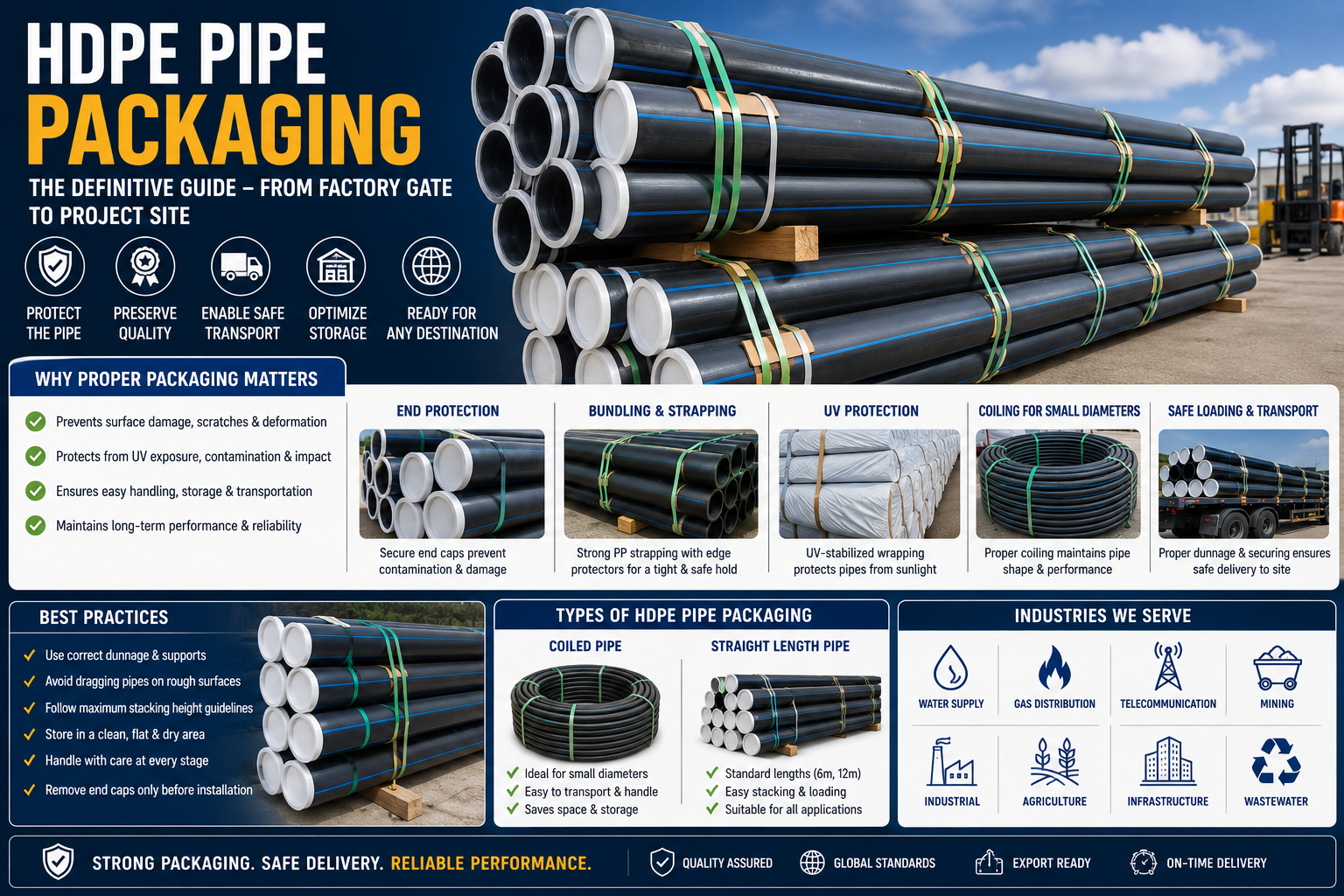
High-Density Polyethylene pipes power the water we drink, carry the gas that heats our homes, and protect the fiber that connects our digital world. The global HDPE pipe market is growing at 5.5% annually yet significant investment is wasted every year by packaging failures that damage pipes before installation begins. This comprehensive guide gives you everything you need.
1. The HDPE Pipe Packaging Paradox
The HDPE Paradox HDPE pipe is extraordinarily tough in service rated for 50–100 years underground. But before installation, it is vulnerable to surface damage, ovality, UV degradation, and bore contamination that can shorten its service life dramatically.
Packaging must account for four distinct risk phases: factory to first warehouse (vibration, impact, weather); primary transport (road, rail, or sea); intermediate warehousing (stack loads, UV, forklift damage); and site delivery and installation preparation (rough terrain, repeated manual handling).
2. The Most Common HDPE Pipe Damage Modes and Prevention
2.1 Surface Scratches and Gouges
HDPE’s smooth surface is vulnerable to abrasion from rough transport vehicle beds, concrete floors, and steel pipe contact. Surface damage creates stress concentration points that reduce long-term pressure performance.
- Use rubber or foam-lined vehicle beds for direct loading
- Place softwood or rubber dunnage between pipe layers in bundled loads
- Use stretch film or shrink wrap as a surface protector for sensitive applications
- Never drag pipes on the ground always lift or roll on rubber rollers
2.2 Pipe Ovality (Out-of-Round Deformation)
Stacking pressure from heavy pipes, or coiling to too-small a diameter, can permanently deform the pipe cross-section. An oval pipe is difficult to connect with standard fittings and may fail pressure testing.
- Specify maximum stack height in accordance with pipe manufacturer recommendations
- Use pipe cradles or A-frame supports for long-term large-diameter pipe storage
- Never coil pipe below its minimum coil diameter typically 20x the pipe outer diameter
- Distribute stack loads with flat wooden sleepers at no more than 1.5m intervals
2.3 UV Degradation
- Carbon-black pigmented pipe (black) provides best UV protection 2% carbon black content gives very long-term UV stability
- Coloured pipes (blue, yellow, orange) contain UV stabiliser additives verify duration rating with manufacturer
- UV-stable white or silver shrink wrap provides additional protection for coloured coils in outdoor storage
- Orient coil stacks to minimise direct sun exposure on end faces
2.4 Bore Contamination
Any foreign material inside pipe intended for potable water, medical gas, or precision pneumatic applications creates a contamination risk impossible to detect after installation.
- End caps are non-negotiable for any pipe destined for sensitive applications
- End caps must remain in place until the moment of jointing
- For potable water pipe: document end cap integrity in the delivery record
2.5 End Damage
Pipe ends are the jointing surfaces even minor deformation can prevent a sound fusion or mechanical joint. This is especially critical for electrofusion and butt-fusion systems.
- Rigid end caps for all pipe diameters above 50mm OD
- Foam ring inserts inside caps provide additional ovality resistance at the end
- Clear marking on caps: “Remove cap before welding” in the project language(s)
3. Coiling: The Art and Science of Small-Diameter HDPE Pipe Packaging
3.1 Calculating Minimum Coil Diameter
- SDR 11 pipe (pressure-rated, thicker wall): minimum coil diameter approximately 25x OD
- SDR 17 pipe (medium wall): minimum coil diameter approximately 20x OD
- SDR 26 pipe (lighter wall): minimum coil diameter approximately 18x OD
Note: Always verify minimum coil diameter with the pipe manufacturer for the specific material and SDR grade.
3.2 Coiling Machine vs Manual Coiling
- Maintain consistent tension throughout the coil, preventing loose inner wraps that collapse in storage
- Achieve precise coil OD and width, optimising pallet space utilisation
- Reduce manual handling injury risk coiling 100m of 90mm HDPE pipe manually is physically demanding
- Enable automatic strapping at programmable intervals without stopping the coiling process
3.3 Strapping Coiled HDPE Pipe
- Minimum three strapping bands per coil evenly spaced at approximately 120-degree intervals
- Polypropylene (PP) strapping preferred over polyester (PET) PP has better elastic recovery when the coil breathes with temperature
- Strap tension: tight enough to hold coil shape; not so tight as to indent the pipe surface
- Protect the pipe at each strap point with corner pads if strap tension is high or pipe wall is thin
- Never use wire or metal banding pipe surface damage and potential cutting hazard
4. Bundling: Packaging Straight-Length HDPE Pipe
4.1 Bundle Configuration
- Hexagonal packing (pipes nested in triangular formation) achieves highest density and most stable bundle geometry
- Standard lengths: 6m and 12m are most common; custom lengths available for project-specific orders
- Maximum bundle weight: determine based on lifting capacity at the destination site typically 1,000–3,000kg
- All pipes in a bundle should be the same OD mixing sizes creates uneven stack loading and increases damage risk
4.2 Dunnage and Separation
- Softwood cradles or rubber pipe separators at minimum 2-metre intervals along the bundle length
- Foam strip tape on all contact points between pipes prevents surface marking from extended storage
- Edge protection at all four corners of the bundle where strapping crosses the pipe
- Top sheet of UV-stable stretch film or corrugated board over the top layer for outdoor storage
4.3 Bundle Strapping
- Minimum two strapping positions per 6m length a 12m length requires four strap positions
- Cross-strapping (diagonal bands) in addition to circumferential bands prevents bundle shift in long-distance transport
- Heavy PP or PET strapping minimum 32mm width for bundles over 500kg
- Strapping tension checked with calibrated tension meter loose strapping allows bundle shift; over-tight damages the pipe surface
5. End Protection: The Detail That Makes All the Difference
- Snap-fit plastic end caps: Correct OD fit a loose cap provides minimal protection; too tight causes damage when fitting. Specify caps by pipe OD and wall thickness.
- Threaded end caps: For larger diameters where snap-fit force would be excessive. Threaded caps also provide better seal against water and insects.
- Foam ring inserts: Inside the end cap, a foam ring supports the pipe end against ovality under static loads in warehouse stacking.
- Colour-coded caps: Match cap colour to pipe application: blue for water, yellow for gas, orange for telecoms. Prevents installation errors.
- Permanent cap ID: Print or stamp the pipe specification on the cap so it is readable without removing the cap useful for receiving inspections.
6. Transport Securing Best Practices
- Distribute load weight evenly across the vehicle bed concentrated loads cause bending in long pipe lengths
- Minimum dunnage at two points per 6m of pipe length increases to three points for pipes over 200mm OD
- Webbing straps at 45-degree angle to the load direction for maximum resistance to longitudinal shift
- Never use chains or wire rope against bare HDPE pipe use rubber-coated or nylon-sleeved chains if chains are required
- For sea freight: verify hold temperature for cold-sensitive specifications HDPE can become brittle below -10C
7. On-Site Storage Best Practices
7.1 Ground Preparation
- Level, firm ground soft or uneven ground allows bundle settlement and uneven loading
- Flat wooden sleepers (minimum 150mm x 50mm) at 1.5m intervals
- Sleepers must be level with each other to prevent rolling
- Create perimeter drainage channels to prevent water pooling under stored pipe
7.2 Stack Height Limits
- 50mm OD SDR 11: maximum 3m stack height
- 110mm OD SDR 11: maximum 2m stack height
- 200mm OD SDR 11: maximum 1.5m stack height
- 315mm and above: maximum single layer storage recommended
Note: Always verify current stack height limits with your pipe manufacturer limits vary by SDR, compound, and ambient temperature.
7.3 Shade and UV Management
- Erect shade cloth or fabric covers over extended outdoor storage even UV-stabilised pipe benefits from shade
- Ensure covers allow air circulation to prevent heat buildup HDPE softens at elevated temperatures
- Rotate coil stacks so the sun-facing side is turned periodically for very long-term site storage
8. Colour Coding, Labelling, and Traceability
- Blue: Potable water BS EN 12201, ISO 4427
- Yellow: Gas BS EN 1555, ISO 4437
- Orange: Telecommunications and data conduit
- Red/Black: Electrical cable conduit
- Green: Sewer and drainage BS EN 13244
- Purple/Lilac: Reclaimed water and irrigation
- Black: All applications where UV exposure is expected
Every pipe package must carry: pipe OD and wall thickness, SDR ratio, pressure rating at 20C, applicable standard, manufacturer identification, production batch number, and best-before date for pipes with UV stabiliser additives.
9. Export Packaging for HDPE Pipe
- Double-layer shrink wrap on all coils inner layer for surface protection, outer layer for weather resistance
- Marine-grade end caps: sealed against water intrusion and rated for humidity above 95% RH
- Fumigation-free timber dunnage specify heat-treated (HT) timber with IPPC marking as required for most destination countries
- Desiccant packs inside shrink-wrapped coils for pipes on long sea voyages
- Export packing list and labelling in English plus the destination country language(s)
- Pallet specification: ISO export pallets where pipe size permits
10. Sustainability in HDPE Pipe Packaging
- Strapping: PP strapping has lower embodied carbon than PET; both are recyclable if returned to manufacturer
- Shrink film: emerging bio-based LLDPE films achieve similar performance with 50–70% lower carbon footprint
- Timber dunnage: specify FSC-certified timber traceable from sustainably managed forests
- End caps: design for return and reuse large-diameter pipe caps are valuable enough to justify a collection scheme
- Transport optimisation: maximise pipe density per vehicle through careful coil and bundle specification
11. Frequently Asked Questions
Q: How long can HDPE pipe be stored outdoors before UV degradation becomes a concern?
A: Black (carbon-black) HDPE pipe can be stored outdoors indefinitely without UV degradation. Coloured pipes with UV stabiliser additives should be verified with the manufacturer — typically 12–24 months outdoor storage is rated. All pipes benefit from shade covering for extended storage.
Q: Can HDPE pipe be transported in freezing temperatures?
A: HDPE becomes less flexible and more brittle below approximately -10C. Pipe should not be dropped or subjected to impact loading in very cold conditions. Reduce drop heights to near-zero and avoid impacts. Some specialist cold-weather grades extend the safe operating temperature range.
Q: What is the correct procedure when pipe arrives on site with damaged end caps?
A: Document the damage photographically before accepting delivery. Inspect all accessible bore surfaces for contamination. For potable water pipe, if bore contamination cannot be confirmed absent, flush per the relevant standard before installation. Raise a non-conformance report with the supplier.
Q: Is it safe to bundle different SDR grades of the same diameter pipe together?
A: Not recommended. Different SDR grades have different wall thicknesses and therefore different stiffness and crush resistance. Mixing SDR grades in a single bundle creates uneven load distribution that can cause the thinner-walled grade to oval under the weight of adjacent thicker-walled pipe.
Q: What fumigation-free timber certification is required for export pipe packaging?
A: ISPM 15 (International Standards for Phytosanitary Measures) requires all wooden packaging material in international trade to be heat-treated to 56C for 30 minutes throughout. Heat-treated timber is marked with the IPPC logo plus country code, producer code, and treatment method (HT). This is mandatory for exports to most countries including EU, US, Australia, China, and Pakistan.
12. PackCec.com HDPE Pipe Packaging Solutions
- PP and PET coil strapping in all widths with calibrated tensioning tools
- UV-stable shrink film and stretch wrap for coils and bundles
- Plastic end caps in the full range of HDPE pipe ODs with colour coding
- Foam ring inserts for large-diameter pipe end support
- FSC-certified and heat-treated timber dunnage
- Custom pipe labelling and stencilling equipment
- Export packing consultation and marine-grade packaging solutions
Speak to our pipe packaging specialists at packCec.com.

[…] If you are registered with PSEB as an IT or IT-enabled services company, ISO 27001 also strengthens your profile with foreign buyers. See our PSEB registration guide. […]