

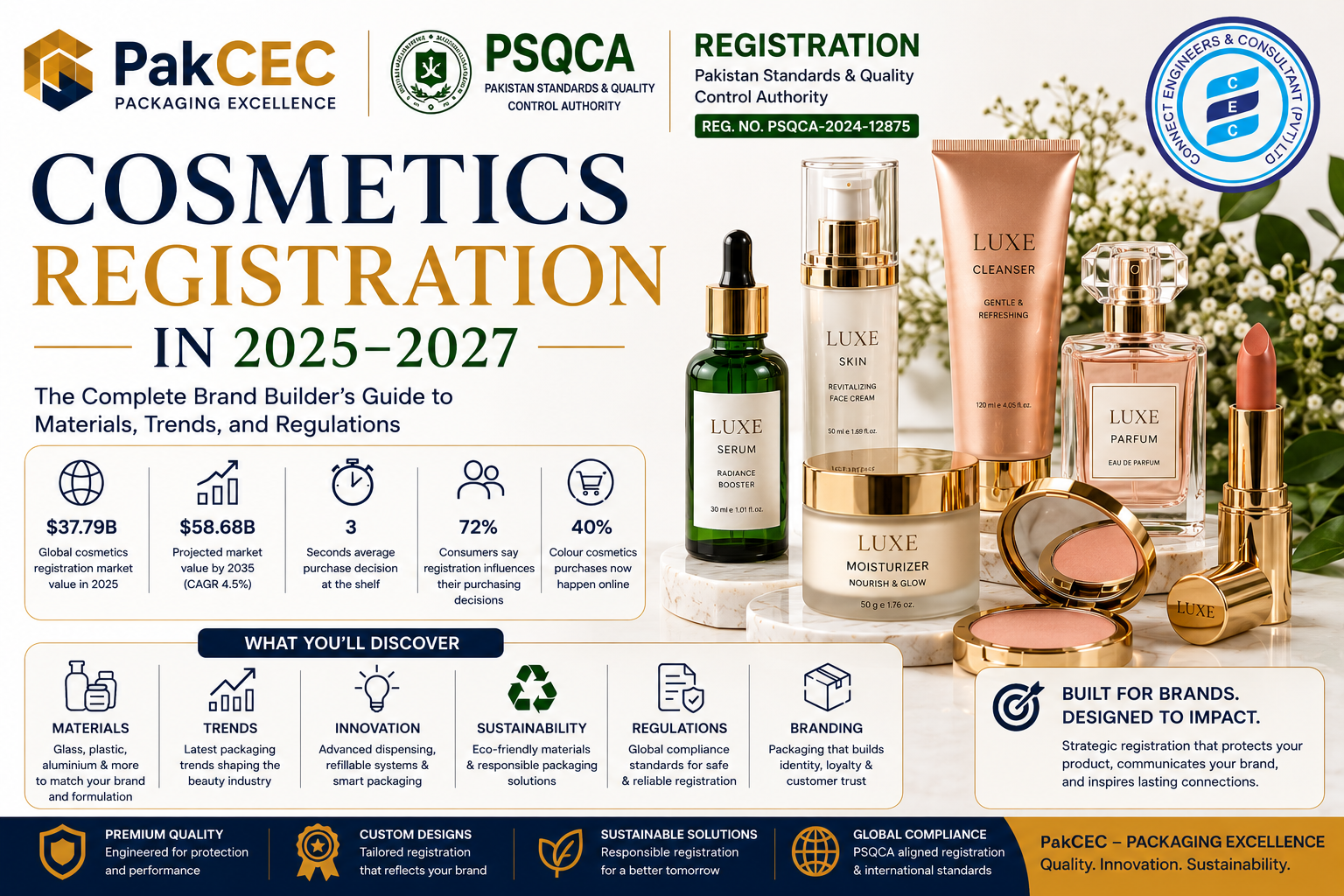
The beauty industry operates at the intersection of science, art, and consumer psychology and packaging sits at the centre of all three. A consumer’s decision to purchase is made in under three seconds at the shelf, and that decision is led almost entirely by packaging. This comprehensive guide explores every dimension of cosmetics packaging: from the psychology of first impressions to barrier material science, sustainability standards, and the regulatory requirements that shape global brand strategy.
1. The Economics of Cosmetics Packaging
USD 37.79 billion Global cosmetics packaging market value in 2025.
USD 58.68 billion Projected market value by 2035 at a CAGR of 4.5%.
3 seconds Average consumer purchase decision time based on packaging at the shelf.
72% Of US consumers say packaging design influences their purchasing decisions (IPSOS 2024).
40% Of colour cosmetics purchases now happen online driving demand for “unboxing-worthy” secondary packaging.
These numbers tell a clear story: in beauty, packaging is not a cost it is a revenue driver. Brands that invest in packaging design and material innovation consistently outperform those that treat packaging as a commodity purchase.
2. The Consumer Psychology of Beauty Packaging
2.1 The Halo Effect
Research consistently shows that premium packaging quality elevates consumer perceptions of the product inside, even when the formula is identical to a lower-priced competitor. This halo effect works in both directions: cheap-feeling packaging undermines even genuinely superior formulations.
- Weight: Heavier packaging is consistently perceived as higher quality why glass and weighted plastic components command premium positioning.
- Sound: The sound a cap makes when it clicks shut is engineered by premium brands a solid, clean click communicates precision manufacturing.
- Texture: Soft-touch coatings, embossed surfaces, and tactile finishes create a physical premium cue that printed imagery cannot replicate.
- Finish: Matte finishes signal minimalism and science; glossy finishes signal vibrancy; frosted finishes signal luxury.
- Colour: White communicates purity; black signals luxury; green signals natural/organic; gold signals heritage and prestige.
2.2 The Social Media Dimension
With 42% of 18–24-year-old beauty consumers citing social media as their primary inspiration source, packaging must now perform on-camera as well as on-shelf:
- Secondary packaging (boxes, bags) creates the first impression in unboxing videos and must be compelling from every angle
- Tissue paper, ribbon, and seal stickers are part of the brand experience, not an expense to be minimised
- Personalisation — the consumer’s name on a box, a handwritten note creates powerful shareable moments
- Limited edition packaging with artistic collaborations creates social media events where earned media far exceeds packaging upgrade cost
- Fragrance — drawer inserts and tissue paper spritzed with the brand’s signature scent engage a sense that standard marketing cannot reach
3. Primary Packaging Deep Dive: Materials and Performance
3.1 Glass
- Complete inertness: glass does not leach any chemicals into the formulation regardless of pH, solvent content, or active concentration
- Excellent barrier: near-zero oxygen and moisture transmission rates protecting sensitive actives better than any plastic alternative
- Infinite recyclability in markets with established glass collection infrastructure
- Premium aesthetic: the weight, clarity, and visual depth of glass cannot be replicated by plastic
- Versatility: can be moulded into virtually any shape; decorated with acid etching, screen printing, hot stamping, and metallisation
Glass disadvantages: weight (higher logistics cost), fragility (breakage in distribution and in the bathroom), and higher filling line cost. For brands targeting the premium segment, these costs are justified by the price premium glass commands.
3.2 Aluminium
- Infinitely recyclable with a well-established collection infrastructure globally
- Excellent barrier to oxygen, moisture, and light —superior to all polymer options
- Lightweight relative to glass comparable protection at lower shipping cost
- Compatible with anodising, printing, embossing, and multi-colour decoration
- Tubes: the standard format for premium skincare, toothpaste, and hair colour provide complete product evacuation and strong luxury signal
- Refillable: aluminium outer compacts with replaceable pressed powder pans are among the most commercially successful refillable beauty formats
3.3 Polymer Plastics
- PET (Polyethylene Terephthalate): Dominant for liquid foundation, serum, and skincare bottles. Excellent clarity, good chemical resistance, lightweight, widely recyclable. Available in PCR grades with 25–100% recycled content.
- PP (Polypropylene): Preferred for compacts, caps, and jar bodies. Good chemical resistance, excellent fatigue resistance for living hinge applications. Widely recyclable.
- HDPE (High-Density Polyethylene): Standard for shampoo and body wash bottles. Good chemical resistance, compatible with most surfactant formulations.
- PMMA (Acrylic): The “luxury plastic” crystal clarity, glass-like weight and feel, excellent scratch resistance. Used for premium jar and bottle bodies in skincare.
- ABS (Acrylonitrile Butadiene Styrene): Standard engineering plastic for compact cases and applicator handles. Durable, accepts vacuum metallisation for mirror finishes.
3.4 Airless Pump Systems
Airless dispensing is one of the most important packaging innovations in skincare as formulations incorporate increasingly potent actives — retinol, Vitamin C, peptides, growth factors:
- Mechanism: a rising piston eliminates the headspace above the product, preventing air from entering as product is dispensed
- Product evacuation: 95%+ vs 70–80% for standard pumps dramatically less product waste
- Dosage consistency: 0.2ml per stroke is the most common dose critical for high-potency actives
- Compatibility: must be engineered for compatibility with the specific formulation high-alcohol or aggressive solvent formulations can cause piston seal failure
- Refillable formats: emerging luxury airless formats use a replaceable inner cartridge in a premium outer case — the circular beauty model in practice
4. Packaging Trends Shaping 2025–2026
4.1 The Skinification of Everything
The convergence of skincare and colour cosmetics is reshaping primary packaging formats. Consumers expect their foundation to deliver SPF, their lip balm to contain hyaluronic acid, and their mascara to include a lash serum tip. This drives:
- Hybrid formats: airless pumps for foundation-serum hybrids that would degrade in conventional pump bottles
- Clinical aesthetics: medical-grade materials (frosted glass, white plastic, aluminium) for colour products carrying skincare claims
- Applicator innovation: precision applicators, roller-ball tips, and micro-needle patches integrated into packaging
- Ingredient transparency on pack: “3% Niacinamide” printed prominently bridges the skincare and colour gap
4.2 Radical Refillability
Refillable beauty packaging is transitioning from marketing claim to commercial reality:
- Compact refills: the highest-adoption format consumers understand the value proposition and savings are tangible
- Skincare pods: precision-dosed active ingredient capsules inserted into a branded dispenser
- Refill pouches: sachets filled with the same formula at significantly lower packaging cost growing rapidly in shampoo and body care
Market Reality Almost 70% of US consumers find in-store refilling inconvenient. Brands achieving real scale with refillables make the home refill process as simple as possible ideally a single-hand pour with no mess.
4.3 Mono-Material Revolution
- All-PP systems: bottle, pump, dip tube, and actuator all in polypropylene a single sortable plastic stream
- All-PE systems: flexible tubes with PE tip and PE cap fully recyclable in PE film streams
- Paper-based: Paperboard tubes with paper membrane seals replacing plastic laminate constructions for powder and balm products
- Design for disassembly: where mono-material is not achievable, designing packaging so components can be easily separated
4.4 Smart and Digital Packaging
- QR codes linking to ingredient safety data, virtual try-on experiences, tutorial videos, and sustainability credentials
- NFC tags enabling anti-counterfeiting authentication and personalised loyalty rewards
- AR-enabled packaging: smartphone-triggered virtual try-on activated by the packaging itself
- Smart dispensers: connected beauty devices that track product usage and reorder product automatically
5. Sustainability: The New Non-Negotiable
5.1 What Sustainable Actually Means in Packaging
- Recyclability: Can this packaging be recycled in the consumer’s local infrastructure? PP is recyclable but not collected curbside in many markets.
- Recycled Content: What percentage of the packaging is made from post-consumer recycled (PCR) material? PCR reduces primary resource extraction.
- Carbon Footprint: What is the total greenhouse gas impact across the full lifecycle? Sometimes the most recyclable material has the highest production carbon footprint.
- Biodegradability: Will this packaging decompose harmlessly if it escapes the waste system? Compostability often requires industrial composting infrastructure.
- Refillability: How many times can this packaging be used? A durable aluminium compact used 10 times has a very different sustainability profile from a disposable plastic case used once.
5.2 Regulatory Landscape for Sustainability Claims
- EU Green Claims Directive: requires quantified, third-party verified evidence for any environmental marketing claim. “Eco-friendly” without substantiation will be prohibited.
- EU Packaging and Packaging Waste Regulation (PPWR): mandates minimum recycled content percentages and recyclability standards for all packaging placed on the EU market by 2030.
- US FTC Green Guides: provide guidance on acceptable environmental marketing claims under revision to address plastic recyclability specifically.
6. Regulatory Requirements: What You Must Know Before You Launch
6.1 Labelling Compliance by Market
- EU (Cosmetics Regulation 1223/2009): INCI ingredient list, responsible person identification, country of origin, net content, use-by date, precautions and usage instructions, batch reference.
- USA (FDA/FD&C Act): Ingredient labelling in INCI order of predominance, net content, distributor identification, required warnings, allergen statements.
- Pakistan (DRAP): Manufacturing licence, composition, batch number, manufacturing and expiry date, country of origin, storage conditions, and DRAP registration number.
6.2 Material Safety
- All packaging materials in direct contact with cosmetic formulations must comply with relevant food contact or cosmetics contact regulations
- Migration testing is required for plastics in contact with formulations particularly important for aggressive solvent-based products
- Ink and coating systems on inner surfaces must be verified non-migratory
- Heavy metal limits in colourants and pigments used in packaging decoration
7. Packaging by Category: Detailed Specifications
7.1 Premium Skincare
- Hero format: glass dropper bottle in 15ml, 30ml, or 50ml for serums and oils amber or frosted for UV-sensitive actives
- Airless pump bottle for formulations containing oxidation-sensitive actives specify 95%+ evacuation and dose consistency testing
- Wide-mouth glass or PMMA acrylic jar for face creams minimum 50ml, maximum 200ml for single product
- Secondary box: rigid-base telescopic box or magnetic closure box printed with soy ink, finished with soft-touch lamination
7.2 Colour Cosmetics
- Foundation: airless pump for serum-foundation hybrids; traditional pump bottle for standard liquid; glass bottle for luxury positioning
- Concealer: retractable twist-up stick, click-pen with applicator tip, or small pump bottle with sponge applicator
- Eyeshadow palette: aluminium or ABS compact with hinged lid; pressed powder pans in magnetic refillable base
- Mascara: sealed tube with wand applicator wand bristle design is a significant differentiator
- Lip colour: classic twist-up bullet; doe-foot gloss applicator in clear tube; cushion lip applicator for cushion-gloss hybrids
7.3 Hair Care
- Shampoo and conditioner: HDPE or PCR-PET bottle 250ml–1000ml with flip-top or pump closure; refill pouches for sustainable positioning
- Hair treatments: glass jar for premium hair masks; squeeze tube for leave-in treatments; pump spray for detanglers and heat protectors
- Hair colour: aluminium tube for cream colour (optimal evacuation); plastic applicator bottle with precision nozzle for root touch-up
8. Frequently Asked Questions
Q: What is the difference between PCR plastic and bio-based plastic?
A: PCR (Post-Consumer Recycled) plastic is made from collected and processed consumer waste it reduces demand for virgin fossil-based resin and supports the recycling economy. Bio-based plastic is made from renewable biological sources (corn, sugarcane) it may or may not be biodegradable. Both have sustainability benefits; PCR is currently more commercially established in cosmetics packaging.
Q: How do I know if my packaging is compatible with my formulation?
A: Formulation-packaging compatibility testing is essential before launch. Testing includes real-time and accelerated stability studies measuring: pH change, colour change, viscosity change, active ingredient degradation, packaging deformation, and migration of packaging materials into the formula. Always conduct testing with final production packaging, not prototypes.
Q: What is the minimum packaging information required to sell cosmetics in Pakistan?
A: DRAP requires: product name and category, list of ingredients (INCI), net content, manufacturing date and expiry date, batch number, country of origin, name and address of manufacturer, storage conditions, DRAP registration number, and any required warnings. Labels must be in English or Urdu or both.
Q: How can I make my cosmetics packaging more sustainable without increasing cost significantly?
A: The highest-impact, lowest-cost improvements are: (1) specify PCR-content resin for plastic components PCR resin is now cost-competitive with virgin resin in many grades; (2) eliminate the outer secondary box for everyday products; (3) concentrate formulations so each bottle delivers more applications; (4) redesign packaging to be mono-material for recyclability without changing visual format.
Q: What is “skinification” and how does it affect packaging design?
A: Skinification is the trend of adding skincare active ingredients (SPF, hyaluronic acid, retinol) to colour cosmetics products. From a packaging perspective, this drives adoption of airless pump formats (to protect sensitive actives), clinical aesthetic materials (frosted glass, white plastic), and precision applicators that communicate science-backed performance.
9. The PackCec.com Cosmetics Packaging Difference
- Primary packaging: bottles, tubes, jars, pumps, droppers, compacts, and palette systems in glass, aluminium, and all major polymer grades
- Sustainable alternatives: PCR-content and mono-material options across all primary packaging categories
- Airless systems: standard and custom airless pump formats with formulation compatibility testing support
- Secondary and tertiary packaging: folding cartons, rigid boxes, tissue, ribbon, and shipper cases
- Regulatory compliance: labelling review for Pakistan, UK, EU, and US markets
- Decoration: screen printing, hot stamping, frosting, and label application
Your brand deserves packaging that performs as brilliantly as your formulations. Contact our team at packCec.com.
