

[ISO Certification] [Pakistan Industry] [Business Future] [Quality Management] [Export] [Transformation]
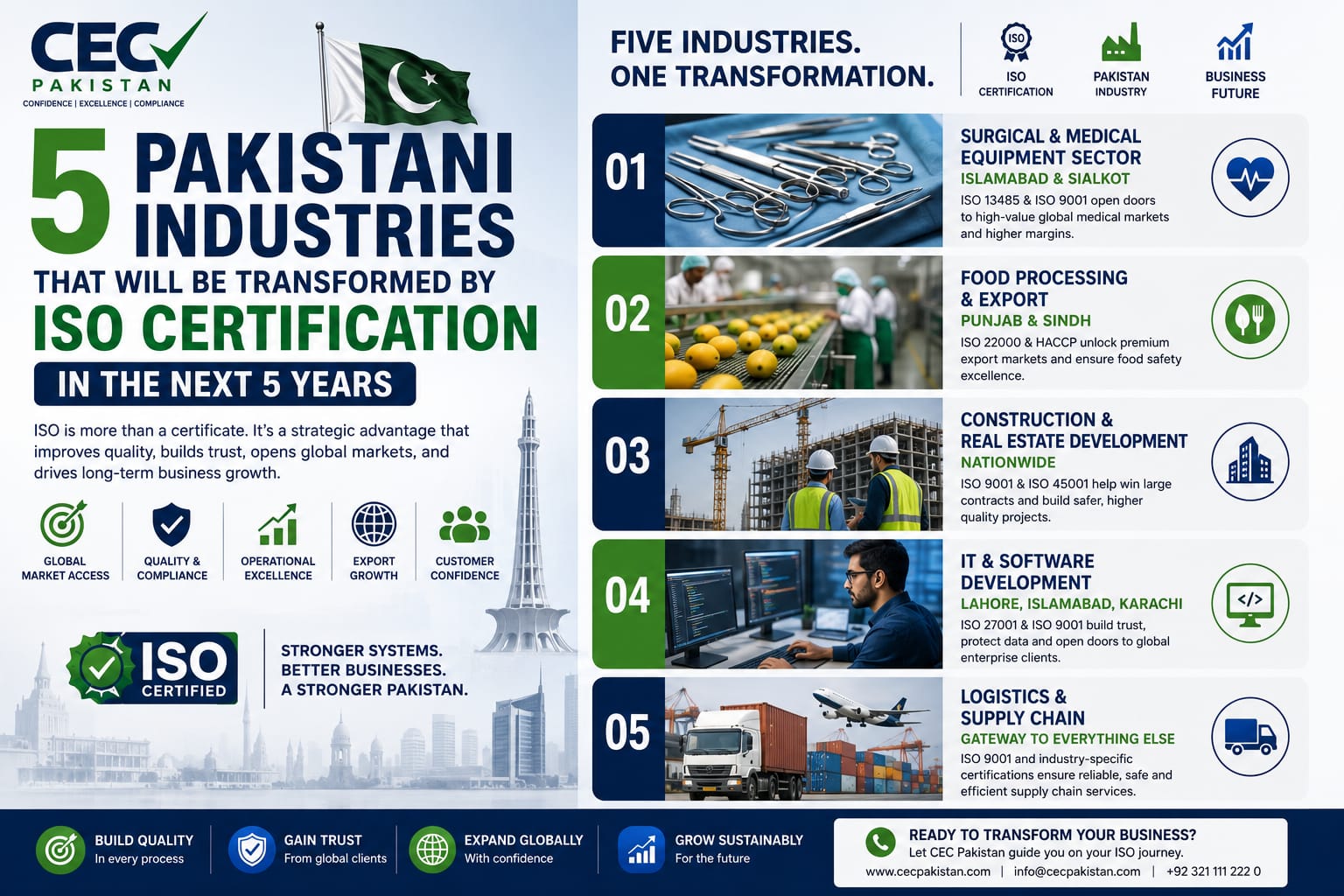
ISO certification is often presented as a compliance checkbox something you get because a client requires it. But the industries that are using ISO strategically are finding that it transforms how they operate, who they can sell to, and how much they can charge. These are the five Pakistani industries where we expect that transformation to accelerate most dramatically in the next five years.
The narrative around ISO certification in Pakistan has traditionally been reactive: a tender requires it, so you get it. But the businesses that are winning in global markets are using ISO differently as a genuine operational discipline that reduces waste, builds client confidence, and unlocks markets that were previously inaccessible. Here are the five sectors where this shift will be most significant.
1. Pakistan’s Surgical and Medical Equipment Sector Islamabad and Sialkot
Sialkot’s surgical instrument industry is already one of Pakistan’s great manufacturing success stories, supplying a significant share of the global market for basic surgical tools. But the sector is at an inflection point. International buyers particularly in Europe, the US, and Gulf markets are increasingly requiring ISO 13485 (Medical Device Quality Management) certification alongside ISO 9001 as a supplier qualification baseline.
Manufacturers who achieve ISO 13485 in the next two years will be positioned to move up the value chain from basic instruments to more sophisticated medical devices a product category commanding significantly higher margins. Those who don’t will face increasing pressure from lower-cost competitors in China and India who already hold the certification. This is one of the clearest examples in Pakistan’s industrial landscape where ISO certification will directly determine which companies survive and which are marginalised.
2. Food Processing and Export Punjab and Sindh
Pakistan’s food processing sector has enormous untapped export potential mangoes, rice, processed fruits, spices, dairy products, and packaged foods could all command premium prices in international markets if they were accompanied by the right quality and safety certifications. ISO 22000 (Food Safety Management) and HACCP certification are the baseline requirements for entry into European supermarket supply chains, US retail food markets, and Gulf institutional food service contracts.
The domestic food processing companies that invest in ISO 22000 certification now are essentially buying access to export markets that are currently closed to them. The regulatory trend in every major importing market is toward mandatory food safety certification for international suppliers and that trend is only tightening. The companies that are certified when these requirements become formal mandates will have a significant first-mover advantage.
Market Opportunity A Pakistani mango processor with ISO 22000 and PSQCA certification is in a fundamentally different competitive position than one without accessing European retailers at premium prices versus selling into commodity markets at margin-destroying rates. The certification investment pays for itself on a single export container.
3. Construction and Real Estate Development Nationwide
Pakistan’s construction sector has historically been characterised by informal quality management experienced foremen and project managers carrying quality standards in their heads rather than in documented systems. This is changing, driven by two forces: the formalization of procurement in government and large private sector projects, and the entry of international developers into the Pakistan market who apply global quality standards to their supply chain.
Construction companies with ISO 9001 and ISO 45001 (Occupational Health and Safety) certification are increasingly winning contracts that their uncertified competitors cannot access. CPEC Phase II infrastructure development, large private real estate projects, and international development organisation contracts all require documented quality management systems. The construction companies that build this capability in the next three years will be positioned to capture a disproportionate share of Pakistan’s infrastructure boom.
4. IT and Software Development Lahore, Islamabad, Karachi
Pakistan’s IT export sector has grown rapidly, with the country now ranking among Asia’s significant software export markets. But the sector is competing for the same global contracts as companies in India, Eastern Europe, and Southeast Asia and international clients at the enterprise level are increasingly applying rigorous supplier qualification criteria that include ISO 27001 (Information Security Management) and ISO 9001.
An IT firm in Lahore competing for a contract to develop a banking system for a UK financial institution will be evaluated not just on technical capability and pricing, but on the maturity of their information security management system. ISO 27001 certification is the internationally recognised evidence of that maturity. Pakistani IT companies that build this certification into their business development strategy are accessing a tier of international contracts that is currently out of reach for most of the sector.
5. Logistics and Supply Chain Gateway to Everything Else
Every export sector in Pakistan ultimately depends on logistic’s freight forwarders, warehousing operators, cold chain providers, and customs clearance agents. As Pakistani manufacturers in food, textiles, pharmaceuticals, and engineering pursue export market certifications, they are beginning to require the same standards from their logistics partners. A food manufacturer holding ISO 22000 certification cannot risk its supply chain being handled by a logistics provider with no quality management system.
ISO 9001 certification for logistics and warehousing companies, combined with sector-specific standards like HACCP for food logistics and temperature-controlled storage certification for pharmaceutical cold chain operators, will become competitive necessities as Pakistan’s export ambitions grow. The logistics companies that invest in certification now will be the ones that premium exporters choose as partners and premium exporters are the highest-value clients in the logistics market.
What These Five Industries Have in Common
In every case, ISO certification is not the end goal it is the enabler. It enables market access, commands higher prices, attracts better clients, and creates operational discipline that reduces costs over time. The companies that treat ISO as a strategic investment rather than a compliance cost are the ones that build sustainable competitive advantage from it.
CEC Pakistan has supported hundreds of companies across all five of these sectors through ISO certification. Our approach focuses on building a management system that genuinely improves how your organisation operates not just creating paperwork that satisfies an auditor. If your business is in any of these sectors and you are thinking about ISO certification, we would be glad to have a conversation about what it would actually mean for your specific situation.

[…] If you are registered with PSEB as an IT or IT-enabled services company, ISO 27001 also strengthens your profile with foreign buyers. See our PSEB registration guide. […]