

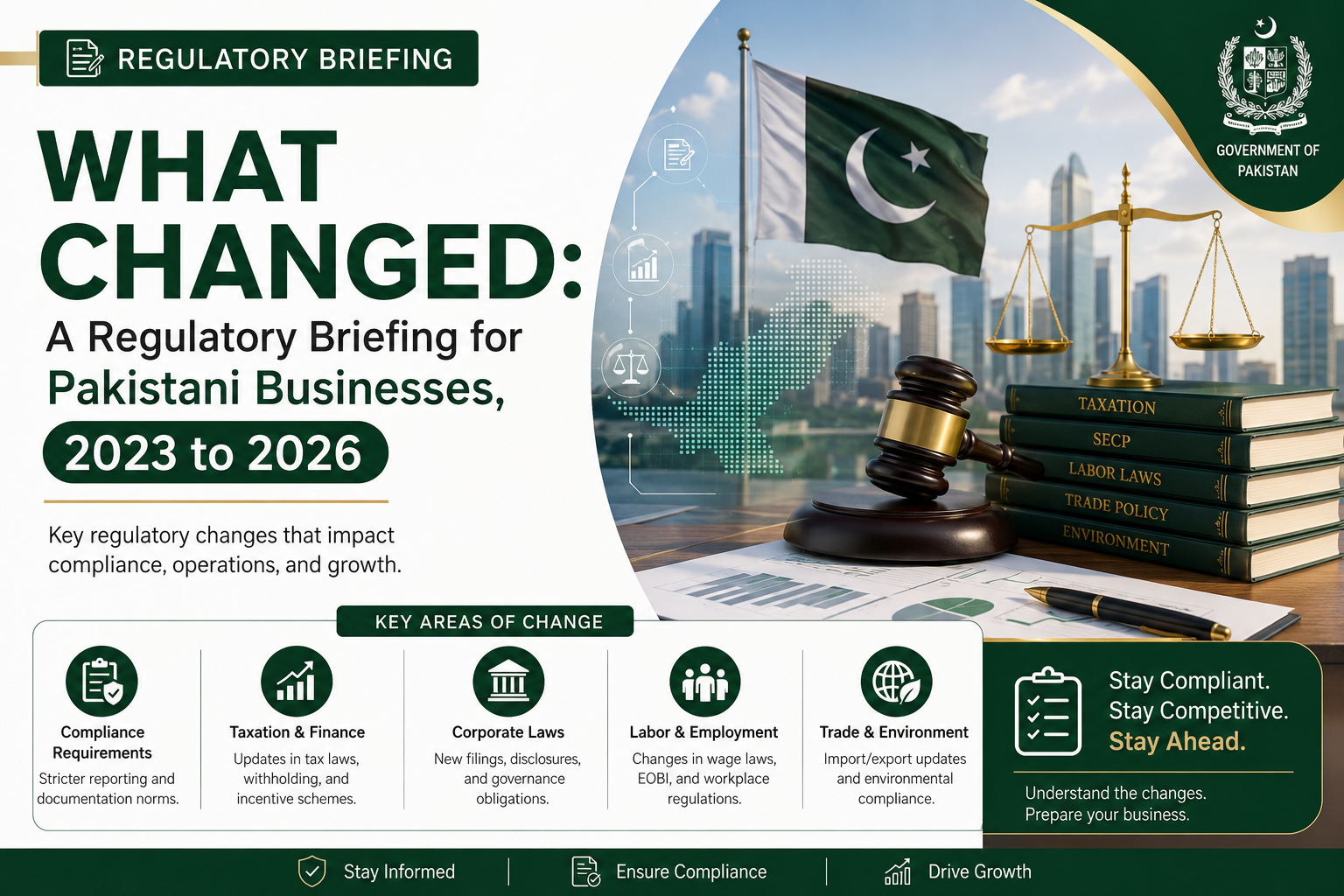
Most compliance problems in Pakistan are not caused by ignorance of the rules. They are caused by knowing the rules as they stood three years ago.
Regulations move quietly. A board merges into another body. A standard gets revised. A province replaces a law that had run since the seventies. None of it makes the evening news, and the advisor working from a 2019 checklist keeps producing files against a framework that no longer exists.
This is a briefing rather than a guide. It lists what has actually changed across corporate, energy, agriculture and product standards since 2023, who each change affects, and what to do about it. Entries carry verification notes where the sourcing warrants one, because a page like this ages and PakCEC would rather you check than take our word for something dated. Where a claim rests on secondary commentary rather than the instrument itself, the text says so.
Corporate and company law
The beneficial ownership regime got teeth.
Ultimate beneficial ownership reporting is not new. The enforcement posture is. Pakistan has been aligning company law with international transparency standards, a dedicated corporate beneficial owner registry was built through amendments to the Companies Regulations 2024, and a risk based supervision methodology followed.
The practical shift is from filing once to maintaining continuously. Reported timelines require updated declarations within a short window after any change in beneficial ownership, and the same short window applies to filing special resolutions that amend your constitutional documents. A register that was accurate at incorporation and never touched since is now an exposure rather than a formality.
Who this hits: every company, and disproportionately those with layered ownership, foreign parents, or shareholders who have changed since incorporation.
What to do: pull your register, compare it against who actually holds and controls the company today, and close the gap. If shares have moved, directors have changed, or a foreign parent has restructured since you last filed, assume the register is wrong until you have checked it.
Multiple SRO notifications landed through 2026.
Reporting suggests several instruments issued during 2026, including a mandatory conversion of physical share certificates to book entry form under SRO 328(I)/2026, proposed amendments to the annual return data fields under SRO 57(I)/2026, and tightened beneficial ownership verification for mergers and schemes of arrangement under SRO 669(I)/2026. Commentators have described the year as the heaviest single year of corporate regulatory change since the Companies Act 2017 replaced the 1984 Ordinance.
Who this hits: companies still holding paper share certificates, anyone filing an annual return, and any business in the middle of a merger or significant asset transfer.
What to do: check whether you hold physical certificates. Many private companies do and have never thought about it. If a transaction is live, confirm the current documentation requirements before filing rather than after a return.
Verification note: the SRO numbers above come from secondary commentary rather than the notifications themselves. Confirm each against the official text before you act on it. SECP corporate services work at PakCEC starts with exactly that check.
Energy
The Alternative Energy Development Board no longer exists as a separate body.
Under Act XXVI of 2023, dated 10 June 2023, AEDB merged into the Private Power and Infrastructure Board and the AEDB Act 2010 was repealed. PPIB now operates as a single window across power technologies.
The certification requirement survived the merger. The industry still calls it AEDB registration, tenders still ask for it, and distribution companies still check it. What changed is which authority and which portal.
Who this hits: every solar company holding or seeking vendor certification, and anyone reading guidance published before mid 2023.
What to do: confirm the current portal and forms before starting a file. Our AEDB energy approvals page covers where this now sits.
Net metering became net billing for new installations.
This is the change with the largest commercial consequence in this entire briefing. In February 2026 the prosumer regulations moved new distributed generation up to 1 MW off net metering and onto net billing. Exported units are now compensated at a reference price rather than the retail tariff, with agreements running on a five year term.
The context explains the intervention. Capacity under the previous regime grew from roughly 190 MW in FY2020 to about 6,978 MW by June 2026, close to a 37 fold rise in six years.
Who this hits: solar installers, EPC contractors, and every commercial or industrial business that modelled a solar payback on net metering assumptions.
What to do: if you are selling solar, your proposal maths needs rebuilding and your product mix should shift toward self consumption, storage and hybrid design. If you are buying solar, recalculate before you sign. Anyone still quoting retail tariff export credits on a new installation is quoting a regime that has moved.
Agriculture inputs
Punjab replaced a fertilizer law that had run since 1973.
The Punjab Fertilizers Control Act 2025 supersedes the Punjab Fertilizers Control Order 1973 and repealed the fertilizer provisions of the older essential articles legislation. It restructures the enforcement chain from provincial level down to tehsil, and places technical control with the Soil Fertility Research Institute.
Two changes matter commercially beyond the headline. The definition of fertilizer now expressly covers bio fertilizers, bio stimulants, crop supplements, soil conditioners, and soil and water amendments, which pulls in businesses that believed they sat outside the regime. And the definition of importer captures buying agents, indenters and manufacturers’ agents, so you can be caught without owning the goods.
Who this hits: fertilizer manufacturers, importers, agents, and anyone selling a soil conditioner or crop supplement in Punjab.
What to do: check whether your product is now within the definition, and confirm which provincial law applies to you, since fertilizer regulation is provincial and Sindh and Khyber Pakhtunkhwa run separate statutes.
Tax and provincial obligations
Taxpayer status enforcement has tightened alongside everything else.
This is less a single change than a hardening across regimes. Active taxpayer status is now checked at submission by bodies that have nothing to do with tax, and the beneficial ownership push has been accompanied by cross referencing between corporate and tax records. The effect for businesses is that a filing gap in one place surfaces somewhere unexpected.
Who this hits: every registered business, and especially anyone who treats tax filing as a year end task rather than a rolling obligation.
What to do: check your status today rather than assuming it. If a sector licence application is coming, check it again on the day you file.
Provincial registration is where growing businesses get caught.
Nothing has changed in the law here, which is exactly the problem. Sales tax on services is provincial, and a business that expanded its client base across provinces during the last two years may have acquired obligations it never registered for. Growth creates exposure quietly.
Who this hits: consultancies, IT firms, and any service business that now invoices outside its home province.
What to do: list the provinces you invoice into, then confirm registration in each. This is a twenty minute check that regularly surfaces a real gap.
Product standards
The bottled drinking water standard has been revised, more than once.
The applicable Pakistan Standard for bottled drinking water is the 2018 fourth revision, carrying a further amendment notified in 2024. Natural mineral water sits under a separate standard entirely, and pre packaged food labelling rules apply on top of both.
This matters because a great deal of published guidance, including material from equipment suppliers, still cites the 2004 revision. A vendor designing your plant against a superseded standard is telling you something about how current their compliance knowledge is.
Who this hits: bottled water producers, plant buyers, and anyone about to sign a turnkey quotation.
What to do: ask which revision your plant is being designed against, and check that your laboratory can actually test the parameters that fail most often in market monitoring. PSQCA product certification files should be built alongside the plant, not after it.
Market surveillance is public, and it names brands.
Quarterly monitoring of bottled water brands is conducted on samples drawn from the open market and shared with the standards authority, provincial governments and food authorities. In one widely reported round covering 176 samples across 20 cities, 28 brands were flagged as unsafe.
Who this hits: every packaged consumer product business, not only water.
What to do: treat market sampling as the real test rather than your application testing. That is a quality control capability question, and it is decided when you specify lab equipment, not when the inspector arrives.
Engineering
Professional Engineer examinations run as a computer based test across the country.
The Engineering Practice Examination is delivered as a computer based test across 16 cities, from Islamabad and Karachi to Swat and Muzaffarabad. Registered engineers who graduated on or after a specified date are eligible, and application windows close well before the exam date.
Who this hits: registered engineers considering the Professional Engineer route, and consultancies whose category depends on staff qualifications.
What to do: check the current exam and application dates directly, since these move annually. PEC engineering services covers the registration side.
What has not changed, and why that matters
Half the value of a briefing like this is stopping businesses from over reacting. These remain as they were.
- Engineering firm licences still run on the fiscal year, 1 July to 30 June, and still lapse on the day. No amount of regulatory modernisation has made that deadline forgiving.
- Active taxpayer status is still the silent blocker. It is checked at submission across multiple unrelated regimes, and it still fails quietly. Our FBR tax compliance work exists mostly because of this.
- Sales tax on services is still provincial. Operating across provinces still creates obligations in each.
- ISO certification is still not a government licence. It carries commercial weight on tender scorecards and with export buyers, and no regulator will stop you trading without it. ISO certification remains worth doing properly or not yet.
- Sequencing still governs everything. Entity, then tax, then sector licence. Changing rules have not changed the dependency chain.
How to use this briefing
Three habits, in order of value.
Check the date on any compliance advice you read, including this page. A guide with no date is a guide you cannot assess. Anything written before mid 2023 on energy, before mid 2025 on Punjab fertilizer, or before 2026 on corporate filings is describing a framework that has moved.
Verify SRO numbers and standard revisions against the issuing authority. Secondary commentary, this article included, is a pointer to the primary source rather than a substitute for it. The cost of checking is an hour. The cost of not checking is a returned file.
Diarise a compliance review twice a year. Not renewals, which you should already track, but a genuine look at whether the rules underneath your registrations have moved. Most of the changes above were public for months before the businesses they affected noticed.
If you want that review done for you, PakCEC has spent 20 years and more than 3,000 registrations and certifications tracking exactly this. Tell us what you hold and what you do, and we will tell you what has moved underneath it. See our business consultancy in Pakistan services, or talk to the PakCEC team.
