
Pakistan's beauty and personal-care market is growing fast, and several everyday cosmetics and toiletries are on the compulsory list of the Pakistan Standards & Quality Control Authority (PSQCA). If you manufacture, import or sell one of these products under your own brand, you need a PSQCA Certification Marks licence before it goes on sale.
This guide sets out which products are covered, the Pakistan Standard for each, where the Drug Regulatory Authority of Pakistan (DRAP) comes in, and what a cosmetics manufacturer needs in place to get licensed.
Cosmetic and toiletry products on PSQCA's compulsory list
These personal-care items appear on PSQCA's list of compulsory items:
| Product | Pakistan Standard | Status |
|---|---|---|
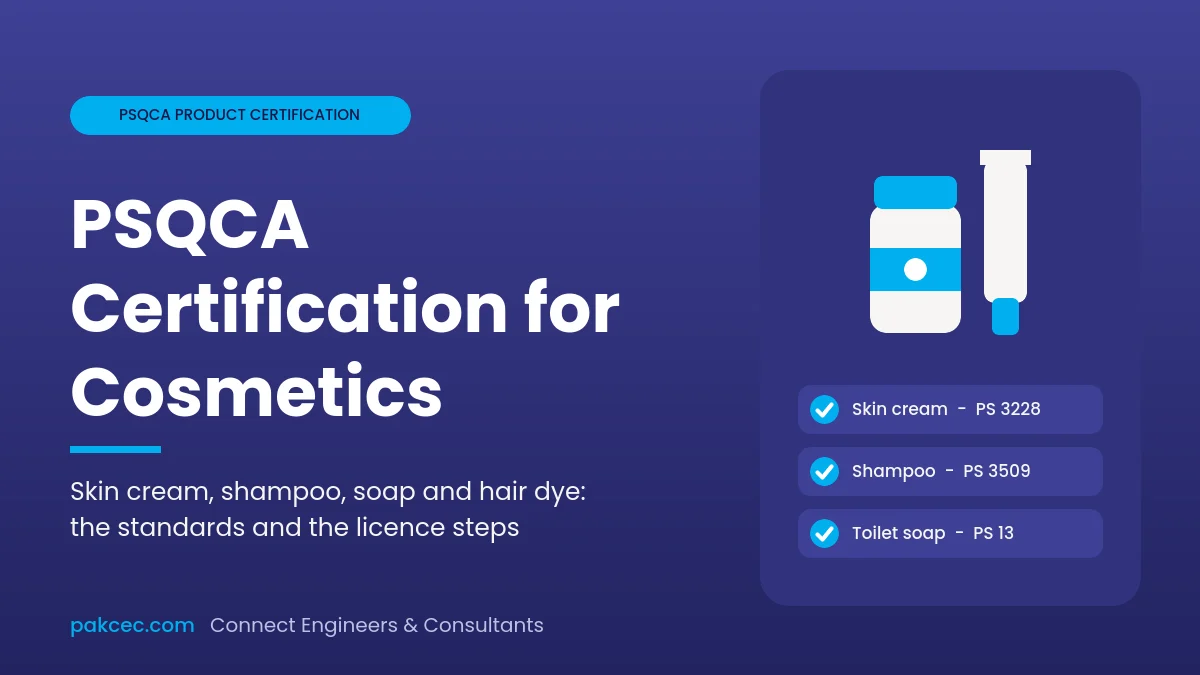
| Skin cream | PS 3228 | Compulsory |
| Shampoo | PS 3509 | Compulsory |
| Toilet soap | PS 13 | Compulsory |
| Toothpaste | PS 1721 | Compulsory |
| Oxidation hair dye (liquid) | PS 5250 | Compulsory |
| Powder hair dyes | PS 4079 | Compulsory |
| Shaving cream | PS 3508-1994 | Compulsory |
| Hair cream | PS 4751-2001 | Compulsory |
| Skin powder | PS 3973-1997 | Compulsory |
Lipstick, nail polish, face wash, perfume, sunscreen and body lotion do not appear on the list. Standards are revised from time to time, so get the current revision of your standard from PSQCA before you apply.
Who needs a PSQCA cosmetics licence?
- Local manufacturers of creams, shampoos, soaps, toothpaste and hair dyes
- Brands whose products are made for them by a third-party manufacturer
- Importers of any listed product
- Online beauty brands selling their own formulations
If a contract manufacturer makes your product, settle in writing who holds the PSQCA licence and who answers for a failed market sample. The brand on the pack is the one buyers and regulators see.
What the cosmetic standards check
Standards such as PS 3228 for skin creams set requirements for product safety and quality, such as pH, stability and limits on harmful substances including heavy metals. They also set labelling rules: ingredients, net content, batch number, manufacturing and expiry dates, and manufacturer details.
Creams sold for skin lightening attract particular attention, because heavy metals such as mercury have been found in products of this kind. Test for them before you apply, not after PSQCA does.
When DRAP is the regulator instead
A product that claims to treat, cure or prevent a condition, such as “treats acne” or “cures dandruff”, can fall under DRAP instead of, or as well as, PSQCA. What you claim on the pack and in advertising can change which regulator owns your product.
Keep your claims cosmetic, or confirm the regulatory route before launch. Our DRAP classification guide explains how that decision is made.
How the licence process works for a cosmetics manufacturer
PSQCA uses the same Certification Marks route for every compulsory product. For cosmetics, each stage looks like this:
- Application. You file an application for each product with the supporting documents, and PSQCA scrutinises and registers it.
- Factory evaluation. Officers visit the unit. Expect them to look at raw-material storage and testing, batch manufacturing records, mixing and filling hygiene, and your laboratory.
- Sampling. Samples are drawn from the line or from finished stock.
- Testing. Samples are tested in your laboratory and at PSQCA's laboratories against the relevant standard.
- Licence. If the product conforms, the licence is issued for that product and you may print the mark.
- Surveillance. PSQCA carries out periodic factory inspections and tests samples from both the factory and the market.
- Renewal. The licence is reviewed and renewed periodically, and can be suspended or cancelled if a product fails to conform.
A formula that passes at lab scale can behave differently in a full production batch, and the market samples come from production. Our guide to why cosmetic formulas fail at production scale covers what to check before you scale up.
Documents to prepare
The core file is the same as for any PSQCA product: proof of company registration, a process flow chart, the quality manual and quality plan, raw-material specifications, a list of test equipment with calibration records, details of QC staff, test reports showing conformity, and factory layout and location plans. Our PSQCA certification checklist sets out every item.
For cosmetics, the part inspectors examine hardest is ingredient control. Keep a full ingredient list for every product, with a certificate of analysis from the supplier for each raw material.
Confirm the current application fee directly with PSQCA before filing, as fees are revised from time to time.
Tips for cosmetic brands
- Get a heavy-metal and safety test report from an accredited laboratory before you apply.
- Keep supplier certificates of analysis for every ingredient, matched to your batch records.
- Check your label against the standard before you print packaging in bulk. Our cosmetics packaging guide covers materials and labelling.
- Apply product by product. A cream and a shampoo are certified against different standards.
Frequently asked questions
Is PSQCA certification required for skin creams?
Yes. Skin cream is on PSQCA's compulsory list under PS 3228.
Is shampoo a PSQCA compulsory item?
Yes. Shampoo is covered by PS 3509.
Do lipstick and face wash need PSQCA certification?
They are not on PSQCA's compulsory list at the time of writing. Check the current list before launch, and check whether any claim you make brings the product under DRAP.
Do imported cosmetics need PSQCA?
Imported products that are on the compulsory list must conform to the relevant Pakistan Standard. Confirm the current import procedure with PSQCA.
Do cosmetics need DRAP registration?
Products with therapeutic or medicinal claims may fall under DRAP. Plain cosmetic products on the compulsory list follow PSQCA's requirements.
How Connect Engineers & Consultants can help
CEC helps cosmetics and toiletries manufacturers and importers prepare the complete PSQCA file: documentation, quality-control setup, pre-testing, readiness for the factory inspection, and follow-up until the licence is issued. If you are building a factory, we also handle cosmetics plant installation, and company registration for a new brand.
Ready to license your cosmetics? See our PSQCA product certification service or talk to our team.
PSQCA's list of compulsory items and Pakistan Standards are revised from time to time. Always confirm the latest standard, fees and requirements with PSQCA before applying.
