

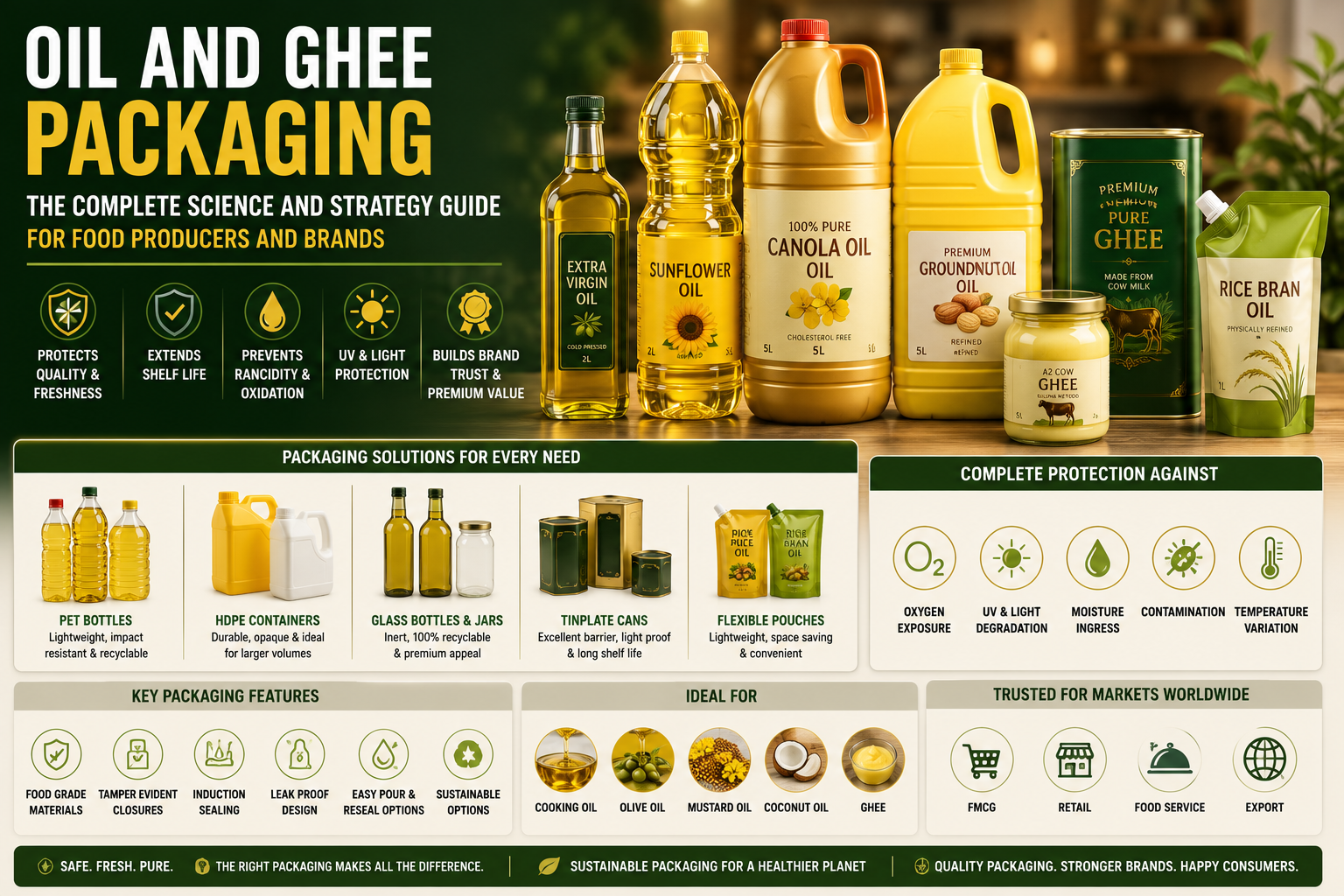
Edible oils and ghee are among the most packaging-critical food products in the world. Their value nutritional, culinary, and commercial is entirely dependent on the integrity of their packaging from the moment of filling to the moment of cooking. Rancidity, contamination, UV degradation, and moisture ingress are not just quality problems: in an era of social media reviews and instant brand reputation damage, they are business-ending failures.
1. The Chemistry of Oil and Ghee Degradation: Why Packaging Is Everything
1.1 Oxidative Rancidity
Oxidative rancidity is the most common form of oil spoilage and the primary packaging engineering challenge. It occurs when unsaturated fatty acids react with oxygen — a process called lipid peroxidation:
- Initiated by oxygen contact, accelerated by light (particularly UV), heat, and metal contamination
- Auto-catalytic once started, it accelerates geometrically as intermediate compounds become catalysts
- Produces hydro peroxides, aldehydes, and ketones the compounds responsible for the characteristic rancid smell and flavor
- Destroys fat-soluble vitamins (A, D, E, K) and antioxidants reducing nutritional value
Oils highest in polyunsaturated fatty acids flaxseed oil, fish oil, sunflower oil are most vulnerable. Ghee, being predominantly saturated fat, is less vulnerable but still sensitive due to its lactone content which contributes its characteristic flavor.
1.2 Hydrolytic Rancidity
Hydrolytic rancidity occurs when water reacts with fat molecules, producing free fatty acids and glycerol:
- Ghee’s exceptionally low moisture content (typically <0.1%) makes it stable against hydrolytic rancidity but only when packaging maintains this low moisture level
- Even small moisture ingress from a poorly sealed closure can trigger hydrolytic rancidity in ghee
- Free fatty acid (FFA) level is the key quality indicator packaging that allows moisture ingress causes FFA levels to rise above regulatory limits
1.3 Photochemical Degradation
- Chlorophyll in unrefined oils acts as a photosensitizer, transferring light energy to oxygen to create highly reactive singlet oxygen
- Singlet oxygen is 1,500 times more reactive than triplet oxygen in oxidation reactions
- Carotenoid pigments responsible for yellow/orange color in palm oil and unrefined sunflower oil fade rapidly under UV and visible light
- Conclusion: colored and unrefined oils require opaque or UV-blocking packaging regardless of other quality parameters
2. Packaging Material Selection: A Comprehensive Guide
2.1 PET Bottles
- Oxygen Barrier: Standard PET has moderate OTR adequate for refined oils with antioxidant addition and 12-month shelf life, but not sufficient for premium cold-pressed or unrefined oils.
- Enhanced Barrier: EVOH barrier layer in multilayer co-extruded PET, or oxygen-scavenger technology integrated into the bottle wall, reduces OTR by 95%+ and extends shelf life to 24 months without preservatives.
- UV Protection: Clear PET provides no UV barrier. Amber or green tinted PET provides partial UV protection. Opaque white PET or UV-blocker additive in the resin provides full UV protection.
- PCR Content: rPET is commercially available in food-grade quality for oil bottles. Key consideration: rPET can have slightly different oxygen barrier performance than virgin PET validate with each PCR content level.
- Heat Resistance: Standard PET should not be used for hot-fill applications (above 60C) without hot-fill grade resin the bottle will deform.
2.2 HDPE Bottles and Containers
- Preferred for cooking oil volumes from 2 litres to 16-litre institutional jerricans
- Naturally opaque when pigmented complete light exclusion available in standard colour options
- Excellent impact resistance for heavy containers that will be lifted and poured repeatedly
- HDPE has lower oxygen barrier performance than PET compensated by opaque pigmentation and antioxidant addition to the oil
- The standard material for ghee in plastic container formats in South Asia and the Middle East
- rHDPE grades available for food contact applications with appropriate migration compliance
2.3 Glass Bottles and Jars
- Absolute inertness no migration of packaging chemicals into the oil, regardless of pH, temperature, or storage duration
- Zero oxygen and moisture transmission the best possible barrier performance
- UV protection: amber glass blocks UV wavelengths to approximately 480nm; dark green glass to approximately 550nm
- Premium aesthetic: the weight, sound, and visual depth of glass communicate premium quality at a level no plastic alternative achieves
- Consumer trust: consumers consistently rate glass-packaged food products as higher quality, safer, and more “natural” in blind tests
- Challenges: weight (higher logistics cost), fragility (breakage in distribution), and higher filling line investment
2.4 Tinplate and Aluminum Metal Cans
- Complete light exclusion the best possible protection against photochemical degradation
- Superior oxygen barrier the internal epoxy lacquer coating provides a hermetic barrier that outlasts most plastic alternatives
- Traditional format associated with premium, authentic ghee in South Asian and Middle Eastern markets
- Extended shelf life: properly sealed ghee in metal tins achieves 24+ month shelf life at ambient temperature without antioxidant addition
- Challenges: higher material cost than plastic, specialist filling equipment required
2.5 Flexible Pouches and Stand-Up Pouches
- Laminate construction: typically PET/AL/PE or Nylon/EVOH/PE the aluminum foil layer provides complete light blocking and very low oxygen transmission
- Spout pouches: standalone pour-and-reseal pouches in 200g to 2kg sizes rapidly displacing rigid containers in economy segments
- Mono-material flexible pouches: all-PE laminate constructions are emerging achieving near-comparable barrier with much improved recyclability
- Hot-fill capability: many laminate constructions are rated for hot-fill applications (up to 90C) required for some ghee filling operations
3. Closure Systems: Where Packaging Integrity Is Won or Lost
3.1 Induction Sealing
Induction sealing is the single most important closure technology for edible oil and ghee packaging:
- Creates a hermetic seal between container neck and foil liner preventing oxygen ingress, moisture ingress, and product leakage
- Provides visible tamper evidence the foil liner must be physically removed before first use
- Extends shelf life by months compared to non-sealed closures in the same packaging format
- Required by FSSAI for ghee and oils sold in retail containers in India, and by equivalent regulations in most export markets
3.2 Dispensing Closures
- No-drip pourers: attached disc with precise pour hole diameter reduces mess and improves consumer satisfaction
- Flip-top dispensing caps: for smaller oil containers and premium formats provides measured dispensing without removing the cap
- Child-resistant closures: required in some markets for certain oil types
- Tamper-evident neck bands: applied over the primary closure for additional visual tamper evidence in export and premium formats
4. Filling Technologies and Their Impact on Packaging Specification
4.1 Cold Fill
Standard filling process for most edible oils. Packaging implications:
- Standard PET, HDPE, glass, or flexible pouch all compatible
- Nitrogen flush of the headspace before sealing is strongly recommended displaces oxygen and significantly extends shelf life
- Fill level critical: insufficient headspace leads to pressure build-up; excessive headspace traps more oxygen
4.2 Hot Fill (Ghee)
Ghee is typically filled in its liquid state at temperatures between 65C and 85C. Specific requirements:
- PET: must use hot-fill grade resin (HF-PET) standard PET deforms above 60C
- HDPE: most grades handle hot-fill temperatures without deformation
- Glass: compatible with hot-fill without modification the preferred format for premium ghee
- Metal tins: ideal for hot-fill ghee metal conducts and distributes heat evenly and resists deformation
5. Labelling: Regulatory Requirements and Premium Design
5.1 Mandatory Label Information (Pakistan/South Asia)
- Product name and type (e.g., “Pure Cow Ghee”, “Refined Sunflower Oil”)
- Net content (weight and/or volume)
- Ingredients and permitted additives
- Nutritional information per 100g and per serving
- Best-before date and batch number
- Manufacturing date
- Storage instructions
- Manufacturer name, address, and FSSAI/DRAP/GSO registration number
- Country of origin for imported products
- Halal certification authority logo and certificate number essential for Muslim consumer markets
5.2 Premium Label Design for Ghee
- Heritage Cues: Illustrations of traditional brass vessels, pastoral farm scenes, and regional motifs communicate authentic small-batch production.
- Ingredient Provenance: “A2 Milk from Desi Cows”, “Grass-Fed Bilona Method”, “Single-Origin Farm Ghee” provenance claims command premium pricing.
- Minimalist Typography: Clean, premium sans-serif fonts with generous white space project quality and differentiate from commodity ghee brands.
- Gold Foil Accents: Hot-foil stamping in gold on label or direct on packaging surface is the single most cost-effective premium cue in ghee packaging.
6. Export Packaging for Oil and Ghee
- Language requirements: labels in English plus local languages Arabic for Gulf markets, French for some European markets
- Halal certification: GCC markets require Halal certification from an approved authority specify on both label and shipping documents
- Enhanced barrier: export journeys may expose product to higher temperatures in containers consider EVOH barrier layer or enhanced antioxidant package
- Outer carton specification: export cartons should meet minimum ECT 44 for road/sea multimodal transport
- Pallet specification: ISPM 15 heat-treated timber pallets for all wooden pallet exports
- Temperature monitoring: data loggers in reefer containers for premium ghee and cold-pressed oil exports
7. Frequently Asked Questions
Q: How long can ghee be stored, and what packaging format gives the longest shelf life?
A: Properly produced and packaged ghee can be stored at ambient temperature for 12–24 months. Metal tins with vacuum sealing provide the longest shelf life up to 24 months. Glass jars with induction seals achieve 18–24 months. PET bottles with EVOH barrier and nitrogen flush achieve 12–18 months.
Q: Can I use the same PET bottle for both oil and ghee?
A: Technically the same bottle design can be used, but the fill process and closure specification differ. Ghee is typically hot-filled and requires hot-fill grade PET resin. Oil is typically cold-filled with standard PET. Additionally, ghee’s higher viscosity requires a different neck finish and closure design for clean dispensing. Always validate specifications for each specific product.
Q: What does Halal certification require from a packaging perspective?
A: Halal certification for packaging requires: (a) no use of animal-derived processing aids or materials in manufacturing the packaging; (b) no cross-contamination with non-Halal products in the packaging manufacturing facility; (c) documentation of material supply chain. For most modern plastic and glass packaging, Halal compliance is straightforward request a Halal Material Declaration from your packaging supplier.
Q: What is the difference between best-before and expiry date for edible oils?
A: “Best before” indicates when the product is expected to be at peak quality it remains safe to consume after this date though sensory qualities may decline. “Expiry date” indicates the date beyond which the product should not be consumed for safety reasons. Edible oils generally carry “best before” dates. Verify your specific regulatory requirement per market.
Q: How do I prevent ghee from absorbing foreign odours during storage?
A: Ghee readily absorbs foreign odours through any permeable packaging. Prevention requires: (1) hermetic sealing induction seal is mandatory; (2) storage away from strongly scented products; (3) use of aluminum foil laminate or glass rather than standard PET which has some odor permeability; (4) warehouse segregation ghee should not be stored adjacent to cleaning products, spices, or other strongly scented goods.
8. PackCec.com Oil and Ghee Packaging Solutions
- PET bottles in the full range from 500ml to 5 litres standard and hot-fill grades, clear and tinted, with barrier options
- HDPE containers from 1 litre to 16-litre jerricans in food-grade formulations
- Glass bottles and jars in amber, green, and clear for premium and export ghee and oil
- Metal tins in traditional round and square formats for ghee
- Flexible pouches and spout pouches in high-barrier laminate constructions
- Induction seal closures for all container formats
- Custom label printing and shrink sleeve application
- Halal-compliant material declarations and certifications
Connect with our food packaging specialists at packCec.com for a tailored consultation
