

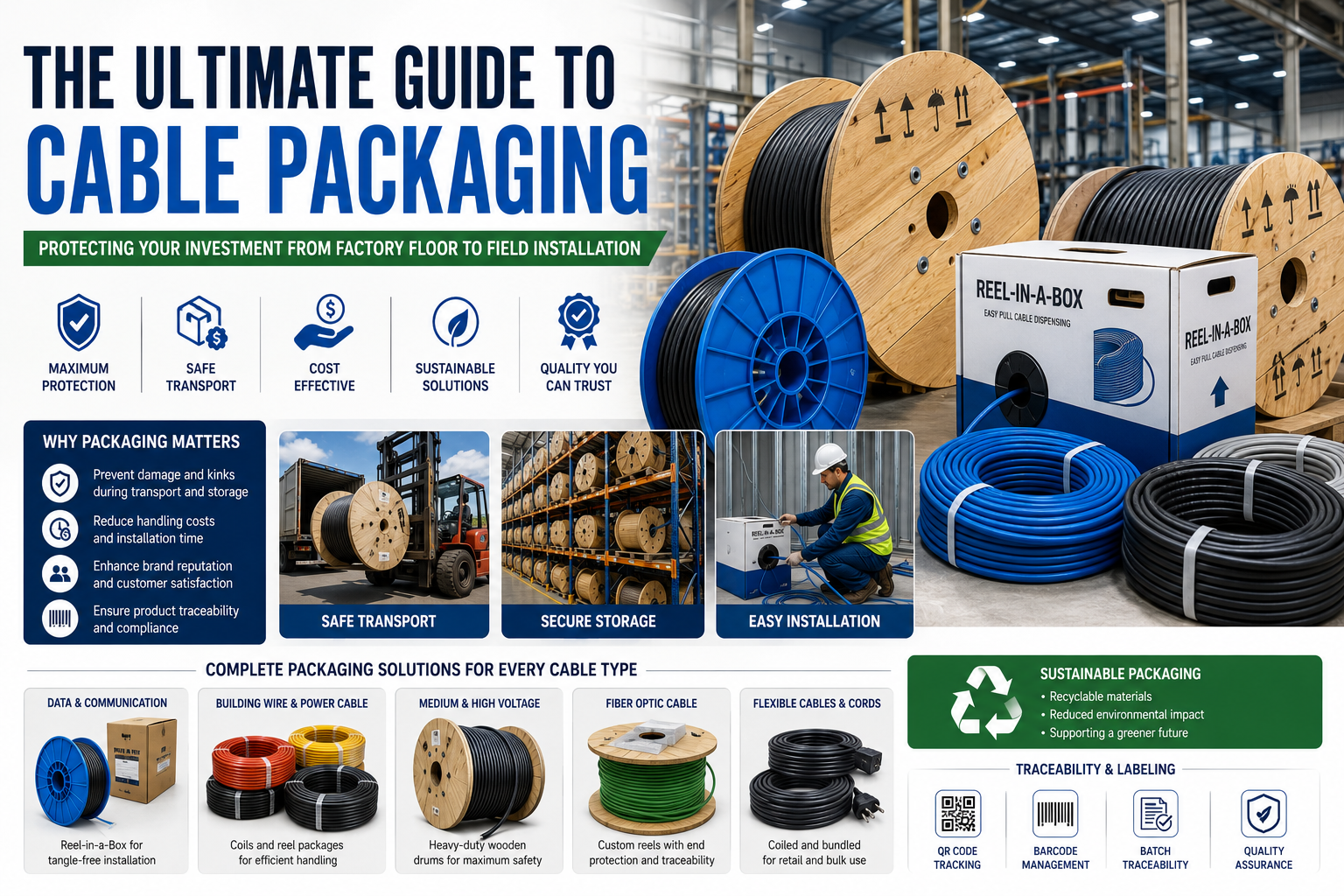
Every metre of cable your factory produces represents engineering precision, raw material investment, and quality assurance effort. That investment can be undone in minutes by packaging that fails during transport, storage, or installation. This comprehensive guide covers every dimension of cable packaging so you can deliver products that arrive perfect, every time.
1. The Business Case: Why Packaging Failures Cost the Industry Millions
Most cable manufacturers are meticulous about conductor quality, insulation integrity, and voltage testing yet packaging is frequently under-resourced. The consequences are significant:
Up to 15% of cable returns in B2B are caused by packaging failures, not production defects.
USD 2–7 is the rework cost per metre when cable arrives kinked or tangled at an installation site.
3–5x is the cost of premium packaging versus standard yet one damaged shipment can exceed a year of packaging savings.
Beyond direct costs, packaging failures damage commercial relationships. Contractors who open a drum to find tangled cable will remember that experience at the next tender. In competitive markets, packaging reliability is a genuine commercial differentiator.
Industry Insight Major data centre operators and grid contractors increasingly audit packaging specifications during supplier qualification. Poor packaging can disqualify a cable manufacturer from preferred supplier lists regardless of product quality.
2. Understanding Cable Types and Their Packaging Requirements
2.1 Data and Communications Cables
Category 5e, 6, 6A, and fibre optic cables represent the highest-volume segment of the structured cabling market. These cables are small in diameter (typically 5–7mm OD), available in 305m and 500m standard lengths, sensitive to kinking, and frequently pulled directly from the box on site.
Best packaging format: Reel-in-a-Box (carton reel). The inner plastic reel maintains controlled coils; the outer double-wall corrugated box protects during transit and provides a dispense hole for direct pull-out installation. Cable arrives tangle-free with no installer preparation required.
2.2 Building Wire and Power Cable (Low Voltage)
Non-metallic sheathed cable, armoured cable, and low-voltage power cables are packaged on coils with shrink wrap for smaller gauges, plastic reels for medium gauges, and knockdown cardboard reel-in-box for contractor convenience. Weight is a primary concern installers must be able to lift and carry packaging single-handed. Maximum target weight: 25kg for retail environments, 50kg for trade wholesale.
2.3 Medium and High Voltage Power Cables
Cables rated from 6.6kV to 500kV for grid infrastructure are among the most technically demanding to package. They are heavy and inflexible, typically shipped on large wooden or steel drums, may weigh from 500kg to over 20,000kg per drum, and are transported by specialist heavy haulage. Drum engineering is a discipline in itself.
2.4 Fibre Optic Cable
Fibre optic cables require the most careful handling of any cable category. Absolute minimum bend radius must never be exceeded during coiling or storage. Crush resistance of the packaging must prevent any point loading on the cable. End caps are critical to protect polished fibre ends. Premium fibre cable is packaged on custom-designed fibre reels with foam-padded end caps and individually serial-numbered for traceability.
2.5 Flexible Cables and Cords
Extension cords, appliance leads, and flexible power cords are packaged as coils, figure-8 wound coils (to eliminate internal twist), retail hangtag packaging for hardware stores, and bundled packs for bulk wholesale distribution.
3. Cable Packaging Formats: A Complete Technical Reference
3.1 Standard Plastic Reels
Plastic reels have largely replaced heavy wooden reels for most applications. When selecting reels, specify:
- Hub Diameter (Core Bore): Must keep cable above its minimum bend radius at the innermost layer. Rule of thumb: core ID at least 10x cable OD for power cables, 12x for data cables.
- Flange Diameter: Determines maximum coil diameter and therefore maximum length per reel at a given cable diameter.
- Flange Strength: Must withstand stacking loads typically tested to 200–300kg static load.
- Arbour Bore: Must match standard dispenser and uncoiler spindle sizes at customer facilities (most common: 30mm and 50mm).
- UV Stability: Essential for outdoor storage carbon-black or UV-stabiliser additive provides 12–24 months outdoor exposure resistance.
- Material Colour Coding: Reel colour can distinguish cable types, voltage ratings, or conductor counts reducing picking errors in warehouses.
3.2 Reel-in-a-Box (Carton Reel)
The dominant packaging system for structured cabling and building wire. Key design elements:
- Double-wall corrugated construction (minimum ECT 44) for robust protection against stacking and transit impacts
- Reinforced pull-out hole with smooth edge guide a rough edge damages cable sheathing during installation
- Dual carrying handles on front and back panels, reinforced with internal handle inserts, sized for gloved hands
- Length indicator window showing a descending scale from full to empty through a transparent panel
- Anti-tamper seal across the pull-out hole to demonstrate product integrity in the distribution channel
- Moisture-resistant corrugated with water-activated tape closure for humid environment storage
Competitive Advantage Contractors who experience smooth, tangle-free cable installation from a well-designed box become loyal repeat customers. Poorly designed boxes lose repeat business.
3.3 Coils
The most economical format for short lengths and small-diameter wire. Critical quality parameters:
- Coiling Tension: Must be consistent throughout the coil. Variations cause inner layers to collapse, creating tangles.
- Coil Diameter: Must respect the cable minimum bend radius. Under-diameter coiling is the most common cause of kinked cable returns.
- Tie Method: Use at minimum three equidistant ties per coil. Paper or fabric ties are preferred over plastic ties.
- Figure-8 Coiling: Standard round coiling introduces one twist per revolution. Figure-8 coiling cancels this twist and is strongly recommended for flexible cables.
- Shrink Wrap: UV-stable clear shrink wrap protects the coil during transport and allows product markings to remain visible.
3.4 Heavy Drums for Power Cable
- Drum sizing: Drum ID calculated from cable minimum bend radius; drum OD and width must fit transport vehicle dimensional limits.
- Lagging boards: Radial wooden boards fixed to the outer cable layer protect from crushing during forklift handling and ship loading.
- Drum end caps: Pressed steel or heavy-duty plastic caps protect the cable from impact during unloading. Secured with bolts, not clips.
- Cable end sealing: Each cable end should be fitted with a heat-shrink or mechanical seal to prevent moisture ingress during ocean freight.
- Drum marking: Drum weight (tare and gross), drum ID, cable details, and shipping marks painted on the drum flange.
4. Packaging Materials: Properties, Performance, and Selection Guide
4.1 Double-Wall Corrugated Cardboard
- Edge Crush Test (ECT) rating: 44–51 ECT for standard applications; 71 ECT for high-stack environments
- Burst strength: minimum 275 PSI for carton-reel outer boxes
- Moisture resistance: specify water-resistant treatment for humid climates and outdoor storage
- Printability: excellent full-colour flexographic printing at reasonable cost
- Recyclability: fully recyclable in standard paper/cardboard streams
4.2 UV-Resistant HDPE Plastic Reels
- UV stabiliser content: minimum 0.5% UV-stabiliser or 2% carbon black for outdoor exposure rating
- Service temperature: typically -20C to +60C verify for hot climate storage
- Impact resistance: far superior to cardboard for rough handling in construction environments
- Reusability: plastic reels can be designed for return-and-reuse schemes, amortising the higher initial material cost
4.3 Steel Drums
- Gauge: typically 1.2–2.5mm cold-rolled steel for power cable drums
- Surface treatment: hot-dip galvanised or epoxy-painted for corrosion resistance in maritime environments
- Weld quality: drum welds must be full-penetration and pressure-tested flange weld failures during cable unreeling create dangerous sudden release
5. Cable Identification and Traceability Systems
Comprehensive identification on cable packaging is now a regulatory requirement and procurement prerequisite for major infrastructure projects:
- Cable type, construction description, and applicable standard (e.g., IEC 60227, BS 6004, ASTM B8)
- Conductor material, cross-section, number of conductors, and colour code
- Voltage rating and temperature rating
- Drum or reel serial number linked to production test records
- Manufacturing date and batch number
- Drum length and tare/gross weight
- 1D barcode for warehouse management system integration
- 2D QR code linking to online product specification sheet, test certificate, and BIM data
Forward-thinking manufacturers are implementing RFID tags embedded in the reel hub allowing automated inventory management in both manufacturer warehouses and contractor storage yards.
6. Sustainability Roadmap for Cable Packaging
6.1 Quick Wins (Implementable Now)
- Replace plastic cable ties with paper ties reduces single-use plastic with no impact on protection
- Transition to water-activated paper tape from plastic tape fully recyclable and stronger than most plastic tape
- Specify minimum 30% post-consumer recycled content corrugated for all outer boxes
- Right-size reel dimensions to the cable length oversized reels waste material and increase transport volume
- Eliminate inner plastic bags for data cable boxes cable enters the branded box directly from the reel
6.2 Medium-Term Initiatives (12–36 Months)
- Reel return and reuse scheme establish a logistics-efficient collection system, particularly for high-volume customers
- Compostable shrink film bio-based alternatives now available with near-equivalent mechanical and UV performance
- PCR-content plastic reels recycled content PP and HDPE resins are commercially available
- Carbon footprint labelling quantify and disclose packaging carbon footprint as part of Environmental Product Declarations
6.3 Long-Term Vision (3+ Years)
- Closed-loop drum systems for heavy power cable manufacturer-owned drums leased to contractors, refurbished and reused indefinitely
- Bio-based resins for plastic reels sugarcane-derived PE as drop-in alternative to fossil-based resin
- Digital product passport packaging-embedded digital identity linking each drum to full environmental impact data
7. Case Studies
7.1 Data Centre Structured Cabling Contractor
A structured cabling installer serving hyperscale data centre clients demanded packaging usable directly during installation without re-handling. Solution: Custom carton-reel with a guided pull-out hole angled at 15 degrees to the box face, allowing cable to unwind at installation pace without a second operator. Result: 40% reduction in installation labour per floor.
7.2 Export Power Cable Manufacturer
A medium-voltage cable manufacturer exporting to humid tropical climates experienced cable sheath discoloration and joint rejection due to moisture ingress during ocean freight. Solution: Heat-shrink cable end seals, foil laminate drum end paper with desiccant sachets, and marine-grade epoxy drum painting. Result: Zero moisture-related rejections over the following 18-month export programme.
8. Frequently Asked Questions
Q: What is the minimum bend radius for data cable, and how does it affect reel selection?
A: The minimum bend radius for typical Cat6 cable is 4x the cable outer diameter during installation and 8x for permanent installation. A carton-reel with a core diameter below these thresholds will cause permanent performance degradation. Always verify with the cable manufacturer specification sheet.
Q: Can I use recycled corrugated cardboard for data cable boxes?
A: Yes , recycled corrugated performs equally to virgin-fibre corrugated for most cable packaging applications. Specify minimum ECT 44 and verify moisture resistance treatment if outdoor storage is expected.
Q: How do I prevent cable tangles when packaging coiled wire?
A: Three measures: (1) use a coiling machine with consistent tension control; (2) use figure-8 coiling for flexible cables; (3) use minimum three equidistant ties. Manual coiling by hand produces inconsistent tension and significantly higher tangle rates.
Q: How do I calculate the correct drum size for a given cable specification?
A: Drum sizing calculation requires: cable minimum bend radius (determines minimum drum core diameter), cable outer diameter (determines cable layer depth), total cable length, and transport constraints. Most drum manufacturers offer sizing calculators. PackCec.com provides a free drum sizing consultation for regular customers.
Q: What information is legally required on cable packaging labels?
A: Requirements vary by market. Most developed markets require: product name, applicable standard, conductor specification, voltage rating, and manufacturing identification. EU CPR additionally requires Declaration of Performance and CE marking for cables used in construction. Always verify current requirements for specific export markets.
9. PackCec.com: Your Cable Packaging Partner
- Standard and custom plastic reels from 100mm to 800mm flange diameter
- Carton-reel systems for data cable, building wire, and flexible cable
- Heavy-duty corrugated outer boxes with custom printing in up to 6 colours
- Steel and composite drums for medium and high voltage cable export
- Sustainable packaging alternatives including PCR-content reels and compostable shrink film
- Labelling and QR code integration for full traceability
- Packaging line audit and specification review service
Our team includes packaging engineers with direct cable industry experience. Contact PackCec.com today , www.packCec.com
Good packaging protects a cable, but it cannot make it compliant. In Pakistan, PVC insulated power and lighting cables are a compulsory PSQCA item; see our guide to PSQCA certification for electric cables and wires for the PS 60227 tests and licensing steps.

[…] If you are registered with PSEB as an IT or IT-enabled services company, ISO 27001 also strengthens your profile with foreign buyers. See our PSEB registration guide. […]