

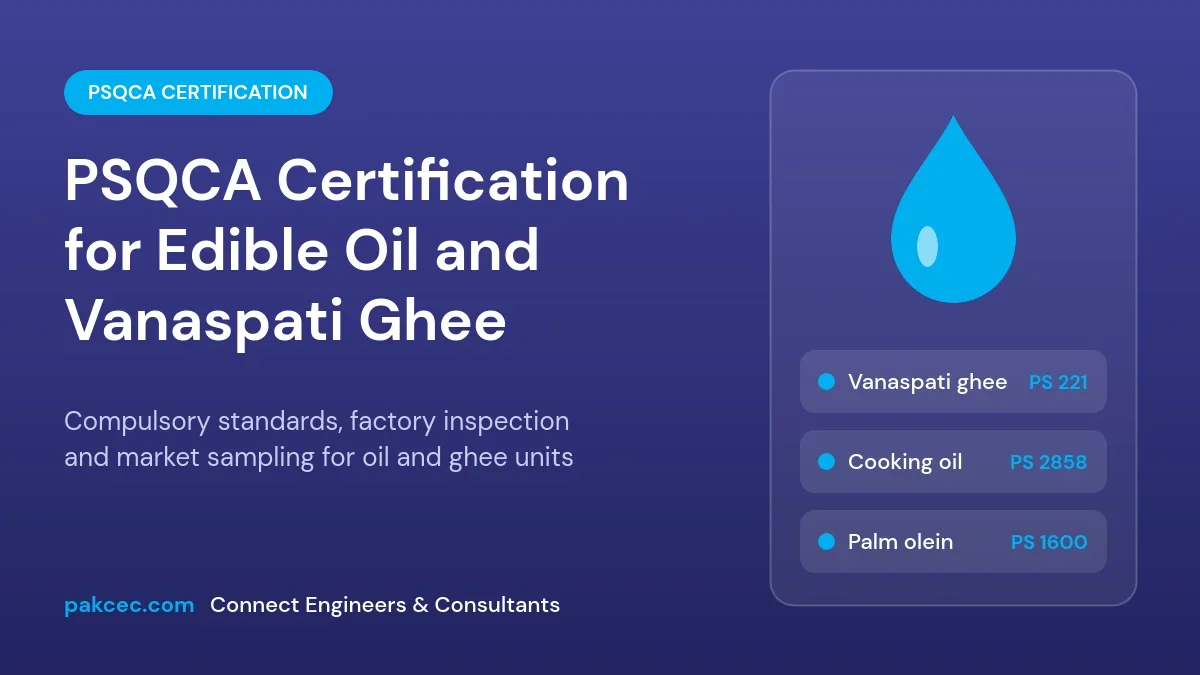
Cooking oil and vanaspati ghee are among the most closely watched products on the compulsory list of the Pakistan Standards & Quality Control Authority (PSQCA). If you refine, blend or pack edible oil or ghee, or sell it under your own brand, each product needs a PSQCA Certification Marks licence before it goes to market, in addition to a licence from your provincial food authority.
Scrutiny of the sector has also increased. In August 2026, tests by PCSIR, consolidated by PSQCA, found that 98 of 204 packaged vanaspati ghee samples and 40 of 146 blended cooking oil samples did not meet standards, and the federal government set up a technical subcommittee to recommend regulatory action. This guide explains which oils and fats are covered, the Pakistan Standard for each, and what a refinery or packing unit needs in place to get licensed and stay licensed.
Edible oils and fats on PSQCA’s compulsory list
These edible oil and fat items appear on PSQCA’s list of mandatory items notified under section 14 of the PSQCA Act, 1996:
| Product | Pakistan Standard | Status |
|---|---|---|
| Vanaspati (banaspati) ghee | PS 221 | Compulsory |
| Cooking oil | PS 2858 | Compulsory |
| Refined palm olein | PS 1600 | Compulsory |
| Palm oil, edible | PS 1562 | Compulsory |
| Refined soybean oil | PS 1563 | Compulsory |
| Refined sunflower oil | PS 1564 | Compulsory |
| Refined maize (corn) oil | PS 1652 | Compulsory |
| Cotton seed oil | PS 21 | Compulsory |
| Mustard oil | PS 25 | Compulsory |
| Coconut oil (expelled) | PS 99 | Compulsory |
| Margarine | PS 1653 | Compulsory |
Oils that are not named separately, such as canola, are usually sold as cooking oil or as part of a blend. Ask PSQCA which standard your exact product falls under before you design the pack, and get the current revision of that standard, because standards are revised from time to time.
Who needs a PSQCA licence for oil or ghee?
- Ghee mills producing vanaspati or banaspati ghee
- Edible oil refineries
- Blending and packing units that buy refined oil and pack it under a brand
- Private-label brands that have oil or ghee packed for them by a third party
- Importers of packed edible oil, ghee or margarine
A private-label brand cannot rely on the packer’s licence for a different brand. The licence is issued for a product, at a factory, under a brand, so check whose name is on each licence before you sign a packing agreement.
What the oil and ghee standards check
The standards set limits for the properties that show whether an oil is what the label says and whether it is still fresh. Typical parameters include:
- Free fatty acids and acid value, which rise when oil is poorly refined or stored badly.
- Peroxide value, the main early sign of rancidity.
- Moisture and impurities.
- Identity characteristics such as iodine value, saponification value and refractive index, which reveal blending with a cheaper oil.
- Melting point for vanaspati ghee and margarine.
- Labelling, including the name of the oil and the composition of any blend.
Fortification. Pakistan has required vitamin A fortification of ghee and oil since 1965, and, as Nutrition International reports, harmonised provincial regulations now cover vitamins A and D. Build the dosing step and its records into your process from the start.
Trans fats. According to APP, PSQCA brought cooking oils and banaspati ghee under trans-fat regulation in 2023. This matters most for vanaspati, which has traditionally relied on partial hydrogenation. Confirm the current trans-fat limit in the revision of PS 221 you are certified against, and test for it.
Why ghee and blended oil fail more often
The 2026 results showed vanaspati ghee failing at almost twice the rate of blended cooking oil. In our experience, most failures come from a few recurring causes rather than from deliberate adulteration:
- The label does not match the blend. A pack that leads with “canola” or “sunflower” but contains mostly palm olein will fail on identity tests and on labelling.
- Fortification is not dosed consistently, especially on smaller lines where premix is added by hand.
- Oil degrades after it leaves the factory. Peroxide value and free fatty acids keep rising in hot warehouses and in packs that let in light and air. Our oil and ghee packaging guide covers the materials that slow this down.
- The process is not controlled for trans fats, which is a newer requirement for many ghee mills.
Market sampling is where these problems surface. PSQCA tests packs from shop shelves as well as from the factory, so a product that passed at the gate can still fail months later in a retailer’s storeroom.
You also need a food authority licence
PSQCA certification does not replace food authority licensing. Your mill or packing unit must also be licensed and inspected by the food authority of its province. In Punjab, that means a Punjab Food Authority licence. PSQCA certifies the product against its standard; the food authority licenses the premises and the business.
How the licence process works for an oil or ghee unit
PSQCA uses the same Certification Marks route for every compulsory product. For an edible oil or ghee unit, each stage looks like this:
- Application. You file an application for each product with the supporting documents, and PSQCA scrutinises and registers it.
- Factory evaluation. Officers visit the plant. Expect them to look at crude oil reception and storage, the refining, bleaching and deodorising stages, hydrogenation or interesterification for ghee, fortification dosing, filling and packing, and your laboratory.
- Sampling. Samples are drawn from the line or from finished stock.
- Testing. Samples are tested in your laboratory and at PSQCA’s laboratories against the relevant standard.
- Licence. If the product conforms, the licence is issued for that product and you may print the mark.
- Surveillance. PSQCA carries out periodic factory inspections and tests samples from both the plant and the market.
- Renewal. The licence is reviewed and renewed periodically, and can be suspended or cancelled if a product fails to conform.
If a product has already failed a market sample or your licence has been suspended, our guide to responding to regulatory action sets out what to do first.
Documents to prepare
The core file is the same as for any PSQCA product: proof of company registration, a process flow chart, the quality manual and quality plan, raw-material specifications, a list of test equipment with calibration records, details of QC staff, test reports showing conformity, and factory layout and location plans. Our PSQCA certification checklist sets out every item.
For an oil or ghee unit, inspectors look hardest at incoming crude oil test records, batch records for each refining run, fortification records, and your in-house testing for free fatty acids, peroxide value and moisture. Our QC laboratory guide covers the equipment you need. Confirm the current application fee directly with PSQCA before filing, as fees are revised from time to time.
Tips for oil and ghee producers
- Test every incoming consignment of crude or refined oil and keep the results with the batch record.
- Write down the blend ratio for each product and make sure the label reflects it.
- Keep fortification premix records that show the quantity added to each batch.
- Retain samples from each batch for the full shelf life, so you can answer a market-sample failure with evidence.
- Apply product by product. Vanaspati ghee, cooking oil and palm olein are each certified against a different standard.
Frequently asked questions
Is PSQCA certification compulsory for cooking oil?
Yes. Cooking oil is on PSQCA’s compulsory list under PS 2858, and several single oils, including refined palm olein (PS 1600), soybean (PS 1563) and sunflower oil (PS 1564), are listed under their own standards.
Which standard applies to vanaspati ghee?
Vanaspati (banaspati) ghee is certified against PS 221. Ask PSQCA for the current revision before you apply, as it is revised from time to time.
Do I need a separate licence for each oil I sell?
Yes. Each product is licensed against its own standard, so a mill that sells ghee, cooking oil and palm olein needs a licence for each.
Does a private-label oil brand need its own PSQCA licence?
Yes. The licence is tied to the product, the factory and the brand, so a brand packed by a third party needs a licence in its own name.
Do I still need a food authority licence?
Yes. PSQCA certification and provincial food authority licensing are separate requirements, and an oil or ghee unit needs both.
How Connect Engineers & Consultants can help
CEC helps edible oil refiners, ghee mills, packers and private-label brands prepare the complete PSQCA file: documentation, quality-control and laboratory setup, pre-testing against the standard, readiness for the factory inspection, and follow-up until the licence is issued. We also handle company registration and food authority licensing if you are setting up a new oil or ghee business.
Ready to license your oil or ghee? See our PSQCA product certification service or talk to our team.
PSQCA’s list of compulsory items and Pakistan Standards are revised from time to time. Always confirm the latest standard, fees and requirements with PSQCA before applying. This guide is general information, not legal advice.
