
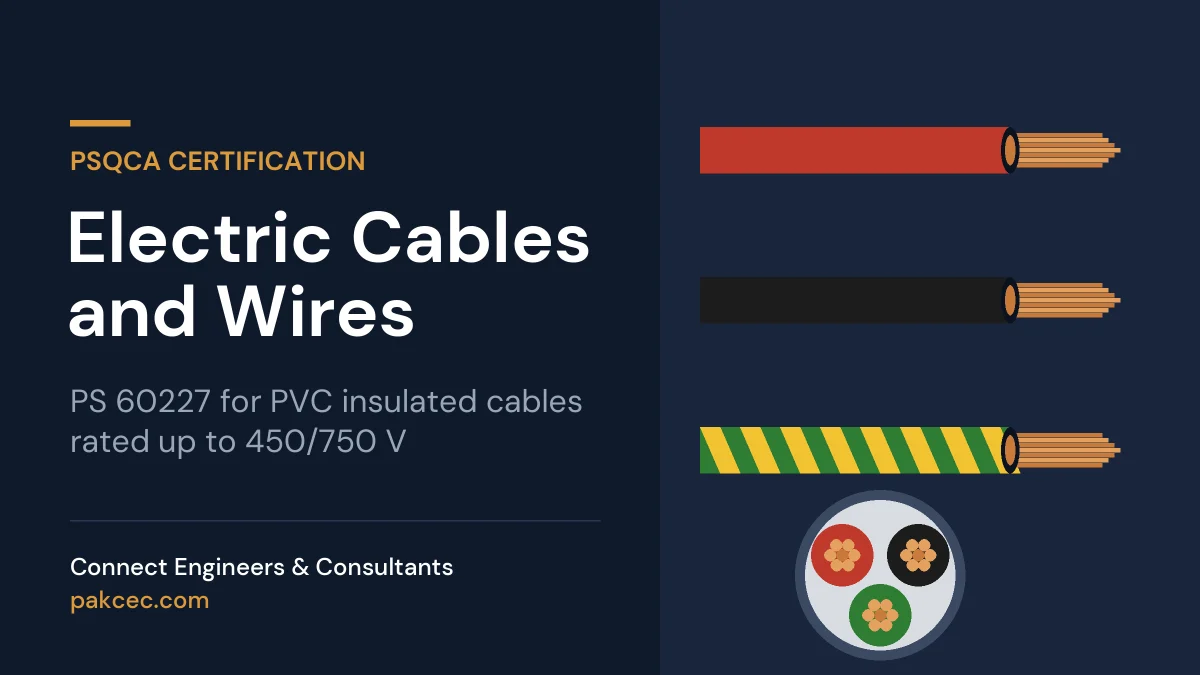
PVC insulated cables for power and lighting are on the compulsory list of the Pakistan Standards & Quality Control Authority (PSQCA). If you draw, strand, insulate or sheath house wiring and flexible cords, or sell them under your own brand, each product needs a PSQCA Certification Marks licence before it reaches the market. Under section 14 of the PSQCA Act, 1996, manufacturing, storing or selling a mandatory item that does not conform to its Pakistan Standard is prohibited.
The stakes are higher than a failed sample. At a national fire safety conference in Karachi, experts told Dawn that faulty electrical wiring causes most urban fires. A wire with too little copper, or insulation that softens in a hot ceiling, looks exactly like a good one on the shop counter. This guide explains which standard applies, what it tests, why cables fail, and what a cable maker needs in place to get licensed and stay licensed.
The Pakistan Standard for electric cables
PSQCA’s list of compulsory items includes “PVC insulated cables (non-armoured) for electric power and lighting” under PS 60227, Parts 1 to 7. PS 60227 adopts the international standard IEC 60227 and covers PVC insulated cables with rated voltages up to 450/750 V. The parts are:
| Part | What it covers |
|---|---|
| Part 1 | General requirements: marking, core colours, conductors, insulation and sheath, and tests on completed cables |
| Part 2 | Test methods |
| Part 3 | Non-sheathed cables for fixed wiring, the single-core building wire used in conduit |
| Part 4 | Sheathed cables for fixed wiring |
| Part 5 | Flexible cables (cords) for appliances and extensions |
| Part 6 | Lift cables and cables for flexible connections |
| Part 7 | Flexible screened and unscreened cables with two or more conductors |
IEC published a new edition of IEC 60227-1 in 2024 and moved the test methods out of Part 2 into a separate standard. PSQCA licenses against the revision of PS 60227 it has adopted, so confirm with PSQCA which revision applies before you plan your process or print your marking.
Each cable type in the series has a code, and the licence and your marking should name it. Common examples include:
- 60227 IEC 01: single-core non-sheathed cable with a rigid (solid or stranded) conductor, 450/750 V, the standard building wire
- 60227 IEC 02: single-core non-sheathed cable with a flexible conductor, 450/750 V
- 60227 IEC 10: light PVC sheathed cable for fixed wiring, 300/500 V
- 60227 IEC 52 and 53: light and ordinary PVC sheathed flexible cords for appliances
Which cables are, and are not, on the compulsory list
The compulsory entry covers non-armoured PVC insulated cables up to 450/750 V: house wiring, flexible cords and similar low-voltage cables. Coaxial communication cables appear separately on the list under PS IEC 61196.
Armoured power cables, XLPE cables to IEC 60502 and solar DC cables are not on the published compulsory list. That does not mean buyers will accept them without proof. Utilities, government tenders and solar EPC contractors usually ask for type test reports against the relevant IEC standard, and solar installers working under AEDB registration are expected to use properly rated components. The list is revised from time to time, so check the current version before deciding a product is outside it.
Who needs a PSQCA licence for cables?
- Manufacturers that draw copper rod, strand conductors and extrude PVC insulation and sheath
- Units that buy drawn wire or stranded conductor and only insulate, sheath and coil it
- Brands that sell cable made for them by another factory
- Importers of PVC insulated cables and flexible cords
The licence is issued for a product, made at a particular factory, under a particular brand. A private-label brand cannot rely on its supplier’s licence, so check whose name is on the licence before you sign a supply agreement.
What PS 60227 checks
The conductor. Conductors must be plain or tinned annealed copper and meet IEC 60228, which sets the classes of conductor (solid, stranded and flexible) and, most importantly, a maximum DC resistance per kilometre at 20°C for each size. Resistance is the test that catches undersized or impure copper, because a conductor with less metal, or recycled metal with impurities, carries more resistance than the standard allows. Reference values for plain copper solid and stranded conductors include:
| Nominal size | Maximum resistance at 20°C (Ω/km) |
|---|---|
| 1.5 mm² | 12.1 |
| 2.5 mm² | 7.41 |
| 4 mm² | 4.61 |
| 6 mm² | 3.08 |
| 10 mm² | 1.83 |
Flexible (class 5) conductors and tinned copper have different limits, so take the figure for your exact conductor from IEC 60228. Much of the Pakistani market still sells wire under imperial designations such as 3/.029 or 7/.044. Map each of these to a metric size and confirm with PSQCA how it will be certified before you print packaging.
The insulation and sheath. Typical tests include:
- Thickness of insulation and sheath, both the average and the thinnest point, and the overall dimensions of the cable.
- Mechanical properties of the PVC, meaning tensile strength and elongation at break, before and after ageing in an oven.
- Heat performance, including loss of mass, hot deformation under pressure and heat shock, which show whether the compound will hold up in a hot roof or a loaded circuit.
- Behaviour in the cold, through bending and elongation tests at low temperature.
- Insulation resistance at the maximum operating temperature.
- Voltage tests on the completed cable and on the cores.
- Flame retardance, so a single cable does not carry a fire along its length.
Marking and core colours. The cable must carry an indication of origin, meaning the manufacturer’s name or trademark, repeated continuously along its length, durable and legible. Cores must be identified by colour or number as the standard sets out, with the green-and-yellow combination reserved for the protective earth.
The standard sorts its tests into type tests, done once to prove a design; sample tests, done on samples from production; and routine tests, such as conductor resistance and the voltage test, done on every production length. Inspectors will expect records of all three.
Why cables fail PSQCA testing
Most failures come from a short list of causes:
- Too little copper. Fewer strands, thinner strands or a conductor drawn slightly under size saves metal and fails the resistance test.
- The wrong metal. Recycled copper with impurities, aluminium or copper-clad aluminium sold as copper will not meet the resistance limits for a copper conductor of that size.
- Thin insulation. Running the extruder to the bare minimum leaves thin points that fail the thickness check and the voltage test.
- Cheap PVC compound. Too much filler or the wrong plasticiser gives insulation that cracks, loses mass in the ageing oven or fails the flame test.
- Missing or wrong marking, which makes the cable impossible to trace and can count as a failure on its own.
Coils that are shorter than the length printed on the pack are a separate problem. They will not fail a PS 60227 test, but they damage trust with dealers and can still draw complaints. Our guide to cable packaging covers coiling, labelling and protecting cable from the factory to the site.
How the licence process works for a cable maker
PSQCA uses the same Certification Marks route for every compulsory product, which our PSQCA registration guide explains in full. For a cable factory, each stage looks like this:
- Application. You apply for each cable type and standard with the supporting documents, and PSQCA scrutinises and registers the file.
- Factory evaluation. Officers visit the plant. Expect them to look at copper rod and PVC compound reception, wire drawing and annealing, stranding, extrusion lines and spark testers, coiling, marking and your laboratory.
- Sampling. Samples are drawn from production or from finished stock.
- Testing. Samples are tested in your laboratory and at PSQCA’s laboratories against PS 60227.
- Licence. If the product conforms, the licence is issued and you may use the mark.
- Surveillance. PSQCA carries out periodic inspections and tests samples taken from the factory and from the market.
- Renewal. The licence is renewed periodically, and can be suspended or cancelled if the product stops conforming.
If your cable has already failed a market sample, or PSQCA has sealed stock, our guide to responding to regulatory action sets out what to do first.
Documents and laboratory you will need
The core file is the same as for any PSQCA product: proof of business registration, a process flow chart, the quality manual and quality plan, raw-material specifications for copper and PVC compound, a list of test equipment with calibration records, details of QC staff, test reports showing conformity, and factory layout and location plans. Our PSQCA certification checklist sets out every item. If you have not yet registered the business, our SECP company registration guide covers that step.
For a cable factory, inspectors look hardest at a resistance bridge or micro-ohmmeter with a temperature-controlled setup for conductor resistance, a high-voltage test set, a measuring microscope or projector for insulation thickness, an ageing oven and a tensile tester for the PVC, and an inline spark tester on every extrusion line. Our QC laboratory guide covers setting up the lab, and our article on calibration and traceability explains why an uncalibrated resistance bridge undermines every result it produces. Confirm the current application fee directly with PSQCA before filing, as fees are revised from time to time.
Why your buyers will ask for the licence
Electrical contractors on public works usually have to prove that the cable they install conforms to the specified standard, and a bid backed by unlicensed cable is easy to reject. Our article on why government bids are rejected shows how often compliance documents decide a tender. Builders face the same checks for other materials, as our guide to PSQCA certification for steel bars explains. A valid PSQCA licence, with routine test records for each production length, makes your cable easier for these buyers to approve.
Tips for cable manufacturers
- Measure conductor resistance on every drum or coil batch, corrected to 20°C, and keep the records.
- Test each lot of copper rod and PVC compound on arrival, not after the cable fails.
- Set extruder targets above the minimum insulation thickness, and check the thinnest point, not only the average.
- Keep the spark tester running and logged on every line, and calibrate it on schedule.
- Retain samples from each batch, so that you can answer a market-sample failure with evidence.
- Apply for each cable type you sell. A licence for building wire does not cover flexible cords.
Frequently asked questions
Is PSQCA certification compulsory for electric cables?
Yes. PVC insulated non-armoured cables for electric power and lighting are on PSQCA’s mandatory list under PS 60227, so they cannot legally be manufactured, stored or sold in Pakistan unless they conform to the standard under a PSQCA licence.
Which standard applies to house wiring and flexible cords?
PS 60227, which adopts IEC 60227 and covers PVC insulated cables rated up to 450/750 V. Part 3 covers non-sheathed building wire, Part 4 sheathed cables for fixed wiring and Part 5 flexible cords. Ask PSQCA which revision is current.
Are armoured or solar cables covered by PS 60227?
No. PS 60227 covers non-armoured PVC insulated cables. Armoured, XLPE and solar DC cables are not on the published compulsory list, although buyers usually ask for test reports against the relevant IEC standard. Check the current list before you rely on this.
Does a cable brand need its own PSQCA licence?
Yes. The licence is tied to the product, the factory and the brand, so a brand whose cable is made by another factory needs a licence in its own name.
What is the most common reason cables fail PSQCA testing?
Conductor resistance. A conductor with too little copper, or impure or substitute metal, has higher resistance than PS 60227 and IEC 60228 allow for its size. Thin insulation and poor PVC compound are the next most common causes.
How Connect Engineers & Consultants can help
CEC helps cable manufacturers, private-label brands and importers prepare the complete PSQCA file: documentation, quality-control and laboratory setup, pre-testing against PS 60227, readiness for the factory inspection, and follow-up until the licence is issued. We also handle company registration and ISO 9001 certification for factories that supply large contractors.
Ready to license your cables? See our PSQCA product certification service or talk to our team.
PSQCA’s list of compulsory items and Pakistan Standards are revised from time to time. Always confirm the latest standard, fees and requirements with PSQCA before applying. This guide is general information, not legal or engineering advice.

[…] If you are registered with PSEB as an IT or IT-enabled services company, ISO 27001 also strengthens your profile with foreign buyers. See our PSEB registration guide. […]