

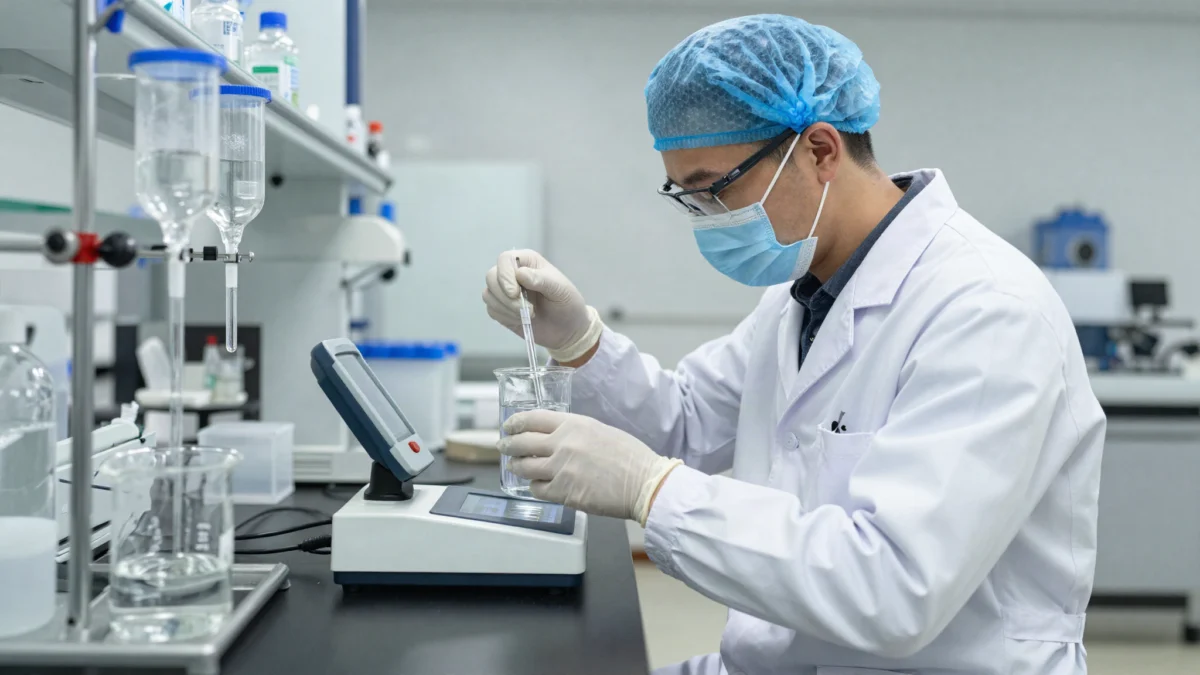
A bottled or mineral water plant in Pakistan is only as good as the laboratory that checks its water every day. PSQCA inspectors expect to see an in-house laboratory that can test the key parameters of each batch, food authorities look for records, and buyers increasingly ask for test results before they list a brand. Yet many new plants either buy too little equipment and fail inspection, or buy expensive instruments they never use. This guide sets out the equipment a water plant laboratory actually needs, what each instrument is for, and how to keep the results defensible.
Quick answer: A water plant laboratory in Pakistan needs equipment for three groups of tests. Physical and basic chemical tests need a pH meter, conductivity and TDS meter, turbidity meter and titration glassware for hardness and chloride. Wider chemical tests, such as nitrate, fluoride and iron, are usually done with a spectrophotometer and reagent kits. Microbiological tests for total coliform and E. coli need a membrane filtration assembly with vacuum pump, an incubator, an autoclave and a clean work area. Add an analytical balance, refrigerator and distilled water supply, calibrate everything, and send parameters you cannot test in-house to an accredited laboratory.
What your laboratory must be able to show
PSQCA licensing for bottled drinking water and natural mineral water is based on Pakistan Standards that set limits for physical, chemical and microbiological parameters. Inspectors do not expect a small plant to run every test in-house, but they do expect you to:
- Test the critical parameters of every batch before release.
- Keep dated, signed records that link results to batch codes.
- Use calibrated instruments and show the calibration evidence.
- Send periodic samples to an external laboratory for the full set of parameters.
If you are still at the licensing stage, our guide to water plant registration in Pakistan explains how the laboratory fits into PSQCA and food authority approvals.
Core equipment for physical and basic chemical tests
| Equipment | What it tests | Notes |
|---|---|---|
| pH meter | Acidity or alkalinity | Benchtop model with buffer solutions for daily calibration |
| Conductivity and TDS meter | Dissolved salts, a key check on RO performance | Temperature-compensated; calibrate with standard solution |
| Turbidity meter | Clarity of the water | Reads in NTU; keep sample cells scratch-free |
| Titration glassware (burettes, pipettes, flasks) | Total hardness, calcium, chloride, alkalinity | Class A glassware for reliable volumes |
| Residual chlorine or ozone test kit | Disinfection carry-over | Important if you ozonate or chlorinate |
These instruments run every shift. A laboratory pH meter and a conductivity meter are the two you will use most, so buy quality probes and keep spares.
Equipment for wider chemical parameters
Nitrate, nitrite, fluoride, iron, manganese, sulphate and similar parameters are usually measured colorimetrically. A UV-visible spectrophotometer with the right reagent methods covers most of them. Metals such as arsenic, lead and other trace elements need specialised instruments that few plants own. Send those to an accredited external laboratory on a fixed schedule, and keep the reports with your batch records.
Supporting equipment for chemical work includes:
- An analytical balance for preparing standards and reagents.
- A distillation unit or deionised water supply for blanks and rinsing.
- A hot air oven for drying glassware.
- A fume hood or well-ventilated area if you handle strong acids.
Microbiological testing equipment
Microbiological safety is where water plants most often fail. The standard approach for coliforms and E. coli is membrane filtration: a measured volume of water passes through a sterile membrane, which is placed on a selective medium and incubated.
| Equipment | Purpose |
|---|---|
| Membrane filtration assembly with vacuum pump | Filters the sample through a sterile membrane |
| Incubator | Holds plates at the specified temperatures for coliform and E. coli |
| Autoclave | Sterilises media, glassware and waste |
| Laminar flow cabinet or clean bench | Prevents contamination during testing |
| Refrigerator | Stores media and samples |
| Colony counter and sterile consumables | Counting colonies, membranes, pads, petri dishes |
See our filtration assembly, incubator and autoclave pages for specifications. Keep the microbiology area physically separate from chemical testing and from production.
Layout and utilities
- A dedicated room with washable surfaces, good lighting and no direct access from the filling hall.
- Separate benches for chemistry and microbiology.
- Stable power with backup for incubators and refrigerators, because a power cut can ruin a test.
- Sinks, drainage and safe disposal of media and chemicals.
- A sample point on each stage of the line: raw water, after RO, after disinfection and finished product.
Calibration and records
An uncalibrated meter produces numbers, not evidence. Calibrate pH and conductivity meters daily with certified standards, verify balances and thermometers, and have instruments calibrated periodically by a competent calibration laboratory. Our guide to calibration and traceability explains how to build a chain inspectors will accept.
Keep a log for each instrument, a sample register, and batch release records signed by the qualified analyst. Good records are often what separates a smooth PSQCA surveillance visit from a suspension.
Common mistakes when setting up a water plant laboratory
- Buying a handheld TDS pen and treating it as a laboratory instrument.
- No autoclave, so microbiological media and glassware are not truly sterile.
- Placing the lab next to the filling area, risking contamination.
- Skipping external testing for parameters the plant cannot measure.
- Training only one analyst, so testing stops when that person is away.
For a broader view of specifying laboratories across food and manufacturing, see our QC laboratory specification reference.
Frequently asked questions
What lab equipment does a water plant need in Pakistan?
At minimum a pH meter, conductivity and TDS meter, turbidity meter, titration glassware, spectrophotometer, membrane filtration assembly with vacuum pump, incubator, autoclave, analytical balance and refrigerator.
Does PSQCA require an in-house laboratory for water plants?
PSQCA expects licensed water plants to test critical parameters of each batch in-house and keep records, with periodic external testing for the full set of parameters.
How are coliform bacteria tested in bottled water?
Usually by membrane filtration: the sample is filtered through a sterile membrane, placed on a selective medium and incubated, then colonies are counted.
Can a TDS pen replace a conductivity meter?
Not for quality control records. A calibrated benchtop or laboratory-grade conductivity and TDS meter gives more reliable, defensible results.
Which tests should be sent to an external lab?
Parameters needing specialised instruments, such as arsenic, lead and other trace metals, are normally tested by an accredited external laboratory on a fixed schedule.
How CEC can help
Connect Engineers & Consultants designs and installs water plants, supplies and commissions laboratory equipment, and prepares plants for PSQCA licensing and inspection. See our water plant installation and lab equipment pages.
Setting up or upgrading a water plant laboratory? Tell us your capacity and product type and we will recommend the right equipment list.
Test methods and limits are defined in the applicable Pakistan Standards and regulator requirements, which may change. This guide is general information, not a substitute for the standard or professional advice.
